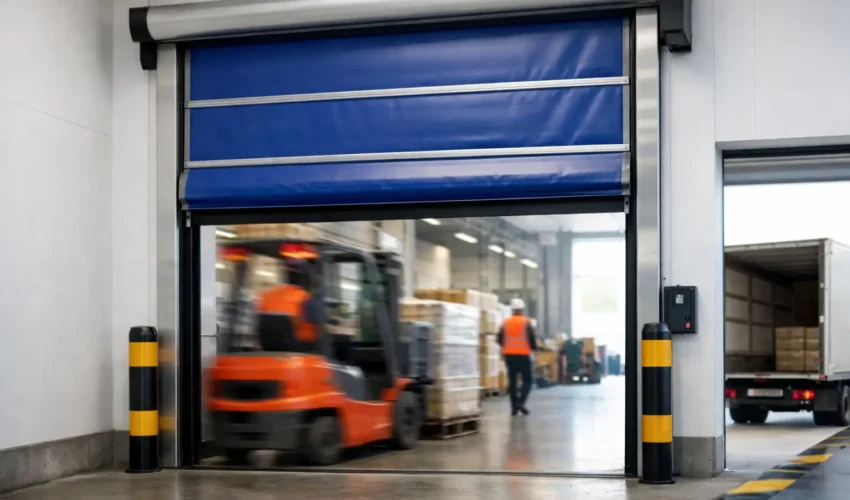
When a warehouse door is opening hundreds of times a day, every second starts to matter. That is why high speed doors UK businesses install are rarely just about access – they are about keeping traffic moving, protecting temperature control, reducing contamination risk and stopping small delays from turning into expensive downtime.
For busy commercial and industrial premises, a standard roller shutter is not always the right answer. If forklifts, staff, pallets or deliveries are constantly moving between areas, a slower door can create bottlenecks, let heat escape and leave internal spaces exposed for longer than necessary. In the right setting, a high speed door solves those problems quickly. In the wrong setting, it can be an unnecessary expense. The decision comes down to how your site operates day to day.
Where high speed doors UK sites benefit most
High speed doors are designed for frequent use. They open and close rapidly, reset access points faster than conventional industrial doors and help control the environment on both sides of the opening. That makes them particularly useful in logistics buildings, food handling areas, manufacturing facilities, pharmaceutical spaces, retail back-of-house operations and distribution centres.
If your building has separate zones with different temperatures, cleanliness requirements or traffic patterns, speed matters. A chilled area, for example, benefits from a door that minimises air exchange. A production area benefits from a door that closes quickly behind traffic to help keep dust, draughts or insects under control. A loading route benefits because drivers and warehouse teams are not waiting unnecessarily at every crossing point.
This is also why facilities managers often look at more than the purchase price. A cheaper door that opens slowly and needs regular reactive repairs can cost more over time than a better specified system that supports efficient operation from the outset.
What makes a high speed door different
The main difference is in the operating cycle. High speed doors are built for repeated opening and closing throughout the day, often in environments where traffic flow is continuous. They typically use a flexible curtain or insulated panel design, paired with control systems and safety devices that allow quick response without compromising safe use.
That said, not all high speed doors do the same job. Some are intended mainly for internal use, where speed and traffic control are the priority. Others are built for external openings and need to cope with wind load, temperature differences and higher security demands. Some are chosen for hygiene-sensitive settings. Others are specified because accidental impact is likely and a self-repairing curtain can reduce disruption.
This is where a proper survey matters. A door at the entrance to a production hall has different demands from one fitted between warehouse zones. A site handling food products has different priorities from a vehicle workshop. The best outcome usually comes from matching the door to the opening, traffic type and operating conditions rather than choosing on brochure claims alone.
Choosing high speed doors UK operators can rely on
Reliability usually comes down to specification, installation quality and ongoing servicing. Buyers often focus first on door size and opening speed, but there are other factors that affect how well the system performs in practice.
Wind resistance is a major consideration for external openings. If the door is exposed, the wrong model may struggle in poor weather or suffer unnecessary wear. Thermal performance matters if you are trying to protect heated or cooled spaces. Safety features matter where pedestrian and vehicle traffic mix. Control options matter because a door that does not integrate well with your workflow can become frustrating very quickly.
There is also the question of usage frequency. A door used occasionally at the side of a building does not need the same duty cycle as one at the heart of a distribution route. Over-specifying can waste budget, but under-specifying tends to show up later as faults, delays and avoidable repair costs.
For that reason, engineer-led advice is usually more useful than a quick price comparison. It is one thing to buy a door. It is another to buy a door system that still performs properly after years of heavy use.
The case for planned maintenance
High speed doors work hard, and hard-working doors need attention. Even well-made systems are subject to wear on curtains, guides, motors, safety edges, sensors and control gear. The more often a door cycles, the more valuable routine servicing becomes.
Planned maintenance helps catch small issues before they become failures. That might mean adjusting limits, replacing worn components, checking safety devices, inspecting the curtain or confirming the control system is responding correctly. On a busy site, this is not just a maintenance matter. It is an operational one.
A door that fails shut can block deliveries or interrupt production flow. A door that fails open can affect security, hygiene or heat retention. Either way, the disruption usually costs more than the service visit that might have prevented it.
For organisations managing multiple access points, servicing also gives a clearer picture of asset condition across the building. Instead of reacting to breakdowns one by one, you can plan repairs, control costs and avoid surprises.
Repairs matter as much as installation
A well-installed door is only part of the picture. When a fault happens, response time matters. High speed doors are often fitted in operational pinch points, so failure is rarely convenient and rarely low impact.
Common issues include impact damage, sensor faults, control panel problems, curtain misalignment and wear caused by heavy daily use. In some environments, accidental strikes from forklifts or pallet lorries are almost unavoidable. That does not always mean a full replacement is needed, but it does mean you need engineers who can diagnose the problem quickly and get the door safely back into service.
This is where local support has a practical advantage. If your premises are in Glasgow, Lanarkshire or nearby, a contractor with regional coverage and 24/7 emergency repair capability can reduce downtime far more effectively than a provider operating at a distance. Fast attendance is not a marketing extra when the door in question is affecting access, security or temperature control.
Installation should fit the way your site works
The best installations are usually the least disruptive ones. That starts with a proper survey, but it also means understanding traffic routes, shift patterns, access restrictions and the operational realities of the site.
On some premises, the challenge is fitting a high speed door into an existing opening with limited structural tolerance. On others, it is choosing controls that suit lorry movements, pedestrian access or internal segregation. Sometimes the main priority is energy efficiency. Sometimes it is hygiene. Sometimes it is simply keeping a busy warehouse moving without queues building up at the door line.
There is rarely a single best specification for every business. A medical environment may prioritise cleanliness and dependable automatic operation. A retail stockroom may focus on speed and compact design. A manufacturing plant may need durability and resistance to frequent impact. Good advice recognises those differences instead of forcing every site into the same solution.
That is also why recognised manufacturers matter. Proven systems from names such as Dynaco and Crawford can give buyers more confidence in long-term performance, parts availability and suitability for demanding environments.
Cost, value and where the balance sits
High speed doors generally cost more than basic industrial door options, so the question is whether the benefits justify the spend. Often they do, but not always for the same reason.
On one site, the saving comes from better energy retention. On another, it comes from reduced waiting times and smoother internal traffic flow. Elsewhere, the value is in hygiene control or lower downtime after minor impacts because the door is designed to recover quickly. Some businesses also see reduced wear on climate control systems because openings are not left exposed for as long.
The balance depends on how often the door is used and what happens when it is not performing. If a slower or less suitable door is already causing delays, heat loss or frequent repair callouts, moving to a high speed system can make commercial sense. If the opening is used only occasionally, a different type of industrial door may be the better investment.
That is why straight answers matter. A dependable contractor should be willing to say when a high speed door is the right fit and when another solution would serve the site better.
Getting the specification right first time
If you are considering high speed doors UK suppliers offer, start with the practical questions. How often is the opening used? Is it internal or external? What traffic passes through it? Does the area need temperature control, hygiene separation or rapid reset after each cycle? What happens operationally if the door is out of action for half a day?
Those answers tell you far more than a headline price ever will. They also make it easier to choose a system that can be installed, maintained and repaired without constant compromise.
For businesses that cannot afford delays, the right door is the one that keeps working, fits the site properly and comes with dependable support when needed. If there is any doubt, get the opening surveyed and talk through the operational detail. A good decision at that stage usually saves time, money and disruption later on.
When a door is part of the working day rather than just part of the building, it deserves the same level of planning as any other critical system.