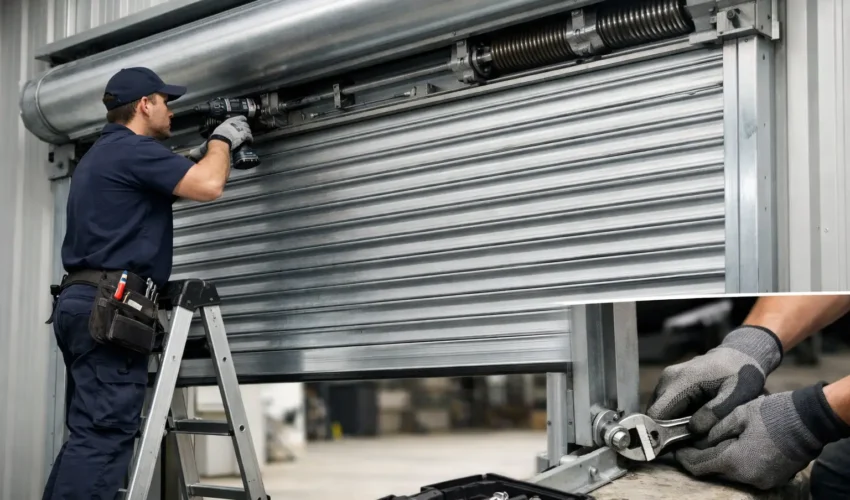
When an industrial shutter stops halfway on a busy loading bay or refuses to lock at the end of the day, the problem is never just the door. It affects security, staff movement, deliveries, safety, and in many cases your ability to keep trading. That is why industrial roller shutter door repairs need to be handled quickly, properly, and by engineers who understand how these systems work under day-to-day commercial pressure.
For warehouses, retail units, workshops, factories, depots and medical facilities, a failed shutter can create a chain reaction. Vehicles are delayed, goods cannot move in or out, the building is left exposed, or customers and staff are forced to use alternative access routes that were never meant to carry the load. In some cases the issue is obvious, such as impact damage or a motor that has failed. In others, the warning signs build gradually until the door becomes unreliable.
When industrial roller shutter door repairs are needed
Most shutters do not fail without warning. Site teams often notice the door becoming noisier, slower, uneven in travel, or more difficult to operate before it stops altogether. A shutter that jerks on opening, catches on the guides, or reverses unexpectedly is already telling you something is wrong.
Common faults include worn motors, damaged laths, misaligned guides, failed safety edges, spring tension problems, control panel faults and issues with limit settings. Electrical faults are one side of the picture, but mechanical wear is just as common, especially on doors that open and close repeatedly throughout the day. A busy warehouse shutter used dozens of times per shift will naturally age differently from a security shutter on a unit that opens only in the morning and closes at night.
That is where a proper site assessment matters. Replacing the first visible part is not always the right fix. A damaged curtain may have been caused by a guide issue. A burnt-out motor may have been put under strain by poor alignment or neglected servicing. Good repair work looks at the cause as well as the symptom.
Why a fast repair response matters
Speed matters, but so does judgement. If a shutter has failed open, your priority may be securing the premises before normal business can resume. If it has failed closed, access for staff, stock or vehicles may be the urgent issue. The right repair approach depends on what the door does for your operation.
For some businesses, a temporary safe close and return visit for parts is the sensible route. For others, particularly where distribution schedules or security exposure are critical, the situation calls for immediate corrective work. This is why many commercial sites prefer working with a local specialist rather than waiting on a wider national chain with less regional focus. Response times are only useful if the attending engineer can diagnose the fault and make practical decisions on site.
In places such as Glasgow, Lanarkshire, Motherwell and Hamilton, local accountability also counts for a lot. You want to know that if a door fails again, or another entrance begins showing the same symptoms, there is an engineering team nearby who knows your site and can act quickly.
What a proper repair visit should involve
A professional repair service should begin with making the door safe. That might mean isolating power, securing the opening, preventing further operation, or carrying out an emergency manual release where appropriate. From there, the engineer should inspect the main operating components rather than guessing from the first fault code or visible defect.
On a typical shutter, that means checking the curtain, barrel, end locks, guides, motor, brake, control system and safety devices. If the door has been struck by a vehicle or pallet load, the supporting structure around the opening may need inspection too. There is no value in fitting new components to a shutter that is still running out of square.
Clear communication is part of the service. Decision-makers need to know what has failed, whether the door can be repaired on the spot, whether parts are needed, and whether continued use is safe. That sounds basic, but it makes a real difference when site managers are juggling deliveries, contractors, staff and security concerns at the same time.
Emergency repairs versus planned repair work
Not every job is a middle-of-the-night callout, but many serious failures begin as minor defects that were left to worsen. That is the trade-off businesses often face. Calling out an engineer only when a door stops can seem cheaper in the short term, but repeated reactive repairs usually cost more over time and create more disruption.
Planned repair work allows faults to be dealt with before they become operational failures. If an inspection shows worn rollers, frayed wiring, loose fixings or deteriorating safety devices, those issues can often be scheduled around your working day. Emergency work, by contrast, happens when the door has already become a problem for trading, security or compliance.
This is one reason maintenance and repairs should not be treated as separate conversations. They are closely linked. A business that invests in routine servicing generally sees fewer major breakdowns, more predictable repair costs and less interruption to daily operations.
The role of maintenance in reducing shutter failures
Industrial shutters are working assets. Like any equipment with moving parts, they need inspection, adjustment and replacement of worn components at the right time. Maintenance is not simply a box-ticking exercise. It is the most practical way to reduce avoidable failures.
Servicing intervals depend on usage, environment and risk. A shutter on a clean internal opening may require a different maintenance schedule from one exposed to weather, traffic impact and constant use. Sites with multiple doors often benefit from a planned programme because it gives a clearer picture of which assets are ageing, which parts are likely to need attention, and where future costs may arise.
It also helps with compliance. Powered industrial doors have safety considerations that cannot be ignored, particularly where staff, customers or delivery drivers are moving around the opening. If safety edges, photocells, emergency stops or control systems are not working correctly, the issue is bigger than convenience. A faulty shutter can become a hazard very quickly.
Choosing the right contractor for industrial roller shutter door repairs
Not all repair providers offer the same level of support. For commercial and industrial premises, the key question is not just whether someone can attend, but whether they understand the door type, carry out a proper diagnosis, and provide a repair that lasts.
Look for an engineering-led service with experience across industrial and commercial access systems. The ability to handle installation, maintenance and repair under one roof is often a good sign because it suggests a stronger technical understanding of how the full system performs over time. It also helps if the company works regularly with recognised manufacturers and can source the right parts rather than forcing unsuitable substitutes.
A dependable contractor should also be realistic. Sometimes a repair is clearly the best option. Sometimes repeated faults, obsolete components or severe structural damage make replacement the better long-term decision. Honest advice matters here. Spending money on repeated short-term fixes for a shutter that is at the end of its serviceable life rarely serves the customer well.
Door Systems Scotland works with businesses across the central belt that need quick, competent support when access and security systems fail. That local, engineer-led approach is often what makes the difference between a simple repair visit and a drawn-out operational problem.
Signs it is time to act before failure happens
Many businesses wait until a shutter stops because the door still appears to be functioning. That can be a costly assumption. If the motor sounds strained, the curtain runs unevenly, controls become intermittent, or staff are starting to comment that the door is sticking, it is worth arranging an inspection before the issue escalates.
The same applies after impact. Even if the shutter still opens and closes, a knock from a forklift or delivery vehicle can knock guides out of line or place stress on components that then fail later. Early intervention usually means a simpler repair, less downtime and fewer surprises.
For site managers and business owners, the practical aim is straightforward. Keep the door safe, reliable and fit for the way your premises actually operate. That is not about over-servicing or replacing parts for the sake of it. It is about making sensible decisions early enough to avoid avoidable disruption.
A shutter door rarely fails at a convenient moment. The best time to deal with a problem is when it is still manageable, not when your building is exposed, your delivery schedule is slipping, or your staff are waiting around a closed entrance.