A door that will not open at 7am can stop deliveries, delay staff, frustrate customers and leave a building exposed. Smart commercial door systems are designed to give operators better control over access, movement and door performance, but the value comes from choosing technology that suits the site rather than adding features for their own sake.
For warehouses, retail units, medical centres and multi-tenant premises, the right system can reduce avoidable callouts and make day-to-day operations easier to manage. It still needs sound engineering, correct safety devices and regular maintenance. Smart controls do not compensate for a poorly specified door, worn components or an installation that has not been set up for the way the building actually works.
What makes a commercial door system smart?
A smart door system combines a physical door with controls that can automate operation, manage who is allowed through and provide useful information about performance. The level of intelligence can be simple, such as timed opening and closing, or more advanced, with access credentials, remote monitoring and integration with a wider building management or security system.
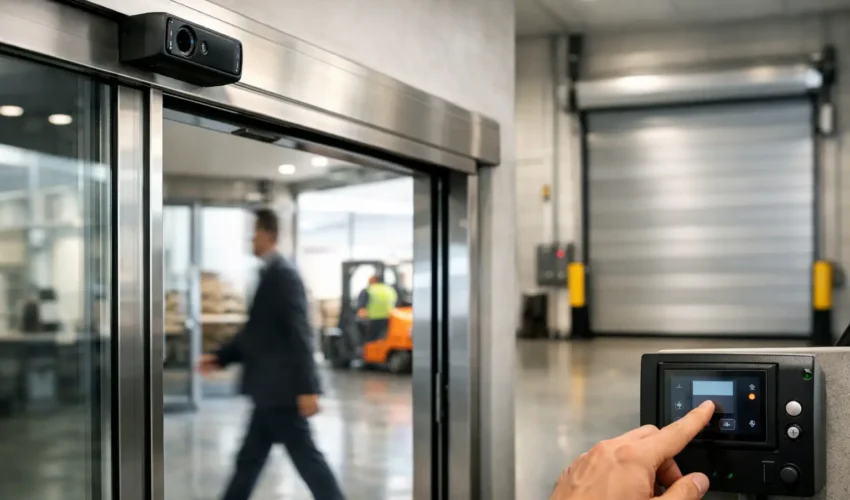
An automatic sliding entrance door may use sensors to control pedestrian traffic and remain locked outside trading hours. An industrial roller shutter might be operated by authorised fobs, keypads or vehicle controls, with status information available to a facilities team. A high-speed door can be programmed to open only when a forklift approaches, helping to retain temperature and reduce unnecessary energy loss.
The common thread is control. Instead of relying entirely on keys, manual checks and staff judgement, the business has clearer rules for who enters, when a door operates and how faults are identified.
Where smart commercial door systems make a difference
The strongest case for smart controls is usually at busy access points where a door affects security, safety or workflow several times each day. At a distribution site, a shutter left open after a delivery can create a serious security issue. At a healthcare setting, reliable automatic access supports patients, visitors and staff, including those with limited mobility. At a retail premises, entrance doors need to welcome customers while helping to secure the property at closing time.
Better control of access
Traditional keys are difficult to track and easy to pass between people. Electronic access can be assigned to individuals, teams or contractors, then removed when it is no longer needed. Depending on the system, access can also be restricted by time, so a cleaner, supplier or member of staff can enter only during agreed hours.
This is particularly useful for sites with shift changes, shared yards or multiple occupiers. It does not remove the need for good site procedures, but it gives managers a clearer audit trail and reduces reliance on a single physical keyholder.
Less wasted movement and energy
A door that opens too early, stays open too long or is used when another route would do can cost money. This is most noticeable in chilled stores, production areas and warehouses where heating or cooling is lost through large openings.
High-speed doors, presence detection and carefully adjusted closing times can reduce that loss without slowing down traffic. The trade-off is that sensors and controls must be set correctly. An overly sensitive detector can cause repeated openings, while an aggressive closing setting can inconvenience users or introduce safety concerns. Site testing matters as much as the product specification.
Faster fault awareness
Some systems can report door position, operating cycles or fault codes to a nominated person or maintenance provider. That can help identify a developing issue before the door fails completely. A door that starts taking longer to travel, reverses unexpectedly or records an unusually high number of cycles may need attention before it disrupts a shift.
Remote information is useful, but it is not a replacement for an engineer inspecting moving parts, safety edges, tracks, springs, motors and fixings. Mechanical wear remains mechanical wear. Planned servicing is what turns data into practical action.
Choosing the right system for the door and the building
The first question should not be, “What is the smartest option?” It should be, “What problem does this door need to solve?” A busy loading bay, a secure shopfront and a public entrance require very different combinations of speed, strength, controls and safety measures.
For industrial roller shutters, the priority may be controlled access, reliable operation and an appropriate level of security. For automatic swing or sliding doors, pedestrian safety, accessibility and clear opening widths are likely to lead the specification. For high-speed doors, cycle frequency, wind resistance, environmental separation and traffic type will affect the choice.
A proper site survey should consider the opening size, available headroom and side room, power supply, floor condition, traffic flow and existing security arrangements. It should also account for what happens during a power failure, whether manual override is required and how emergency egress will be maintained.
Do not overlook safety compliance
Automation adds convenience, but it also creates moving-door risks that must be managed. Sensors, safety edges, emergency stops, warning signage and force settings all need to be appropriate for the installation. A door used by pedestrians requires a different approach from one operated in a restricted goods yard.
Alterations should not be treated as a quick add-on. Fitting a new control panel or access device can affect how the door operates, who uses it and which safety measures are required. An experienced engineer can assess the complete system rather than looking only at the new component.
Integration can help, but keep it proportionate
Many businesses want doors to work alongside alarms, CCTV, intercoms and access control. That can be sensible. For example, a gate or shutter may be linked to an approved-entry system, while a reception entrance can use an intercom for visitors outside normal hours.
However, integration brings dependencies. If the network fails, the access platform is changed or a third-party installer alters settings, the door must still behave safely. Decide in advance who owns the system, who can make changes and what the fallback process is when communication is lost.
Cybersecurity also deserves attention where door controls connect to a network. Use reputable equipment, control administrator access, change default credentials and keep software support in mind. A low-cost device with no clear support route may create more risk than value over time.
Maintenance is part of the smart investment
Smart features are often presented as a way to make a building more self-managing. In practice, they work best alongside a planned maintenance programme. Regular servicing helps keep doors safe, identifies wear before it becomes a breakdown and checks that sensors, controls and safety functions are operating as intended.
The right service interval depends on use. A warehouse shutter operating dozens of times per day will need more attention than a lightly used staff entrance. High-speed doors, automatic entrances and doors exposed to harsh weather or vehicle impact also merit closer monitoring.
Facilities managers should keep a simple record of faults, impacts, unusual noises and occasions when users override the normal controls. These details help an engineer diagnose recurring problems and can reveal whether the issue is mechanical, electrical, environmental or caused by how the door is being used.
When a failure does occur, rapid repair support matters. A secure but unusable loading bay can hold up a full operation; an open shutter can leave stock and equipment vulnerable. Door Systems Scotland supports businesses with installation, planned maintenance and emergency repairs, helping local operators restore access and security with minimal disruption.
Questions to ask before investing
Before approving a smart door project, ask what operational result is expected. Is the aim to stop unauthorised access, speed up forklift traffic, improve accessibility, reduce heat loss or give the facilities team earlier warning of faults? A clear answer prevents money being spent on technology that is not used.
Also ask how staff will operate the system, who will receive alerts, what happens during a power or network failure, and how future maintenance will be arranged. Training is often overlooked. The people opening, closing and supervising the door every day should understand normal operation, emergency release procedures and when to report a fault.
A well-designed system should make a busy site easier to run, not create another complicated platform for staff to manage. Start with the access, security and uptime issue in front of you, then arrange a professional survey to specify controls that earn their place over the long term.