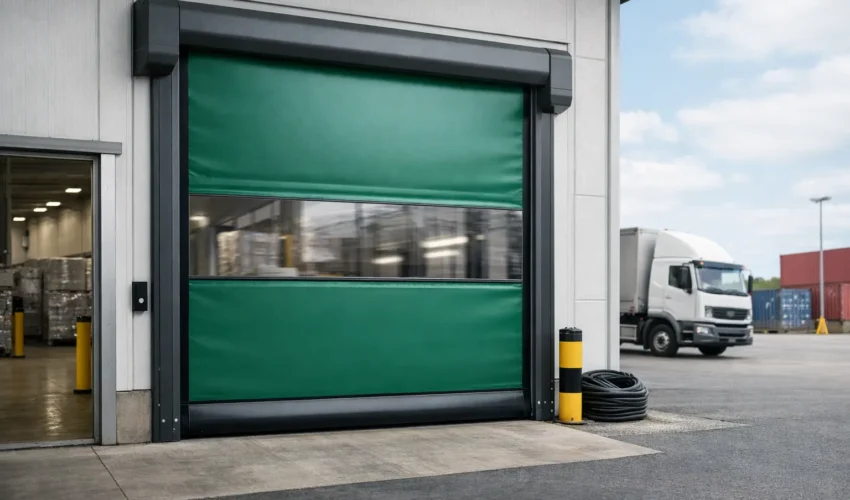
A door that delays forklifts, lets cold air escape or needs constant callouts soon becomes an operational cost rather than a building feature. This Dynaco high speed door review looks at where these doors perform well, what to consider before specifying one, and why the quality of installation and servicing matters just as much as the door itself.
Dynaco is a well-known name in flexible high-speed doors for industrial, commercial and specialist environments. They are commonly considered for warehouses, distribution centres, manufacturing areas, food-related premises, clean working zones and busy internal traffic routes. Their appeal is straightforward: fast opening cycles, flexible curtains and safety-led design intended to keep people, products and vehicles moving.
What a Dynaco high-speed door is designed to solve
A conventional roller shutter may be suitable for a low-use opening, security boundary or outbuilding. It is less suitable where a forklift or pallet truck passes through repeatedly during the day. Each slow opening can hold up staff, expose the building to weather and create avoidable heat loss.
High-speed doors are designed for frequent use. A Dynaco door is typically fitted with a flexible curtain rather than rigid metal slats, allowing rapid operation and, on suitable models, a degree of resilience if the curtain is struck. This makes the range particularly relevant where vehicle movements are regular and where an impact on a traditional shutter could mean bent laths, damaged guides and a blocked opening.
The exact arrangement depends on the model, opening size, location and level of use. A cold-store entrance has different requirements from a warehouse loading route, while an external opening exposed to Scottish wind and rain needs a different assessment from an internal production doorway.
Dynaco high-speed door review: key strengths
Speed can reduce everyday downtime
The main benefit is not simply that the curtain moves quickly. It is the reduction in small delays across a shift. At a busy warehouse entrance, operators do not have to wait for a standard shutter to travel its full height before moving through. Faster cycles can improve traffic flow and help prevent bottlenecks around dispatch, storage and production areas.
Speed also supports temperature control. Every second an external opening is left open allows warm air out and cold, damp air in. For businesses heating a large workspace, or managing temperature-sensitive stock, this can be a meaningful operational consideration. The saving will vary with traffic volume, opening dimensions and the building’s overall insulation, so it should not be treated as a guaranteed figure without a proper site assessment.
Flexible curtains are well suited to active sites
One of the practical advantages of many Dynaco systems is the flexible curtain design. In the right application, this can be more forgiving than a rigid door if a forklift, roll cage or pallet makes contact. Depending on the system, the curtain may be designed to release or reinsert following an impact rather than suffer the extensive damage associated with a struck steel shutter.
That does not mean a high-speed door is indestructible. Repeated collisions, damaged sensors, poor forklift routes and neglected guides will still lead to faults. However, for sites where minor impacts are a realistic risk, the flexible format can reduce the chance of a long closure caused by a single incident.
Safety features support busy pedestrian and vehicle routes
High-speed openings must be considered as part of the site’s traffic management, not treated as an isolated product. Dynaco doors can be specified with appropriate activation and safety arrangements, such as radar, pull switches, remote controls, induction loops, photocells and warning devices. The right combination depends on who uses the entrance and how they approach it.
For example, a forklift-only route may require a different activation method from a doorway shared by pedestrians and pallet trucks. The goal is to avoid unexpected movement, prevent collisions and ensure the door responds appropriately when an obstruction is detected. A competent survey should review sightlines, approach speeds, floor condition and segregation measures before recommending controls.
Suitable options exist for specialist environments
The Dynaco range covers more than general warehouse doors. Some applications require improved sealing, wind resistance, hygienic finishes or a layout that supports controlled internal environments. This is why product selection should begin with the opening’s job rather than a preference for a particular model.
A food processing area, for instance, may prioritise cleanability and separation between zones. A distribution depot may prioritise traffic speed and recovery after accidental impacts. A retail stockroom entrance may have more modest usage but need a tidy, reliable installation in limited space. The same brand can meet very different needs, but only if the specification fits the operation.
The trade-offs to consider before buying
A high-speed door is usually a larger upfront investment than a basic roller shutter. The return comes through better throughput, reduced exposure to weather, improved working conditions and potentially fewer disruption-causing repairs. If an opening is used only a handful of times a day, those benefits may not justify the additional cost.
The surrounding structure also matters. The lintel, side room, floor level, available headroom and electrical supply all affect the viability and price of the installation. An old or uneven opening may need preparation work before a new door can operate safely and reliably. This should be identified during the survey, not after the equipment arrives on site.
There is also a maintenance commitment. High-speed doors move frequently and rely on controls, safety devices, guides and curtain components working together. Planned servicing is not an optional extra for a heavily used opening. It is how minor wear, sensor alignment issues and control faults are found before they stop traffic entirely.
Installation quality is part of the product
Even a well-specified Dynaco door can underperform if it is poorly installed or incorrectly commissioned. Fixings must suit the building structure, the curtain must be set correctly, safety devices need testing, and staff should understand normal operation and basic fault reporting.
The handover stage is especially valuable. Site teams should know which activation devices serve which traffic, how to isolate the door where appropriate, what to do after a minor impact and when to call for assistance. Clear guidance can prevent a small issue turning into further damage.
For businesses in Glasgow, Lanarkshire and across Scotland, local engineering support is an important part of the decision. A fast-moving entrance that fails during a busy shift can disrupt deliveries, warehouse routes and security arrangements at once. Door Systems Scotland can survey the opening, advise on suitable Dynaco options and provide installation, planned maintenance and responsive repair support.
What servicing should cover
The servicing interval should reflect usage, environment and risk. A clean, lightly used internal door may have different needs from an external door operating all day in a dusty, cold or wet environment. There is no sensible one-size-fits-all schedule.
During a planned visit, an engineer should assess the curtain condition, guides, drive system, fixings, control panel, activation equipment and safety devices. They should also look for signs of impact damage, unusual wear, loose components and changes to the opening that may affect performance. Testing the safety function is particularly important, as sensors and protection devices need to work consistently in real operating conditions.
Keep a record of faults and callouts as well. If the same problem recurs, it may point to more than a worn component. The cause could be operator behaviour, an unsuitable activation method, poor vehicle routing or a door that is being used beyond its intended application.
Is a Dynaco high-speed door the right choice?
For a high-traffic industrial opening, the answer is often yes. Dynaco doors are a strong option where speed, flexible operation and reliable separation between working areas are important. They can be particularly worthwhile for logistics, manufacturing and temperature-conscious premises where a conventional shutter would be slow, vulnerable to knocks or left open for too long.
They are not automatically the best answer for every doorway. A low-use security opening may be better served by a roller shutter, while a high-security external boundary may need additional measures alongside a flexible high-speed door. The right decision rests on traffic frequency, environment, security requirements, building layout and the cost of disruption if the entrance fails.
Before committing, arrange a site survey that looks beyond the opening dimensions. Discuss how many cycles the door will complete, what vehicles and pedestrians use the route, whether the opening faces prevailing weather, and what level of emergency response your operation needs. A properly matched door, installed correctly and maintained by experienced engineers, gives you a working entrance that supports the business instead of slowing it down.