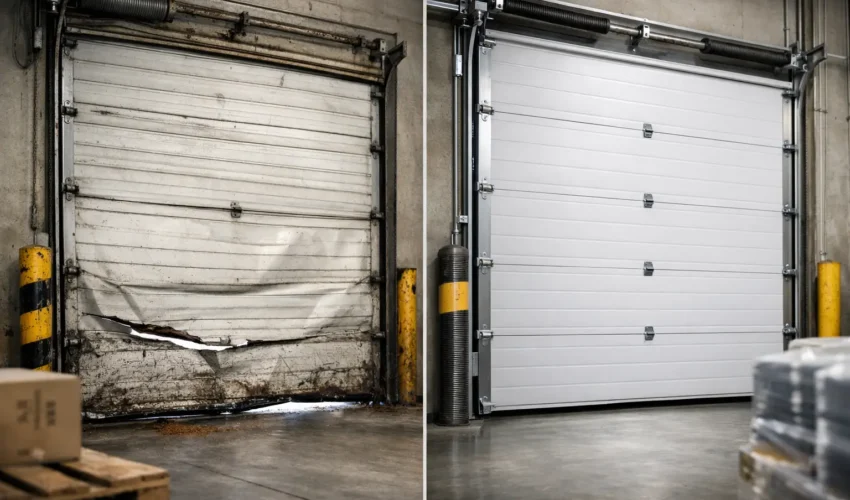
A failed industrial door rarely picks a convenient moment. It usually happens during a delivery window, at opening time, or when you are trying to secure the building at the end of the day. That is why knowing the top signs your industrial door needs replacing can save more than repair costs – it can prevent downtime, security problems and disruption across your site.
Not every fault means a full replacement is needed. Many door issues can be put right with the right repair and maintenance support. But there comes a point where ongoing callouts stop being the sensible option. If your door is affecting safety, reliability or day-to-day operations, replacement may be the more cost-effective decision.
When repairs stop making commercial sense
Most industrial doors are designed for hard use, but heavy traffic, accidental impact, weather exposure and ageing components all take their toll. A roller shutter on a busy warehouse, for example, will wear very differently from a security shutter on a retail unit. The question is not simply whether the door can be repaired. It is whether it should be.
A one-off fault on an otherwise sound system is usually worth repairing. Repeated issues on an older door are different. If your team is regularly reporting breakdowns, delays in opening or closing, or concerns about safe operation, the wider cost starts to build. Lost time, interrupted access, failed deliveries and emergency engineer callouts often outweigh the price of continuing to patch an ageing asset.
Top signs your industrial door needs replacing soon
1. Breakdowns are becoming frequent
If the same door keeps failing, that is usually the clearest warning sign. One motor issue or damaged curtain section might be repairable without much debate. But recurring faults often point to wear across the full system, not just one failed part.
In practical terms, if you are booking repeated repairs within short periods, the door has probably moved beyond economical maintenance. Older systems can also become harder to support because compatible parts are less available, which pushes up repair times and costs.
2. The door is slow, noisy or unreliable in operation
Industrial doors should open and close smoothly and predictably. If yours is jerking, hesitating, grinding, dropping unevenly or making more noise than it used to, the mechanism is telling you something.
Sometimes this comes down to worn bearings, guide damage or drive issues. Sometimes the door has simply reached a stage where multiple elements are deteriorating at once. A slow or inconsistent door may not seem urgent at first, but on a busy commercial site it can quickly affect vehicle flow, staff movement and site security.
3. There is visible structural damage
Dents, bent slats, distorted guides, corrosion and impact damage are more than cosmetic problems. They can affect how the door tracks, seals and locks. On loading bays and service yards, minor collisions are common, but repeated impact can weaken the whole assembly.
The key point is whether the structure still performs as intended. If the curtain is badly misshapen, the frame is compromised or the door no longer closes squarely, replacement is often safer than trying to correct extensive physical damage.
4. Safety features are outdated or not functioning properly
A door that lacks dependable safety edges, photo cells, emergency stop controls or proper guarding can create real risk for staff, visitors and vehicles. On automatic and high-use door systems, safety performance is not an optional extra.
In some cases, older doors can be upgraded. In others, especially where the original system is dated or poorly suited to the current use of the building, a replacement is the better route. This is particularly relevant if the door now serves a busier operation than it did when first installed.
Performance problems that affect the whole building
Poor insulation and higher energy loss
An industrial door does more than provide access. It also helps control heat, draughts, dust and noise. If your existing door has worn seals, gaps around the edges or poor thermal performance, you may notice it in the wider building environment before you notice it in the door itself.
For warehouses, production units and temperature-sensitive spaces, this matters. Heat loss can increase running costs, and poor sealing can make working conditions less comfortable. If the door is no longer supporting the building effectively, replacement can improve efficiency as well as reliability.
Security is no longer where it needs to be
A weak or damaged door is an obvious security risk, but there are subtler issues too. An old shutter that does not lock properly, a roller door that can be forced more easily than modern alternatives, or a slow-closing entrance that leaves the premises exposed all deserve attention.
Security requirements also change. A unit that was adequate ten years ago may not suit current stock values, operating hours or insurance expectations. In that case, replacing the door is not just about fixing a problem. It is about bringing the site up to the standard the business now needs.
The door no longer suits your operation
Businesses change, and door systems do not always keep pace. You may have more vehicle traffic, different opening frequencies, updated access control requirements or new hygiene standards. A traditional shutter might be too slow for a busy logistics setting. A manual door may no longer be practical in a modern commercial environment.
This is one of the most overlooked reasons to replace rather than repair. The existing door may still function, but if it is creating bottlenecks or limiting efficiency, it is no longer the right solution.
How age changes the decision
There is no single age at which every industrial door should be replaced. Lifespan depends on door type, usage levels, environment and maintenance history. A well-maintained system can last well, while a poorly maintained one may deteriorate much earlier.
That said, older doors usually bring a combination of issues rather than one obvious failure. Parts wear out, compliance expectations change, motors become less dependable and the door becomes more vulnerable to downtime. If your door is reaching the stage where each repair reveals another weakness, replacement often becomes the more predictable option.
This is where a proper site survey matters. An experienced engineer can usually tell the difference between a door with life left in it and one that is simply costing you time.
Repair or replacement – what is the better option?
The right answer depends on cost, risk and operational impact. If a newer door has suffered isolated damage, repair is usually the logical route. If an older door has repeated electrical, mechanical and structural issues, replacement is often the smarter investment.
A useful way to think about it is this: are you paying to restore reliable performance, or are you paying to delay an inevitable replacement? Those are not the same thing.
For many facilities managers and business owners, the decision comes down to downtime. An ageing door that fails unexpectedly can disrupt staff access, deliveries, stock movement and security in a single incident. Planned replacement gives you more control over timing, specification and installation, which is often far easier to manage than repeated reactive callouts.
Why acting early usually costs less
Waiting for total failure rarely saves money. It tends to create more urgent labour, more disruption and fewer options. If a door fails in the open position, security becomes the immediate concern. If it fails closed, access to goods, vehicles or customers may be blocked altogether.
By acting when the warning signs first appear, you can assess whether repair is still viable or whether a replacement should be scheduled before the issue becomes urgent. That gives you time to choose the right system for the building, whether that means a new roller shutter, high-speed door, automatic entrance system or a more secure upgraded solution.
For businesses across Lanarkshire, Glasgow and the surrounding area, that kind of forward planning usually leads to less disruption and better value over the long term.
What to do if you are seeing these signs
If your industrial door is becoming unreliable, visibly damaged or increasingly expensive to keep operational, the best next step is a professional assessment. A good engineer will not push replacement where a sound repair will do the job. Equally, they should be clear when continued repairs are no longer the practical answer.
At that stage, you want honest advice based on condition, usage and site requirements, not guesswork. Door Systems Scotland works with commercial and industrial customers who need exactly that – clear recommendations, dependable engineering support and a fast response when door problems start affecting the working day.
An industrial door should support your business quietly in the background. Once it starts demanding constant attention, it is usually time to ask whether repair is still serving you, or simply postponing a better decision.