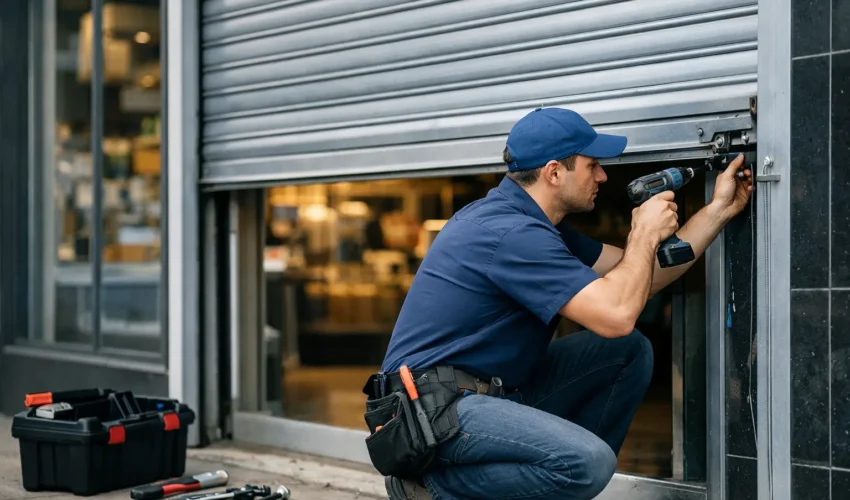
A shop shutter rarely picks a convenient time to fail. It sticks halfway down before opening, jams shut at closing time, or starts making enough noise to tell you something is wearing out. When that happens, shop front shutter repair stops being a maintenance task and becomes an operational problem – one that affects security, access, staffing and takings.
For retail units, trade counters, pharmacies, convenience stores and mixed-use commercial premises, a faulty shutter can quickly turn into lost trading hours or an exposed frontage. The right response is not always a full replacement. In many cases, a properly diagnosed repair gets the shutter safely back into service with less cost and less disruption than owners expect.
When shop front shutter repair is the right call
A lot depends on the age of the door, the type of fault and the overall condition of the assembly. If the curtain is sound, the guides are still structurally good and the motor or controls have developed a localised fault, repair is often the sensible option. The same applies where impact damage is limited to a few laths, an end lock, a safety edge or a control component.
The opposite is also true. If a shutter has a history of repeated failures, poor previous repairs, significant corrosion or damaged core components throughout, a low-cost repair can become false economy. That is why a proper site assessment matters. A dependable engineer will not just get it moving again for the day. They should tell you whether the repair is likely to hold up under normal use or whether you are paying to postpone a larger issue.
For many businesses across Glasgow, Lanarkshire and nearby areas, that distinction matters more than shaving a small amount off the callout. A shutter that fails again next week is not a saving.
Common faults that lead to shutter breakdowns
Most shopfront shutters fail in fairly predictable ways. Wear builds up slowly, then one component reaches the point where the whole system becomes unreliable. In other cases, the cause is sudden – attempted forced entry, accidental impact, power issues or misuse.
Electrical and control faults
Motor problems are one of the most common reasons for a shutter stopping mid-cycle or refusing to move at all. Sometimes the motor itself has failed. Sometimes the fault sits in the key switch, control panel, isolation point, safety device or power supply. To a non-specialist, all of these can look the same because the shutter simply does not respond.
This is where diagnosis matters. Replacing a motor when the issue is a faulty control or damaged cabling wastes time and money. Equally, repeatedly resetting a tripped system without finding the underlying electrical fault can create a safety risk.
Mechanical wear and alignment issues
A shutter may still have power but struggle because the curtain is running badly in the guides, the barrel is worn, springs are out of balance, or bearings are beginning to fail. You might notice uneven movement, scraping, a heavier feel during manual operation, or a louder-than-normal cycle.
These faults tend to get worse rather than stabilise. A shutter that starts to pull out of line can damage adjacent components, turning a straightforward repair into a more involved job.
Impact and security damage
Retail frontages take knocks. Delivery cages, trolleys, vehicles and attempted break-ins can all leave their mark. Bent guides, damaged bottom rails, twisted laths and forced locks are all repairable in some cases, but the extent of the damage has to be checked properly. A shutter may still move after impact while no longer being safe to operate.
Lack of servicing
A large number of emergency breakdowns come from shutters that have simply been left until something gives way. Dirt in the guides, worn consumable parts, loose fixings and neglected safety checks create the kind of avoidable failures that appear urgent only because no one had reason to look at the door beforehand.
What a proper repair process should look like
Good shop front shutter repair is not guesswork. It starts with making the area safe, especially if the premises cannot be secured or if the shutter is stuck in a position that blocks access or escape routes. After that, the engineer should identify the actual cause of failure rather than replacing parts on assumption.
Once the fault is confirmed, the repair approach should be clear. If a same-visit fix is possible, that is usually the best outcome. If specialist parts are required, you should be told what has failed, whether temporary securing measures are needed, and how quickly the return visit can be arranged.
There is also a practical difference between getting the shutter moving and repairing it properly. In an emergency, a business may only need the shutter safely opened to trade or closed to secure the unit. That can be the right short-term response, but it should not be passed off as a finished repair if further work is still needed.
Emergency repair versus planned repair
Some faults can wait until the next service window. Others cannot. If the shutter will not lock down, leaves the frontage exposed, traps stock access, or prevents the premises opening, it becomes an urgent issue very quickly. Medical centres, food retailers and busy town centre units usually have less tolerance for delay because access and security are tied directly to daily operations.
Emergency response has real value in those situations, but not every job needs a middle-of-the-night attendance. If the shutter is secure and the defect is manageable until morning, a planned repair visit may be the more cost-effective option. A good contractor will tell you honestly which category the job falls into.
Should you repair or replace the shutter?
This is the question most owners ask once a repair cost is on the table. The answer depends on lifecycle, not just price. If the shutter is otherwise sound and the failed parts are isolated, repair is normally the practical route. If the system is obsolete, parts are difficult to source, and downtime is becoming frequent, replacement starts to make more sense.
It also depends on how critical the entrance is. A shutter protecting a secondary store area is not the same as one protecting your main customer entrance. If failure directly stops trade, reliability carries more weight in the decision.
There is no universal age where every shutter should be replaced. Some units run for many years with sensible maintenance and occasional part replacement. Others have been poorly installed, badly maintained or heavily used from the start. That is why an engineer-led recommendation matters more than a rule of thumb.
How to reduce future shutter failures
The cheapest repair is often the one you never need to call in as an emergency. Planned servicing helps catch wear before it turns into a lockout or security problem. It also gives you a record of condition, which is useful for budgeting and for managing multiple sites.
Daily use also matters. Shutters suffer when staff force them against obstructions, use the controls incorrectly, or ignore unusual noises and slow travel. Reporting a change in operation early often keeps the repair small. Leaving it until the curtain jams completely usually does the opposite.
For businesses with regular deliveries, high footfall or extended trading hours, maintenance intervals may need to be more frequent. A lightly used shutter on a low-traffic unit and a busy town centre frontage do not wear at the same rate.
Choosing a contractor for shop front shutter repair
Speed matters when your premises cannot open or close properly, but speed on its own is not enough. You need a contractor who understands commercial door systems, can diagnose faults accurately and can advise whether repair is genuinely worthwhile.
Look for practical signs of reliability: clear communication, engineers who attend prepared, realistic timescales, and a service that covers both reactive repairs and ongoing maintenance. Local accountability helps too. If you are responsible for a site in Motherwell, Hamilton or the wider central belt, it is reassuring to know the engineer attending understands the area and can respond quickly when access or security is on the line.
This is where specialist support makes a difference. Firms such as Door Systems Scotland work with commercial and industrial access systems every day, so the advice is based on how these doors perform in real operating environments, not just on what part happens to be in stock.
Why timing makes all the difference
Shutter faults rarely improve with use. If anything, they become more expensive the longer they are left. A sticking shutter can turn into a seized one. A damaged guide can lead to curtain damage. A minor control issue can leave the unit inoperable at exactly the wrong time.
Acting early gives you more options. You may be able to book a controlled repair, avoid lost trading time and keep the premises secure without the pressure of an after-hours emergency. Leave it too long, and the decision gets made for you.
If your shutter is slowing down, making noise, catching in the guides or failing intermittently, that is usually the point to get it checked – not when the keyholder is standing outside at 6 am with a shop that will not open.