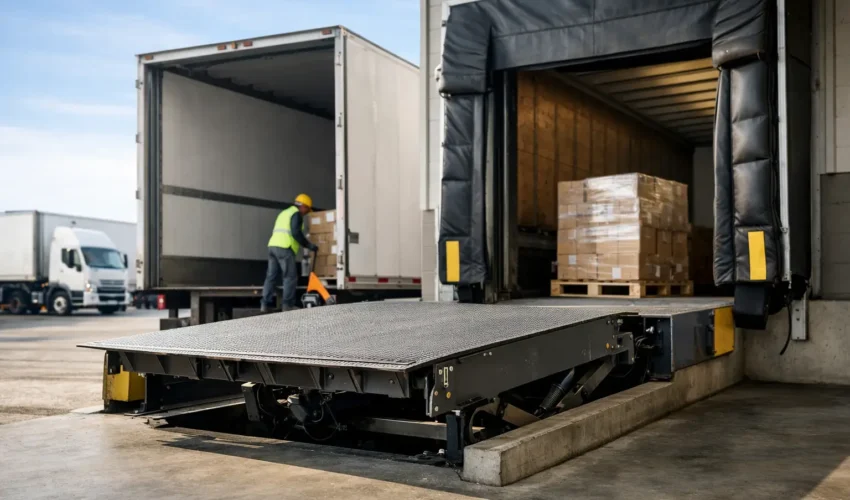
A loading bay only has to go wrong once to cause a serious problem. A misaligned trailer, a leveller that does not suit the traffic, or a shelter that fails to seal properly can lead to damaged stock, vehicle movement, slips, impact damage and lost time. That is why loading bay safety: choosing the right dock leveller and dock shelter should be treated as an operational decision, not a box-ticking exercise.
For warehouses, distribution sites, food premises and busy commercial units, the dock area is one of the hardest-working parts of the building. It deals with repeated vehicle movements, changing loads, pressure on turnaround times and, often, a mix of vehicle types. When the equipment is well matched to the site, loading is quicker and safer. When it is not, the problems show up fast.
Why loading bay safety starts with specification
Many loading bay issues begin before installation. A leveller and shelter may be good products in their own right, but still be the wrong fit for the building, the vehicles or the workload. This is where a proper site survey matters.
The key questions are practical. What height range are the incoming vehicles? Are you handling pallet trucks, powered MHE or heavier forklift traffic? How often is the bay in use? Is temperature control important? Are you loading standard rigid vehicles, articulated trailers, or a mix of both? These details affect what will actually work day to day.
There is also the matter of condition and maintenance. A bay that sees heavy use needs equipment that can cope with repeated cycles without becoming a constant repair issue. Cheaper upfront choices can become expensive if they lead to downtime, callouts and avoidable damage.
Choosing the right dock leveller for your operation
A dock leveller bridges the gap and height difference between the loading bay and the vehicle bed. That sounds simple, but leveller selection has a direct effect on safety, loading speed and equipment wear.
The main issue is compatibility with the vehicles using the bay. If the leveller travel range is too limited, you can end up with steep working angles. That puts more strain on forklift operators and equipment, and increases the risk of load instability. If the lip length is wrong, the contact area may be poor, especially with shorter vehicle beds or awkward approaches.
Swing lip or telescopic lip?
For many sites, a standard swing lip leveller is a practical and reliable choice. It suits consistent vehicle fleets and general loading patterns well. Where fleets vary more, or where precise lip positioning matters, a telescopic lip can offer better contact and improved flexibility.
That does not mean telescopic is always the better option. It depends on traffic, vehicle variation and budget. In some environments, the added control is worthwhile. In others, a well-specified swing lip model will do the job perfectly well and keep maintenance simpler.
Capacity matters, but so does real usage
One common mistake is choosing by headline load rating alone. The true question is what loads the leveller will face in operation. A bay serving lightweight pallet traffic has different demands from one taking heavy forklift loads all day.
Dynamic load, axle loads, traffic frequency and impact from repeated use all need to be considered. Over-specifying can add cost without much benefit, but under-specifying is where safety and reliability problems begin. A leveller should be selected for how the bay actually works, not how it looks on paper.
Hydraulic or mechanical?
Hydraulic dock levellers are widely used because they are efficient, easier to operate and generally better suited to frequent use. They can support faster loading cycles and reduce manual handling around the bay.
Mechanical options still have a place in lower-use environments, but they are rarely the best answer for busy operations where speed and consistency matter. If the bay is critical to daily throughput, hydraulic usually makes more sense over the long term.
Loading bay safety and dock shelter selection
A dock shelter is often seen as secondary to the leveller, but it plays a major role in loading bay safety and overall performance. It helps form a seal between the building and the vehicle, protecting the opening from weather, reducing draughts and supporting cleaner, more controlled loading conditions.
That matters in Scotland, where wind and rain are not minor considerations. An ineffective shelter can leave wet surfaces around the bay, increase the chance of slips and expose goods to the elements during loading. In temperature-sensitive operations, it can also make environmental control harder and more expensive.
Curtain, foam or inflatable?
Curtain shelters are commonly chosen for their flexibility and suitability for a range of vehicle sizes. They are often a good fit for general logistics use, especially where there is regular movement and some variation in fleet dimensions.
Foam shelters can provide a tighter seal for more uniform vehicle fleets. They work well where thermal performance matters and where drivers are reversing consistently into position. The trade-off is that they are less forgiving if vehicle sizes vary widely.
Inflatable shelters tend to be used where the best possible seal is needed, such as food production, cold chain or controlled environments. They can deliver excellent environmental performance, but they are not necessary for every site. The right answer depends on the value of the seal, the consistency of vehicle positioning and the cost of energy loss or product exposure.
Common site factors that change the decision
The loading bay itself often dictates the specification. Yard gradient, restricted manoeuvring space, exposed locations and older buildings can all affect what equipment is suitable. A tight site may need more precise vehicle alignment measures. An exposed site may need a more durable shelter face and stronger weather protection.
If the building has mixed-use bays, the decision becomes more complex. One bay may serve palletised goods with forklifts, while another handles cages, handballing or occasional specialist deliveries. In those cases, standardising everything is not always the most efficient route. Sometimes the safer option is to tailor each bay to its actual use.
There is also the question of driver behaviour and traffic discipline. Even the right equipment can be compromised by poor reversing practice, rushed loading or lack of bay control. Wheel guides, buffers, restraints and clear operating procedures should be considered alongside the leveller and shelter rather than afterwards.
Installation quality is part of safety
Good equipment can still underperform if it is installed badly. Dock levellers need correct integration with the pit or bay structure, proper alignment and reliable control operation. Shelters need to be fitted so they seal effectively without being too vulnerable to impact damage.
This is why engineer-led surveys and installation matter. The aim is not simply to fit a product, but to make sure the full bay arrangement works as a system. That includes vehicle approach, building interface, operational use and future maintenance access.
For businesses in Lanarkshire, Glasgow and surrounding areas, local support also has practical value. If a loading bay is out of action, you need a contractor who can respond quickly and understand the operational pressure that creates.
Maintenance, repairs and long-term performance
Choosing the right dock leveller and dock shelter is only part of the job. Once installed, they need routine inspection and servicing to stay safe and dependable. Wear on hinges, lips, hydraulic components, shelter curtains, side pads and fixings can all affect performance over time.
Small issues tend to become bigger ones in a loading bay. A damaged shelter face can expose the bay to weather and impact. A leveller fault can stop loading entirely or create an unsafe transition into the vehicle. Planned maintenance usually costs far less than disruption caused by avoidable failure.
This is where a service-led approach makes sense. Businesses should think beyond installation and ask what support looks like after handover. Fast repairs, regular servicing and practical advice are often what protect the value of the original investment.
What a good specification process looks like
A sound specification usually starts with a site survey, followed by questions about vehicles, traffic levels, load types and environmental needs. From there, the right leveller type, shelter type and supporting bay equipment can be recommended based on actual operating conditions.
That process should be straightforward, not overcomplicated. You need a clear explanation of what is being proposed, why it suits the site and where the trade-offs sit. If one option costs more, there should be a practical reason for it, such as better durability, improved sealing or greater flexibility with mixed fleets.
Door Systems Scotland takes that engineer-led approach because loading bay equipment has to work in the real world, not just on a specification sheet. For most operators, the best result is equipment that keeps goods moving safely, stands up to daily use and can be maintained without fuss.
The right choice at the loading bay is rarely about buying the most expensive system or the simplest one. It is about matching the equipment to the job, the building and the people using it, so the bay works safely every single day.