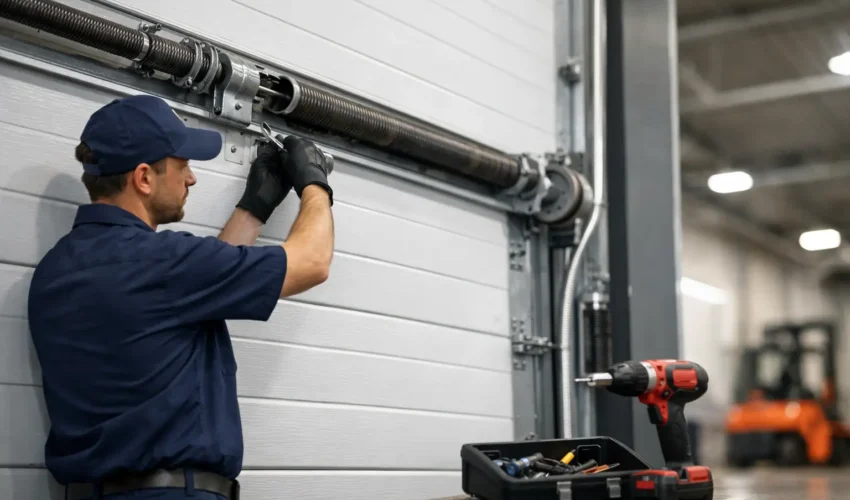
A failed industrial door rarely picks a convenient time. It tends to happen during a delivery slot, at opening time, or when you need to secure the building at the end of the day. That is why industrial door maintenance: how to prevent costly breakdowns is not just a technical question. For most commercial and industrial sites, it is an operational one.
When a roller shutter sticks halfway, a high-speed door starts hesitating, or an automatic entrance begins misfiring, the direct repair cost is only part of the issue. The bigger cost often comes from lost access, delayed goods, security risks, staff disruption, and pressure on the rest of the site. Good maintenance reduces those problems long before they turn into emergency callouts.
Why industrial door maintenance prevents costly breakdowns
Industrial and commercial doors work hard. In a warehouse, they may open and close dozens or even hundreds of times each day. On a retail or healthcare site, they also need to operate safely and consistently for staff, customers, and visitors. Wear is inevitable. The real question is whether that wear is identified early or ignored until a failure stops the door altogether.
Most major breakdowns start as minor faults. A worn cable, damaged roller, drifting limit setting, misaligned track, tired spring, or failing safety sensor can often be corrected during a service visit. Left alone, the same issue can strain the operator, damage connected parts, or create an unsafe door condition. That is when the repair becomes more expensive and the downtime longer.
Planned maintenance also gives you a clearer picture of the door’s condition. Instead of reacting to each fault as it appears, you can make practical decisions about repair versus replacement, budget for upcoming work, and keep access points dependable.
The faults that usually lead to expensive downtime
Different door types fail in different ways, but some patterns appear again and again. Industrial roller shutters often suffer from curtain damage, motor issues, brake problems, worn end locks, or alignment faults. High-speed doors can develop problems with sensors, control panels, wind bars, curtains, and drive systems, particularly in busy environments where impact damage is common.
Automatic sliding and swing doors tend to show early warning signs through slow operation, inconsistent opening cycles, sensor faults, or unusual noise from the operator. Dock levellers and loading bay equipment introduce another layer of risk because defects affect both access and loading safety.
What matters is not just the fault itself, but how early it is spotted. If a door is becoming noisier, moving unevenly, pausing unexpectedly, or showing signs of impact, that is usually the time to act. Waiting until it fails fully rarely saves money.
What a proper maintenance visit should include
A worthwhile service visit is more than a quick visual check. It should assess the components that carry the load, control the movement, and protect the user. That means looking at motors, springs, cables, drums, tracks, rollers, hinges, safety edges, photocells, control panels, emergency stop functions, fixings, and door balance where relevant.
The engineer should also test the door in operation, not just when stationary. Some faults only appear under movement or after repeated cycles. A door may seem functional at first glance but still show hesitation, poor travel, or inconsistent stopping points once tested properly.
Cleaning, adjustment, lubrication, and minor corrective work are all part of keeping a system in serviceable condition. That said, maintenance is not a magic fix for every door. If a component is heavily worn or damaged, replacement is often the better option. A good engineer should be straightforward about that rather than trying to stretch the life of a part that is already near failure.
Industrial door maintenance: how to prevent costly breakdowns in practice
Prevention comes down to routine, not guesswork. Sites that experience the fewest serious failures usually have a servicing schedule based on traffic level, door type, and operating environment. A loading bay door used all day in a busy depot needs more attention than a shutter on a secondary access point that only opens a few times each week.
Environment matters too. Dust, moisture, temperature changes, impact from pallet lorries, and exposure to wind can all shorten component life. A food production area, vehicle workshop, distribution centre, and retail unit each place different demands on the door system. Maintenance should reflect those demands rather than follow a one-size-fits-all timetable.
It also helps to keep a simple internal reporting process. If staff know they should report unusual sounds, slow travel, jerky movement, or damage as soon as they notice it, faults are more likely to be addressed before they escalate. Many expensive callouts begin with a problem that had been visible for weeks.
Planned maintenance versus reactive repairs
Reactive repairs will always have a place. Even well-maintained doors can be struck by vehicles, suffer sudden electrical faults, or fail unexpectedly. But relying on callouts alone usually means paying more over time, because the repair happens after the disruption has already started.
Planned maintenance shifts the balance in your favour. You reduce emergency situations, improve reliability, and usually extend the usable life of the door. It can also help with compliance and record keeping, especially where doors form part of a wider safety or access strategy on site.
There is, of course, a cost to regular servicing. For some low-use doors, very frequent visits may not be necessary. That is where a site survey and sensible service plan matter. The aim is not to over-service equipment. It is to maintain it at a level that matches real usage and risk.
Signs your site is overdue for maintenance
If you are not sure whether your current setup is enough, the warning signs are usually practical rather than technical. Doors that have become noisy, slow, or inconsistent should be checked. So should doors with visible impact damage, worn seals, unreliable remote controls, or sensors that occasionally fail to respond.
Another common issue is when a site has no clear record of the last service. That often means maintenance has been handled ad hoc, usually after something has already gone wrong. In busy commercial premises, that approach tends to catch up with you.
Age is another factor, but it is not the only one. An older door that has been looked after can remain dependable. A newer installation that is heavily used and poorly maintained can become troublesome surprisingly quickly.
Choosing the right maintenance support
For most businesses, the value of maintenance depends as much on response and practical experience as it does on the checklist. If a contractor understands industrial and commercial door systems properly, they will usually spot patterns early, recommend sensible remedial work, and act quickly when a repair is needed.
That local response matters when access or security is compromised. Businesses across Glasgow, Lanarkshire and surrounding areas often do not need long reports or overcomplicated advice. They need a door specialist who can attend site, diagnose the problem properly, and keep disruption to a minimum.
This is where an engineer-led approach tends to work best. It gives you clearer recommendations and fewer surprises than a purely sales-led service. Door Systems Scotland works in that practical way, with maintenance and repairs built around keeping sites operational rather than adding unnecessary extras.
A smarter way to reduce door-related downtime
The most cost-effective maintenance plan is usually the one that fits the building, the traffic, and the consequences of failure. A warehouse dispatch door, a shopfront shutter, an automatic entrance at a medical centre, and a high-speed door in a production area should not all be treated the same. They have different risks, different wear patterns, and different urgency when faults occur.
If you review your most important access points now, before the next failure, you put yourself in a stronger position. You can schedule service visits around operations, deal with minor defects while they are still minor, and avoid the cycle of breakdown, disruption, and urgent repair.
A dependable door system is easy to overlook when it is working properly. That is exactly the point. The best maintenance keeps it that way, so your building stays secure, accessible, and ready for business.