A roller shutter that is even slightly out of line will tell you quickly. It will bind, lift unevenly, strain the motor and turn a straightforward installation into a recurring repair job. That is why understanding how to install industrial roller shutter door systems properly matters long before the first bracket is fixed in place.
For most commercial premises, installation is not just about getting a door to open and close. It is about security, safe operation, compliance and avoiding disruption to daily trading or warehouse activity. In practice, that means careful surveying, correct structural fixings, proper electrical work and thorough testing at handover. If you are responsible for a unit, depot, workshop or retail frontage, it helps to know what good installation looks like, even if you intend to appoint a specialist contractor.
Before you install an industrial roller shutter door
The job starts with the opening, not the curtain. A proper site survey checks the width, height, headroom, sideroom and the condition of the supporting structure. On paper, an opening may look straightforward. On site, steelwork may be out of square, masonry may be weaker than expected, and services such as conduit, pipework or fire alarm equipment can affect bracket positions.
This stage also confirms the door specification. That includes whether the shutter is manually operated or motorised, the required wind loading, usage frequency, insulation needs and the level of security expected. A door serving a busy warehouse is a different proposition from one fitted to a small commercial store. The right product and the right fixing method go together.
Power supply is another early consideration. If the shutter is electrically operated, the installer needs to verify voltage, isolator location and cable routing before work starts. Where there is uncertainty, an electrician may need to be involved alongside the door engineer. Rushing this point often causes delays later.
How to install industrial roller shutter door systems safely
Installation begins with setting out. The opening is marked so the guides and support brackets will sit plumb, level and square to each other. This sounds basic, but accuracy here affects every stage that follows. If one guide is out by only a small amount, the curtain can run poorly and wear prematurely.
Once the positions are marked, the engineer prepares the fixing points. The type of fixing depends on the structure – concrete, steel, brick or blockwork all call for different anchors and, in some cases, spreader plates or secondary steel supports. A dependable installation is only as good as the structure carrying the load. For larger industrial shutters, the weight involved is significant, so bracket loading must be taken seriously.
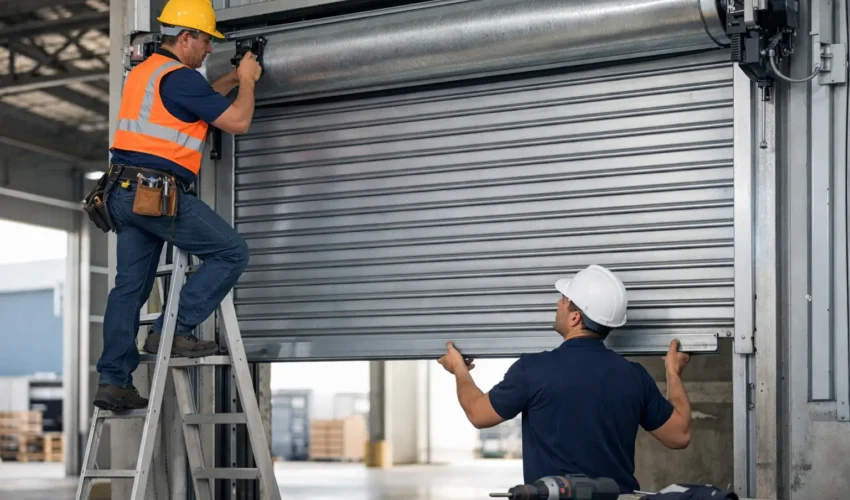
The guide channels are then fixed in place, but not always tightened fully until final alignment is confirmed. After that, the barrel assembly and brackets are lifted into position. On smaller doors this may be manageable with suitable lifting equipment and trained installers. On larger doors, mechanical lifting is normally required. Trying to manage a heavy barrel without proper equipment is unsafe and risks damaging the door before it has even been commissioned.
With the barrel secured, the curtain is attached and fed into the guides. This needs care to avoid damaging slats, end locks or the finish of the shutter. The curtain must run freely and sit correctly within both guides. If it drags, catches or twists, the installer will stop and correct the alignment rather than forcing the system to operate.
Motor fitting, controls and electrical connection
For a motorised shutter, the drive unit is fitted in line with the manufacturer’s instructions. Limit settings are then adjusted so the door stops accurately in the open and closed positions. Poorly set limits are a common cause of service calls because the curtain can overrun, leave gaps at the floor or place unnecessary strain on the motor.
Control panels, key switches, push buttons or remote access systems are installed to suit the site layout and the way the building is used. A warehouse with forklift traffic may need controls in a different location from a retail premises with staff-only access. Safety accessories such as photocells, safety edges and warning devices also need to be positioned and tested correctly.
Electrical work must be completed to the relevant standard, with suitable isolation and protection. This is not an area for guesswork. If the door is part of a wider access or fire strategy, the integration requirements should be checked before final commissioning.
The parts of the job that matter most
Many installation problems do not come from the shutter itself. They come from poor preparation, weak fixings or missing allowances for site conditions. An opening that is not true can sometimes be accommodated, but only if it is identified early and the installation method is adjusted accordingly.
Another important factor is usage. A shutter on a unit that opens a few times a day has different demands from one working continuously through loading hours. Higher use may justify a heavier-duty motor, upgraded controls or a different door type altogether. This is where a practical site survey adds value. It avoids fitting a door that looks suitable on day one but struggles in real operation.
There is also the question of access during the works. Some premises can tolerate downtime for a full day. Others need installation planned around deliveries, staff entry points or customer trading hours. In live commercial environments, careful sequencing matters just as much as technical accuracy.
Common mistakes when learning how to install industrial roller shutter door equipment
The biggest mistake is assuming every opening is standard. Industrial sites often have uneven floors, aged lintels or previous alterations that affect fit. Taking one or two basic measurements is not enough.
Another common issue is underestimating the importance of structural support. If the brackets are not fixed to sound material, the shutter may operate for a time but develop movement, noise or safety concerns later. That is why experienced installers check the substrate, not just the dimensions.
Electrical shortcuts cause their own problems. Incorrect cable routes, poorly positioned controls or inadequate isolation all make maintenance harder and can compromise safety. The same applies to limit setting and final testing. A shutter that opens once during fitting is not necessarily ready for service.
Finally, handover is often overlooked. The end user should know how the door operates, what to do in an emergency, and when servicing is due. Without that, even a well-installed system can suffer from misuse.
Testing, commissioning and handover
Once installation is complete, the shutter should be run through repeated open and close cycles. The engineer checks travel, balance, guide alignment, motor performance and safety devices. If the door includes manual override, that should be demonstrated and tested as well.
Any unusual noise, hesitation or uneven running is investigated before sign-off. This is also the stage for checking the bottom seal contact, locking function and control response. On a busy site, reliable operation from the start is what prevents avoidable downtime.
Documentation matters too. Depending on the installation, this may include operating instructions, maintenance recommendations and records of commissioning checks. For commercial customers, planned servicing after installation is not an optional extra in practice. It is the best way to keep the door safe, compliant and reliable over time.
Should you install an industrial roller shutter door yourself?
For most business premises, the honest answer is no. Knowing how to install industrial roller shutter door systems is different from having the equipment, training and site experience to do it safely. Industrial shutters involve heavy components, structural loading, electrical connection and safety compliance. If anything is wrong, the cost is rarely limited to the door itself. It can affect security, workflow and staff safety.
There are cases where a client wants to understand the process for project planning, procurement or contractor oversight. That is sensible. It helps you ask better questions, compare quotations properly and spot when corners are being cut. But actual installation is usually best left to trained engineers who can survey the opening, specify the right product and complete the job with a proper test and handover.
For businesses across Lanarkshire, Glasgow and the wider region, that local, engineer-led approach tends to save time and prevent avoidable callouts later. A shutter door should not become a weekly concern. It should open when needed, secure the premises properly and stay dependable under day-to-day use.
If you are planning a new shutter installation, the best starting point is not the cheapest door on paper. It is a proper survey, a realistic specification and a contractor who understands how the building actually works day to day.