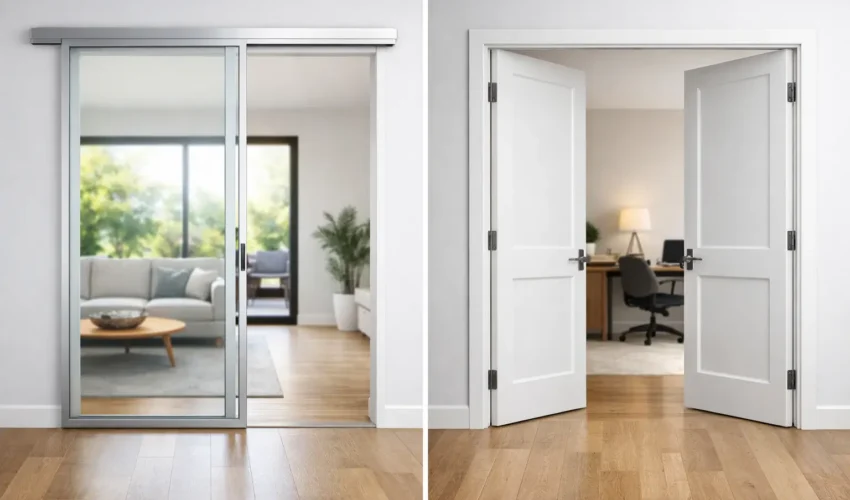
When a door is being opened hundreds of times a day, the wrong choice shows up quickly. You see it in bottlenecks at entrances, draughts in reception areas, doors clashing with foot traffic, or constant repair callouts that could have been avoided. That is why sliding doors vs swing doors is not just a design question. For commercial and industrial sites, it affects access, safety, efficiency and long-term maintenance.
For many premises, both systems can work well. The better option depends on how people move through the building, how much clear space you have, what level of automation is needed and how much wear the door will face. A busy medical centre will not have the same priorities as a warehouse office, a retail frontage or a secure staff entrance.
Sliding doors vs swing doors: the basic difference
A sliding door opens sideways along a track, so it does not need a door leaf to project into a room or walkway. In commercial settings, this often means automatic glazed entrance doors, internal access doors in healthcare settings, or larger industrial systems where space needs to stay clear.
A swing door opens inwards or outwards on hinges. That can be a single leaf or double leaf arrangement, manual or automatic. Swing doors are common across offices, shops, communal entrances, back-of-house access routes and many public-facing buildings.
On paper, the difference looks simple. In practice, the door has to suit how the entrance is used every day, not just how it looks on a drawing.
Where sliding doors tend to work best
Sliding doors are often the stronger choice where traffic is frequent and space around the opening is tight. Because the leaves move laterally, they do not interrupt circulation in the same way as swing doors. That makes them particularly useful at main entrances, hospitals, clinics, retail units and public buildings where people may be arriving with pushchairs, trolleys, wheelchairs or deliveries.
They also help where you want a more controlled and predictable flow. People understand how to approach an automatic sliding entrance. They are less likely to hesitate, step back suddenly or get caught in the path of a door opening towards them.
Another advantage is usable floor area. In a reception, lobby or shopfront, every bit of clear space matters. A swing door needs an arc to open safely. A sliding door does not, which can make furniture layouts, queuing space and internal circulation easier to manage.
For businesses trying to create a clean, accessible main entrance, sliding doors often feel more natural. They can also support better environmental control when properly specified, especially in vestibules or where opening times are managed efficiently.
That said, sliding systems are not automatically the best answer for every site. They rely on tracks, sensors, control systems and alignment. If the opening is awkward, the side room is limited, or the environment is exposed to dirt and impact, the specification needs careful thought.
The trade-offs with sliding doors
Sliding doors can cost more upfront than a straightforward swing door installation, especially where automation, safety sensors and glazing are involved. They also need the wall space or structural allowance for the leaves to slide or stack correctly.
Maintenance matters too. Tracks can collect debris, rollers wear, sensors need checking and automatic operators need regular servicing. None of that is a problem when the system is maintained properly, but it does mean the door should be seen as an active part of the building, not a fit-and-forget item.
In high-use settings, that is usually a worthwhile trade. In low-traffic areas, it may not be.
Where swing doors make more sense
Swing doors remain a practical and dependable option for a wide range of commercial properties. They are often simpler in construction, easier to integrate into existing openings and well suited to internal doors, staff-only access points, fire-rated openings and locations where traffic is steady rather than constant.
If you have enough clearance around the opening, a swing door can be highly effective. For many businesses, it is the more economical choice at installation stage and can be easier to repair if the hardware is standard and the usage is moderate.
Automatic swing doors also have their place. They can improve accessibility without requiring the side clearance needed for a sliding system. In smaller premises, or on retrofit projects where structural change needs to be kept to a minimum, this can be a sensible solution.
Swing doors can also offer strong sealing performance when specified correctly. For entrances where weather resistance, acoustic separation or controlled access matters, they may be preferable to sliding systems depending on the frame design and surrounding structure.
The limits of swing doors
The main issue is space. A swing door needs clear room to open and close safely. In a narrow corridor, busy entrance, or area with two-way traffic, that can create conflict. The door leaf can obstruct movement, strike nearby users if visibility is poor, or limit where equipment and furniture can be placed.
In high-footfall locations, swing doors can also slow people down. This is especially noticeable where users are carrying items, pushing cages or moving through with mobility aids. Even with automation, the opening pattern can feel less intuitive than a sliding system at a busy public entrance.
Wear can also build up around hinges, closers, pivots and operators if the door is in near-constant use. Again, that does not make swing doors unsuitable. It simply means usage level should shape the specification.
Space, traffic and purpose matter more than preference
The most useful way to compare sliding doors vs swing doors is to start with the opening itself. Is this a main customer entrance, a staff access point, a clinical corridor, a warehouse office door or a secure internal division? The answer changes everything.
For a public entrance with steady footfall, sliding doors usually make movement easier and create less friction. For an internal office door or a controlled access room, a swing door may be perfectly adequate and more cost-effective. For healthcare and care settings, hygiene, touch-free access and user comfort often push sliding systems ahead. For service corridors or plant areas, robust swing doors may be the better fit.
A good door choice is rarely about what is generally best. It is about what will keep working with the least disruption in that exact location.
Safety and accessibility considerations
Both door types can be safe and compliant when installed and maintained properly, but they create different risks and user experiences. Sliding doors remove the hazard of a leaf swinging into a person’s path, which is one reason they are common at busy entrances. They are also well suited to inclusive access, particularly where users may have reduced mobility or need a wider, more predictable opening.
Swing doors can also support accessibility, especially with the right automation and controls, but the opening arc must be considered carefully. The door should not create a pinch point or force users to manoeuvre awkwardly. In some buildings, that is manageable. In others, it becomes a daily nuisance.
Safety sensors, activation devices, hold-open functions and emergency escape requirements all need to be considered early. The door should not only work when everything is calm. It should also perform reliably during peak periods, deliveries and emergency situations.
Maintenance, lifespan and downtime
For most commercial clients, the real cost of a door is not only the purchase price. It is the disruption when it fails.
Sliding doors have more moving parts in many configurations, particularly automated entrances. That can mean more planned servicing is required. The benefit is that, when looked after properly, they can cope very well with heavy daily use.
Swing doors may appear simpler, but they are not maintenance-free. Closers drift out of adjustment, hinges wear, alignment changes and automatic operators need routine checks. A door that scrapes, slams or fails to close properly soon becomes a safety and security issue.
This is where site surveys and planned maintenance matter. A well-specified door, backed by responsive engineering support, usually gives better value than a cheaper system that is under strain from day one. For businesses across Lanarkshire and Glasgow, that often means choosing not just the right door type, but a service partner who can keep it operational when usage is high and downtime is expensive.
So which should you choose?
If your priority is smooth traffic flow, accessibility and making the most of limited entrance space, sliding doors are often the stronger option. If your opening is simpler, your traffic levels are lower, or you need a practical solution for internal or controlled access areas, swing doors may be the better choice.
There is no universal winner in sliding doors vs swing doors. The right answer comes from the site layout, the people using the entrance, the frequency of use and the standard of maintenance the system will receive.
If you are unsure, the safest next step is a proper site assessment rather than a guess based on appearance or initial cost. A door should make the building easier to run, not harder. When it is specified properly, you stop noticing it, and that is usually a sign it is doing its job well.