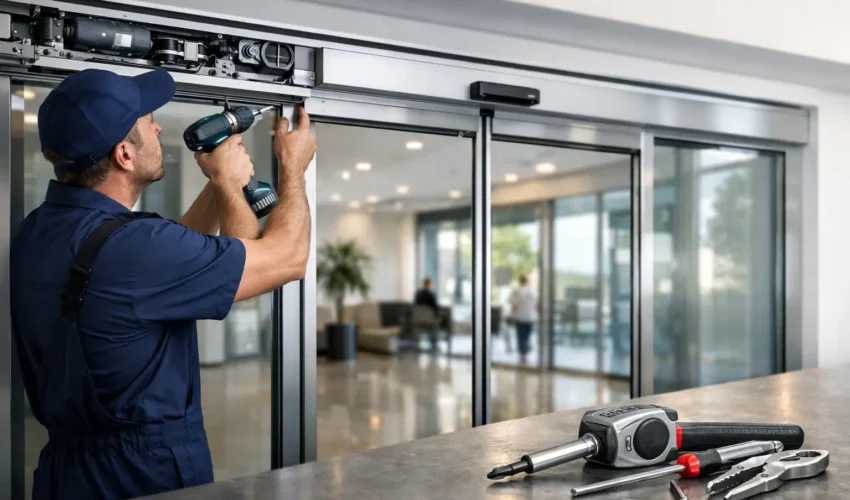
When an entrance starts causing delays, draughts, access issues or failed openings at peak times, the problem is rarely just the door leaf. Automatic sliding door installation is about how people move through a building, how safely they do it, and how reliably that entrance performs day after day. For commercial premises, the right system needs to do more than look tidy. It has to suit traffic levels, meet safety requirements, and keep disruption to a minimum.
For a shopfront, medical practice, office entrance or warehouse reception, sliding automatic doors are often the most practical option where space is limited and regular footfall is expected. They create a clear opening width without door swings getting in the way, and they help manage accessibility more effectively than a manual entrance that depends on users pushing or pulling at the right moment. That said, the installation itself needs careful planning. A poor survey, the wrong operator, or weak attention to the surrounding structure can leave you with recurring faults and unnecessary callouts.
What automatic sliding door installation actually involves
From the outside, the job can look straightforward – fit the frame, install the glass or door leaves, connect the operator and set the sensors. In practice, there is more to it than that. Every site has its own constraints, and the quality of the installation is usually decided before any equipment arrives.
A proper process starts with the survey. The opening width and headroom are only part of the picture. Engineers also need to assess traffic patterns, internal and external space, structural support, floor levels, electrical supply, and how the entrance is used throughout the day. A front entrance serving a care setting or busy retail unit will be specified differently from a private office with controlled access.
The installer should also look at exposure to wind, rain and temperature changes. In Scotland, external conditions matter. An entrance that works well on paper can become unreliable if the environment is ignored, particularly where sensors, seals and door travel are affected by weather or pedestrian congestion.
Choosing the right system for the building
Not every sliding door setup is the same. Some businesses need a standard single-slide or bi-parting arrangement for everyday public access. Others need integrated access control, locking, emergency breakout options or better performance for high traffic sites.
This is where automatic sliding door installation becomes a specification exercise rather than a simple product choice. If your building sees trolleys, wheelchairs, deliveries or frequent visitor traffic, opening speed and sensor positioning become more important. If security is a priority, the locking arrangement and the strength of the framing need closer attention. If energy efficiency matters, glazed configuration, sealing and operating cycles all come into play.
There is also the question of whether a sliding system is the best fit at all. In some buildings, an automatic swing door may suit the entrance better, particularly where the structural opening is awkward or pedestrian volumes are relatively low. A good installer should say so if that is the case. The right answer is not always the most expensive one, and it is not always the same across every entrance on a site.
Automatic sliding door installation and compliance
For commercial property operators, compliance is one of the main reasons to avoid a rushed installation. Automatic doors need to be safe in use, correctly commissioned and appropriate for the people using them. That includes the activation method, safety sensors, emergency function and the physical operation of the system itself.
The details matter here. Sensor zones need to be set correctly to protect users approaching or passing through the door. Clear opening widths need to support accessibility. The operator should be adjusted to suit the site rather than left on a generic factory setting. A door that opens too slowly can create queues and frustration. One that closes badly or reacts inconsistently can create a genuine safety risk.
Documentation and handover are part of the job too. Once installed, the system should be tested, commissioned and explained properly so the site team understands its operation, any user controls and the maintenance requirements. This tends to be where experienced commercial door engineers stand apart from general contractors. The install is only complete when the entrance is working reliably and the customer knows what has been fitted.
What affects cost and programme
One of the most common questions around automatic sliding door installation is cost. There is no fixed figure that covers every site because the price depends on the opening, the surrounding construction, the door specification and any additional works required.
If an existing entrance is being replaced, the condition of the current frame and power supply can affect the job more than expected. Structural alterations, glazing changes and making good works can add time and cost. If the installation is part of a refurbishment, coordination with other trades also matters. Delays elsewhere on site often end up affecting access system works.
Programme is not just about fitting speed either. Businesses usually want minimal downtime, especially at customer-facing entrances. In some cases, work can be phased to keep access open during trading hours. In others, an out-of-hours installation is the more sensible route. The best approach depends on how critical the entrance is to the operation of the building.
Why installation quality matters after day one
A sliding entrance can look fine when it first goes in and still become a problem later if it has not been installed accurately. Misalignment, poor roller setup, weak cable routing, badly set sensors or marginal structural fixing points may not cause immediate failure, but they often lead to repeat faults over time.
For facilities managers and business owners, this is where long-term value is decided. A correctly installed automatic door should open smoothly, close consistently and cope with regular traffic without constant adjustment. If engineers are back on site too often in the first year, the issue is often rooted in the original installation or in a poor match between the system and the application.
That is also why planned maintenance matters. Automatic entrances are moving systems, not static building features. Rollers, tracks, belts, guides, sensors and control components all need periodic inspection and adjustment. An installation carried out properly from the start gives that maintenance schedule a much better chance of keeping the door reliable.
Working with an engineer-led installer
If you are comparing contractors, look at how they approach the survey and whether they ask practical questions about traffic, safety and day-to-day operation. A proper commercial installer should be thinking beyond dimensions. They should be considering usage, compliance, future servicing and how to reduce the chance of avoidable breakdowns.
That local, engineer-led approach often makes a difference, especially when fast support matters after installation. For businesses in Lanarkshire, Glasgow and surrounding areas, having a contractor who can survey properly, install efficiently and respond quickly if an issue arises is not a small detail. It affects downtime, customer access and the confidence of the site team using the entrance every day.
Door Systems Scotland works in that practical way – surveying the site, specifying to suit the building, and supporting the system after handover rather than treating installation as a one-off job. For commercial customers, that continuity is often as valuable as the product itself.
When to replace rather than repair
Some businesses look into automatic sliding door installation after repeated repairs on an older entrance. That is often the right time to step back and assess whether replacement is more cost-effective than continuing to patch an ageing system.
If parts are becoming difficult to source, the operator is unreliable, safety components are dated, or the frame condition is poor, a new installation may be the better long-term choice. The upfront spend is higher, but repeated reactive repairs can become more expensive than planned replacement, particularly when failures affect trading, patient access or staff movement.
The decision is not always obvious. A relatively modern system with one failed component may still have plenty of life left in it. An experienced engineer should be honest about that. Sometimes a repair is the sensible route. Sometimes replacement avoids months of disruption and uncertainty.
A better entrance should make the building work better
The best automatic sliding doors are the ones people barely notice. They open when they should, close properly, help visitors move through the building safely and support the day-to-day operation without fuss. Getting to that point depends less on sales claims and more on good surveying, sound specification and careful installation.
If you are planning an entrance upgrade, it is worth looking past the door itself and focusing on how the system will perform in real use. A well-installed sliding door should support access, safety and reliability from the first day onward, and that is what makes the investment worthwhile.