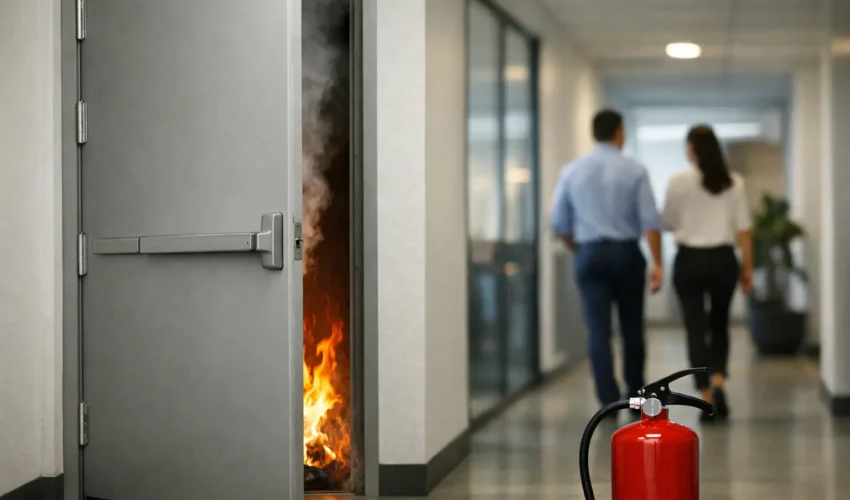
A fire door only matters when something has already gone badly wrong. That is exactly why it needs to perform properly.
The importance of fire-rated doors in commercial and industrial buildings is not just about meeting a box-ticking requirement. These doors help contain fire and smoke, protect escape routes, reduce damage to stock and equipment, and give staff, visitors and emergency services more time to act. For a warehouse, factory, retail unit, medical centre or shared commercial premises, that time can make the difference between a controlled incident and a major loss.
Why the importance of fire-rated doors in commercial and industrial buildings is often underestimated
In many premises, fire-rated doors are part of the background. People walk through them every day without thinking much about them, unless one starts sticking, slamming, dragging on the floor or failing to close properly. The problem is that a fire door is a safety system, not just another door set.
When a fire starts, its job is to resist the spread of flames and hot smoke for a set period, helping to compartmentalise the building. That delay supports evacuation and can limit how far damage travels through corridors, stairwells, plant rooms, service risers, loading areas and office sections. In industrial buildings especially, where large floor plates, high-value equipment and mixed-use spaces are common, compartmentation is a practical line of defence.
A standard door cannot be expected to do the same job. Fire-rated doors are designed and tested as complete assemblies. The leaf, frame, seals, hinges, closer, glazing and ironmongery all play a part. If one element is wrong, damaged or poorly fitted, the overall performance may no longer match what the building needs.
What fire-rated doors actually do during an incident
A properly specified and maintained fire-rated door slows the spread of fire from one compartment to another. That sounds simple, but the benefits reach further than many site managers first realise.
The first benefit is life safety. Protected routes need to stay usable for long enough to allow people to leave the building safely. In a busy premises, evacuation is rarely as straightforward as a clear corridor and an empty stair. There may be customers unfamiliar with the layout, staff finishing machinery shut-down procedures, or contractors working in isolated areas. Fire doors help hold those routes.
The second benefit is property protection. Fire and smoke do not stay neatly contained unless the building is arranged to resist them. If a fire door performs as intended, it can reduce spread into adjoining units, offices, stock rooms or production areas. That may lower the extent of structural damage and improve the chances of recovery.
The third benefit is business continuity. For many commercial and industrial operators, the real cost of a fire is not only the physical damage. It is the lost trading time, halted production, delayed deliveries, insurance complications and disruption to staff and customers. Containment matters because downtime matters.
Compliance matters, but performance matters more
Most decision-makers understand that fire doors connect to compliance. That is true, but it helps to look beyond the regulation itself and focus on what good compliance is trying to achieve.
A fire-rated door that has been propped open, fitted with unsuitable hardware or left with damaged seals may still appear to be in place. On paper, the premises may seem covered. In reality, the door may not do its job when required. This is where regular inspections and planned maintenance become essential.
Commercial and industrial buildings change over time. Tenants alter layouts, access patterns shift, new equipment is installed, and heavy use takes its toll. A fire door that was suitable at handover may need attention later because the operating conditions have changed. Warehouses with forklift traffic, service corridors used for deliveries, and high-footfall entrances all create wear that can affect performance.
It also depends on the type of premises. A small retail unit has different risks from a distribution site or manufacturing facility. Medical settings, schools, offices and mixed-use properties all place different demands on internal doors, escape routes and compartment lines. The right specification is rarely one-size-fits-all.
The practical risks of poor installation or neglected maintenance
Fire-rated doors are unforgiving of shortcuts. A door leaf on its own is not enough. Gaps around the frame, incorrect seals, unsuitable glazing, misaligned closers or damaged hinges can all compromise the set.
This is one reason engineer-led surveys matter. A proper site assessment looks at opening sizes, traffic levels, fire strategy, door function and the surrounding structure. In busy premises, the balance between safety and day-to-day use needs careful judgement. A door that protects an escape route still has to work reliably for staff using it throughout the day.
Neglect usually shows up in familiar ways. Doors stop self-closing. Latches no longer engage properly. Staff wedge doors open because they are inconvenient for movement of goods. Impact damage builds up near loading or service areas. None of these issues should be treated as minor.
There is also a trade-off to manage. In some areas, businesses need both fire resistance and fast, efficient access. That is common in industrial settings where separate zones support production, storage and dispatch. The answer is not to choose one over the other, but to specify systems that reflect the operational reality of the site while still protecting people and property.
The importance of fire-rated doors in commercial and industrial buildings for business continuity
If you are responsible for a premises, you already think in terms of disruption. A failed shutter can stop deliveries. A faulty automatic door can affect customer access. Fire doors sit in the same broader picture of operational risk, even though they are called upon less often.
When fire-rated doors are in the right locations and kept in good condition, they can help limit the scale of closure after an incident. Instead of losing an entire building, you may be dealing with one contained area. Instead of extensive smoke damage across multiple zones, you may have a more manageable repair scope. That difference can affect insurance claims, reinstatement times and whether a business can continue trading in part.
For landlords and property managers, fire doors also support the wider duty of care to tenants and visitors. In multi-occupancy commercial buildings, a fault in one area can have consequences well beyond one occupier. Compartmentation is part of protecting the whole asset.
What building operators should pay attention to
The most useful approach is a practical one. Fire-rated doors should be treated as active safety assets, not passive joinery.
Look closely at whether doors close fully, whether seals are intact, whether hardware is suitable, and whether there are signs of impact or misuse. Consider how the opening is actually used. A clean corridor in a drawing may be a busy route for stock cages, trolleys or maintenance equipment in real life. If staff regularly work around the door rather than with it, the arrangement may need to be reviewed.
It is also sensible to think about service support before there is a problem. Planned maintenance helps pick up issues early, while responsive repair matters when damage or faults create a risk that cannot wait. For businesses across Lanarkshire and Glasgow, having a specialist contractor who understands commercial and industrial door systems can save time when decisions need to be made quickly.
Where fire-rated doors sit alongside shutters, automatic entrances or other access systems, coordination matters as well. Buildings work best when the whole access strategy has been considered properly, rather than each opening being treated in isolation.
Choosing the right support
Not every contractor approaches fire door work with the same level of care. For commercial and industrial premises, experience on live sites matters. So does the ability to assess the building properly, explain the options clearly and respond when faults affect safety or operations.
That is where a service-led, engineer-backed approach stands out. Door Systems Scotland works with businesses that need practical advice, dependable installation and ongoing support that keeps premises safe and operational. For many clients, that is just as important as the door itself.
A fire-rated door is easy to overlook because, most days, it does nothing dramatic. That quiet performance is the point. When the worst happens, you need it to close, hold, and buy the time your building and the people in it may depend on.