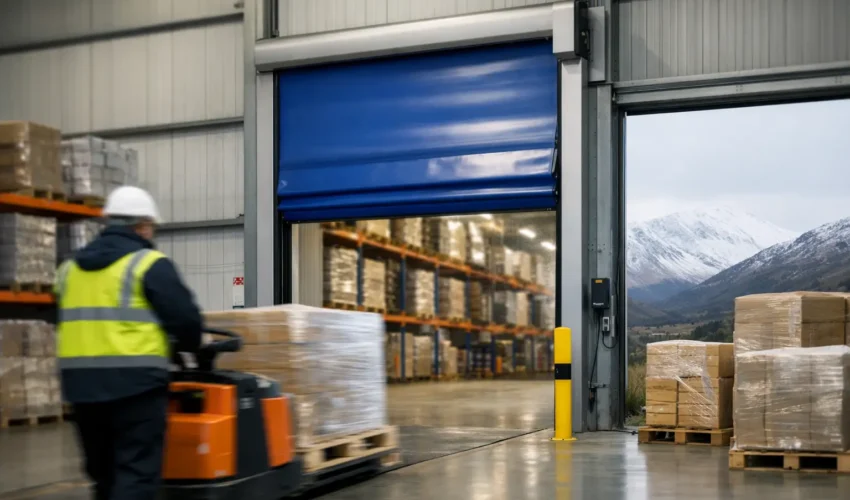
A forklift waiting at a slow roller shutter does not look like a major cost. Across a full shift, though, those pauses add up. That is where understanding how high-speed doors can improve efficiency in Scottish warehouses becomes less about the door itself and more about keeping goods, people and vehicles moving without unnecessary delay.
In warehouse operations, door performance affects more than access. It influences heat retention, traffic flow, stock protection, safety, and the amount of time your team spends dealing with avoidable disruption. In Scotland, where weather conditions can change quickly and heating costs are a real operational concern, the right high-speed door can make a measurable difference.
Why door speed matters on a working warehouse site
A warehouse door is opened and closed repeatedly throughout the day. If each cycle takes too long, internal transport slows down, loading areas stay exposed for longer, and staff are more likely to leave doors open as a workaround. That tends to create another set of problems, from draughts and contamination to security risks.
High-speed doors are designed to reduce those delays. They open quickly, close quickly and return the opening to a controlled condition in far less time than a standard industrial door. In busy environments, that shorter cycle time helps keep forklift routes clear and reduces hold-ups between storage zones, production areas and dispatch bays.
For sites handling chilled goods, food products, packaging, pharmaceuticals or high-volume pallet traffic, those seconds matter. Even in a general distribution warehouse, frequent slowdowns at access points can affect picking rates and vehicle turnaround more than many operators realise.
How high-speed doors can improve efficiency in Scottish warehouses day to day
The most obvious gain is reduced waiting time. Forklift drivers are not stopping as long at internal or external openings, which helps maintain pace across a shift. That may sound minor in isolation, but repeated hundreds of times a day, it improves workflow consistency.
There is also a strong case for energy efficiency. Scottish warehouses often have to balance ventilation, staff comfort and product protection against the cost of heating large spaces. A door that opens only when needed and closes promptly helps reduce heat loss, especially on exposed sites where wind and cold air can move through a loading area quickly.
That benefit extends beyond comfort. A more stable internal environment can support stock quality, reduce condensation issues and create better conditions for equipment and personnel. If a warehouse includes temperature-sensitive zones, fast-closing doors can help separate those areas more effectively.
Another practical advantage is fewer manual interventions. When doors are reliable and suited to the traffic pattern, staff are less likely to prop them open, override controls or report repeated faults caused by the wrong specification. That saves management time and reduces the hidden inefficiency that comes from constantly working around a problem.
Better traffic flow between warehouse zones
Many warehouses are not operating through one single loading entrance. They have internal divisions between goods-in, storage, packing, production and dispatch. If those transitions are slowed by poorly performing doors, the whole building feels less efficient.
High-speed doors help preserve movement between these areas without leaving them permanently open. That matters where different zones have different cleanliness requirements, temperature ranges or noise levels. It also helps where pedestrian routes cross vehicle paths, because a door can be tied into traffic management systems and safety controls.
Lower exposure to weather and external contamination
Scottish weather is one of the clearest operational arguments for high-speed doors. Rain, wind and colder temperatures can affect loading areas quickly, particularly at external openings used throughout the day. The longer a door stays open, the more likely you are to bring moisture, debris and cold air into the building.
Fast operation reduces that exposure. It can help keep floors drier near entrances, which supports safer movement for staff and MHE. It can also reduce the amount of dust, leaves or general outdoor contamination entering storage or processing areas.
Efficiency is not only about speed
It would be too simple to suggest that every warehouse should replace every door with a high-speed model. The right answer depends on traffic volume, building layout, environmental requirements and budget.
For example, a rarely used external opening may not justify a high-speed door if a well-maintained insulated shutter is already doing the job. On the other hand, a heavily used internal route between dispatch and storage may offer a strong return because of the constant movement through that opening.
The best results usually come from matching door type to use case. External high-speed doors may be chosen for rapid access and weather control, while internal fabric doors may be more appropriate for separating warehouse zones. In some cases, a site benefits from a combination of high-speed doors and conventional industrial shutters, rather than a full one-size-fits-all change.
Safety and uptime are part of efficiency too
When warehouse managers talk about efficiency, they are often talking about throughput. But uptime matters just as much. A door that is frequently out of service can create bottlenecks, force route changes and in some cases stop part of an operation altogether.
Modern high-speed doors are often designed with busy industrial use in mind. Depending on the model, features may include impact resistance, self-reinserting curtains, safety sensors and control options suited to forklift traffic. These details are not just technical extras. They help reduce the chance that a minor collision becomes a prolonged access issue.
That is especially valuable on sites where damage from vehicle contact is common. A door that can recover from minor impact more easily may save far more in downtime than it costs in specification.
Planned maintenance matters here as well. Even the best door will not stay reliable if servicing is neglected. Regular inspection, adjustment and repair support help protect the efficiency gains you invested in to begin with. For many warehouse operators, that service side is as important as the initial installation.
Where the return on investment usually shows up
Warehouse operators tend to judge improvements by practical outcomes rather than headline claims. With high-speed doors, the return often shows up in several smaller gains rather than one dramatic change.
You may see quicker internal movement, fewer delays at loading points and lower heating waste around frequently used openings. You may also see better separation between zones, cleaner working conditions and fewer callouts linked to inappropriate or ageing door systems.
If your operation handles high volumes, works to tight dispatch windows or runs multiple shifts, those gains can become significant. Even where the financial return is not immediate on paper, the operational benefit of reduced disruption can still justify the investment.
Choosing the right system for your warehouse
Specification matters. Door size, opening speed, wind resistance, insulation needs, activation method and traffic frequency all need to be considered properly. A quick quote based only on rough dimensions rarely gives the full picture.
That is why engineer-led site surveys are useful. A proper assessment looks at how the opening is used, where delays are happening, what environmental pressures the site faces, and how the new door will integrate with existing operations. In practical terms, that reduces the risk of fitting a door that looks right on paper but causes issues in daily use.
Across warehouse sites in places such as Glasgow, Lanarkshire and the wider central belt, local support also matters. If a critical door fails, fast repair response helps limit downtime. Door Systems Scotland works with warehouse and industrial customers on supply, installation, maintenance and emergency repairs, which is often what operators need most – a reliable door and dependable backup when something goes wrong.
How to tell if a high-speed door is worth considering
If staff regularly leave doors open because they are too slow, that is a warning sign. If forklift queues build up at certain access points, that is another. The same applies if heating costs feel high around loading or transfer areas, or if repeated damage and repair callouts are becoming normal.
A high-speed door will not fix poor warehouse layout or weak traffic management on its own. But when an opening is a genuine pinch point, it can remove friction from the operation in a very direct way. That is often where the best improvements come from – not from changing everything, but from fixing the points that slow the site down every single day.
If your warehouse is busy, heated, exposed to the weather or split into multiple working zones, it is worth looking closely at how each door is affecting the wider operation. The right door system does more than open and close. It helps the building work as it should.