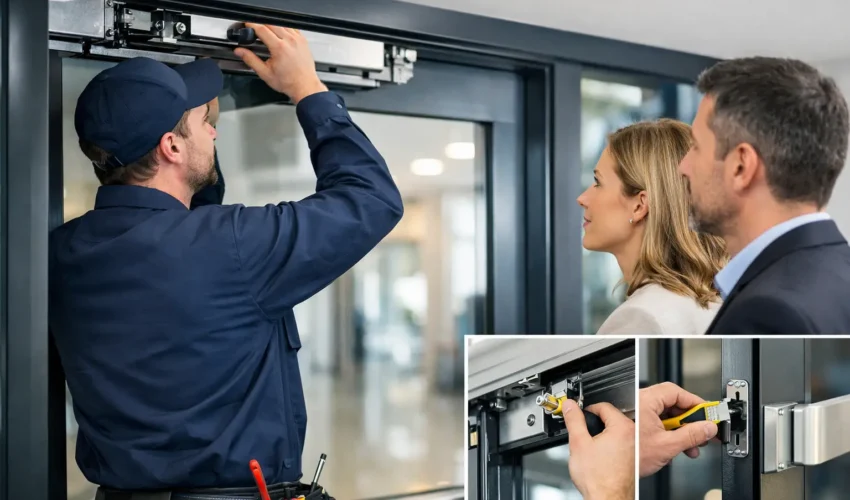
A fire exit that sticks during a routine check, an automatic entrance door that closes too quickly, or a roller shutter with worn safety edges can turn into more than a repair issue. For many businesses, it becomes a compliance problem. That is exactly how regular door servicing helps businesses stay compliant – by identifying faults early, keeping safety features working properly, and creating a clear maintenance record when standards need to be demonstrated.
For facilities managers, warehouse operators, retailers and property owners, compliance is rarely about one single rule. It usually sits across health and safety duties, fire safety responsibilities, accessibility requirements, workplace regulations and insurer expectations. Doors are part of that picture because they affect how people enter, exit, secure and use a building every day.
Why door compliance is often overlooked
Doors tend to be taken for granted until they fail. If a shutter still opens and a pedestrian door still closes, it is easy to assume everything is fine. The problem is that many compliance issues start long before complete failure. Sensors drift out of alignment, closing speeds change, hinges wear, emergency release mechanisms stiffen up and damage from repeated impact starts to affect safe operation.
In commercial and industrial settings, that matters because doors are not just passive building features. They are working systems. Automatic doors rely on sensors, controls and safety devices. Roller shutters and high-speed doors depend on motors, brakes, limit settings and protective components. Fire doors need to close correctly, seal correctly and remain fit for purpose. If any of that slips, the legal and operational risk grows quietly in the background.
How regular door servicing helps businesses stay compliant in practice
Regular servicing gives businesses a planned way to check whether door systems are still operating as intended. That sounds straightforward, but it has real value because compliance often comes down to evidence as much as condition. If an inspector, insurer, landlord or health and safety assessor asks what checks are in place, a business needs more than a vague assurance that the door “seems fine”.
A proper service visit helps establish three things. First, whether the door is safe to use. Second, whether wear, damage or faulty settings are pushing it outside acceptable operation. Third, whether there is a service record showing that the business is taking reasonable steps to maintain critical access and safety equipment.
That record matters. In many cases, businesses are expected to show that equipment affecting safety is maintained in an efficient state and in good working order. The exact obligations depend on the premises, the type of door and how the building is used, but planned servicing supports that duty in a practical way.
Automatic doors and accessibility duties
Automatic sliding and swing doors often sit at the front of the customer experience. They also carry obvious compliance implications. If sensors fail to detect movement properly, if opening widths are restricted, or if the door closes too aggressively, there may be a safety issue and an accessibility issue at the same time.
Regular servicing helps keep these systems within safe operating parameters. Engineers can test sensor response, opening and closing cycles, safety presence detection, activation devices and emergency breakout functions where fitted. They can also pick up signs of wear that may not have stopped the door yet, but could soon lead to unsafe performance.
For medical centres, retail units, offices and public-facing premises, that is particularly important. A door that works inconsistently can create access problems for wheelchair users, older visitors, parents with prams and anyone moving through the entrance at a slower pace. Compliance is not only about avoiding enforcement. It is also about making sure the building can be used safely and fairly.
Roller shutters, security shutters and workplace safety
Industrial roller shutters and security shutters do a lot of hard work. They protect stock, secure openings and support day-to-day operations in warehouses, shops and service yards. But heavy moving doors bring obvious hazards if they are poorly maintained.
A service inspection can cover curtain condition, guides, motors, controls, safety brakes, bottom rails, edge protection and manual override functions. It can also highlight misuse, impact damage or wear caused by high traffic volumes. In a busy loading area, those issues build up quickly.
From a compliance point of view, the main risk is allowing a powered door to continue operating when safety features are reduced or unreliable. If staff work around that door every day, the business may be exposed not just to breakdown costs but to avoidable health and safety failings. Planned servicing reduces that risk because faults are identified before they become normalised.
Fire doors and emergency escape routes
Few compliance issues are taken more seriously than compromised fire safety. While not every commercial door is a fire door, any door on an escape route or with a fire-resisting role needs attention. A fire door that has been altered, damaged or allowed to fall out of adjustment may no longer do the job it was designed for.
Servicing and inspection help spot common problems such as damaged seals, failed self-closers, poor alignment, gaps outside tolerance, hardware wear or obstruction caused by poor use. In occupied buildings, these defects are often gradual. Staff get used to a door being wedged open, dragging on the floor or failing to latch properly.
That is where routine checks are useful. They bring a fresh, technical view and help ensure that emergency escape and compartmentation measures are not being undermined by everyday wear and tear.
Compliance is also about documentation
One of the biggest mistakes businesses make is assuming that carrying out repairs only when something breaks is enough. Reactive repair has its place, especially when a door fails unexpectedly, but it does not create the same compliance position as a planned maintenance approach.
If a business can show that doors are serviced at sensible intervals, defects are recorded, recommendations are acted on and urgent faults are dealt with quickly, it is in a much stronger position. That applies during audits, insurance reviews, landlord discussions and incident investigations.
It also helps internally. When maintenance records are clear, decision-makers can plan ahead rather than firefight. They know which assets are becoming unreliable, which sites need closer attention and where replacement may be more sensible than repeated repair.
The right servicing schedule depends on the site
There is no single service interval that suits every premises. A high-speed door in a busy warehouse will usually need more attention than a lightly used shutter on a secondary store. An automatic entrance door at a healthcare site may justify more frequent checks than one in a low-traffic office.
Usage levels, door type, environment and risk profile all matter. Dusty industrial settings, exposed external openings and premises with long operating hours generally put more strain on components. So do sites where doors are regularly impacted by trolleys, cages or forklifts.
That is why a site-specific maintenance plan is usually the sensible route. It balances cost against risk instead of treating every door the same. A good engineer will not recommend servicing simply to fill a calendar. They will look at the actual condition, duty cycle and role of each system.
What businesses gain beyond compliance
The compliance benefit is strong, but it is not the only reason to keep door systems properly serviced. Regular maintenance usually means fewer emergency callouts, less disruption to trading and better lifespan from the equipment you already have.
For a retailer, that could mean keeping the shop secure overnight without unexpected shutter failure. For a warehouse, it could mean avoiding loading delays because a door has stopped mid-cycle. For a medical or office setting, it could mean keeping entrance doors safe, presentable and reliable for staff and visitors.
There is also a financial point that is often missed. Minor adjustments and part replacements carried out at the right time are usually less expensive than major failures caused by neglect. Compliance and cost control are not separate issues here. In many cases, they support each other.
When a repair is not enough
Sometimes a business services a door regularly and still reaches the point where replacement is the better option. That is not a failure of maintenance. It is simply part of managing assets properly.
Older systems may no longer be economical to repair, or they may lack safety features expected on newer equipment. In those cases, regular servicing still helps because it gives businesses a clearer basis for decision-making. Instead of being forced into a rushed emergency replacement, they can plan the work with less disruption.
For businesses across Lanarkshire, Glasgow and surrounding areas, that local, engineer-led support makes a real difference. Fast response matters when a door is down, but knowledgeable servicing matters just as much when the aim is to prevent the fault from affecting safety, access or compliance in the first place.
If your doors are part of how people work, enter, exit or secure the building, they are part of your compliance picture too. A regular servicing plan keeps that responsibility manageable, visible and far less likely to turn into an urgent problem at the worst possible time.