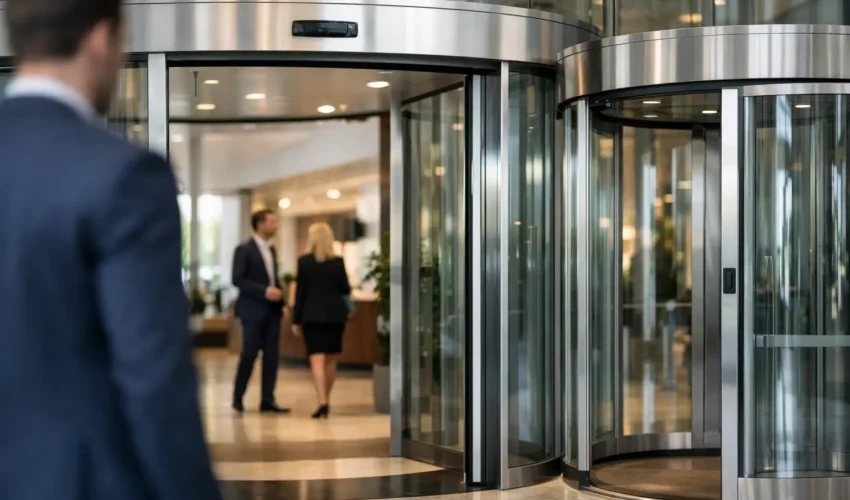
A sticking entrance door at 8.30 on a wet Monday morning causes more than irritation. It slows footfall, frustrates visitors, creates access issues, and can leave staff trying to manage a building entrance by hand when they should be getting on with the day. That is why choosing the best automatic entrance systems is less about appearances and more about keeping your premises safe, accessible and operating properly.
For most commercial sites, there is no single best option in the abstract. The right system depends on traffic levels, available space, the type of users entering the building, security requirements, and how much downtime your operation can tolerate if a fault develops. A retail frontage in a busy town centre needs something different from a medical practice, and both have different demands from a warehouse office or industrial unit.
What makes the best automatic entrance systems?
The best automatic entrance systems do three jobs well. They provide reliable access, they suit the way the building is actually used, and they remain serviceable over the long term. A door that looks right on paper but struggles with daily traffic, poor weather exposure or awkward opening widths will become a problem quickly.
Reliability matters first. Automatic entrances are used constantly, often without anyone thinking about them until they stop working. Sensors, operators, safety devices and control panels all need to work together consistently. If one part begins to fail, you can end up with slow operation, false triggering, partial opening or a complete shutdown.
Safety and compliance matter just as much. These systems are part of your building’s public-facing operation. If customers, staff, patients or deliveries are moving through that entrance every day, the door must open and close in a controlled way, with the right safety measures in place. That includes protecting pedestrians, supporting accessibility, and making sure the installation is suitable for its environment.
The final piece is support. Even a well-specified automatic entrance system will eventually need adjustment, servicing or repair. For many businesses, the real value is not only in the product itself but in having engineers available to maintain it properly and respond quickly if something goes wrong.
Best automatic entrance systems by building type
Automatic sliding doors
Sliding doors are often the first choice for high-traffic public entrances. They work especially well for retail units, healthcare settings, offices, and customer-facing commercial premises where people need straightforward access with minimal physical effort.
Their main advantage is flow. Because the doors slide clear rather than swinging in or out, they make good use of the opening width and avoid conflicts with internal layouts, external pavements or waiting areas. They are also well suited to wheelchair users, people with pushchairs, and sites where visitors may be carrying goods.
That said, sliding doors are not always the answer. They require the right structural space for the leaves and operator, and lower-cost systems can struggle if the traffic level is heavy or the door is poorly maintained. On exposed sites, wind loading and sensor setup also need proper attention.
Automatic swing doors
Automatic swing doors are a strong option when you need automation but the opening is better suited to a hinged arrangement. These are common in offices, care environments, schools, internal corridors, and lower to medium traffic commercial entrances.
They can be a sensible choice where retrofitting a sliding system would be too intrusive or too costly. In some cases, a swing operator added to an existing suitable door set can improve access without requiring a full redesign of the entrance.
The trade-off is space. Swing doors need a safe arc of movement, and that has to be considered carefully where foot traffic is tight or where people may pause near the entrance. Sensor coverage, guarding and control setup are important here.
Telescopic and bi-parting systems
Where the opening is limited but traffic demands are still high, telescopic or bi-parting sliding arrangements can offer a practical answer. These are often used in busy entrances where every bit of clear opening width matters.
They are more specialised than a standard single-slide arrangement, but in the right setting they can improve throughput and accessibility without major structural alterations. This tends to be a specification-led choice rather than a standard one, and it benefits from a proper site survey rather than guesswork.
Hermetic and specialist healthcare entrances
In medical centres, clinics and controlled environments, the entrance system may have to do more than open automatically. It may need better sealing, controlled access, reduced air transfer or compatibility with hygiene-focused environments.
These installations are not suitable for every building, but in healthcare and certain clean environments they can be the right long-term fit. Here, the detail matters. Operator quality, door leaf construction and safety setup all need to match the practical use of the space.
How to choose the right system for your site
The best approach starts with how the building works on an ordinary day, not on a specification sheet. Think about who uses the entrance, how often they use it, and what happens if the door is unavailable for even a short period.
A shop or supermarket entrance may prioritise steady traffic flow, visibility and ease of access. An office may need a quieter, more controlled entrance with integration into access control. A warehouse office or trade counter may need an entrance that handles frequent movement while still offering security outside operating hours.
Accessibility should never be treated as an afterthought. If members of the public, staff or visitors need step-free and low-effort entry, the system must support that consistently. That means appropriate opening width, reliable activation, safe closing forces and a layout that does not create pinch points or confusion.
Security also deserves honest discussion. Automatic entrance systems improve convenience, but convenience alone is not enough for every site. Some premises need timed locking, controlled access, integration with shutters or out-of-hours security measures. The best setup often combines easy daytime access with stronger protection when the building is closed.
Installation quality matters as much as the door itself
A good product installed badly will still give you trouble. Poor alignment, rushed sensor positioning, weak cable routing or inadequate commissioning can all lead to faults that appear early and keep returning.
That is why engineer-led surveys matter. A proper site visit should look at traffic patterns, floor levels, available headroom, structural fixing points, power supply, user safety and future maintenance access. It should also consider whether the proposed system can be repaired efficiently if a component fails later on.
For businesses across Lanarkshire and Glasgow, this practical side of the job often matters more than brochure features. Premises managers usually want the same thing: a system that opens when it should, closes safely, and does not become a regular source of callouts.
Maintenance is part of choosing the best system
The best automatic entrance systems are not simply the newest or most expensive. They are the ones you can keep in dependable working order. That means planned maintenance should be considered at the buying stage, not once a fault appears.
Regular servicing helps catch wear in rollers, operators, sensors, guides and safety devices before a breakdown affects trading or access. It also gives you a clearer picture of parts likely to need replacement, which can reduce disruption and avoid emergency closures.
This is particularly important on busy sites. A lightly used office entrance may tolerate minor wear for a while. A retail or healthcare entrance usually will not. High-cycle doors need closer attention because even small issues can escalate quickly under constant use.
If your business cannot afford extended downtime, ask a simple question before installation: how quickly can the system be repaired, and who is responsible when it goes wrong? That answer often separates a sensible investment from an expensive inconvenience.
Common mistakes businesses make
One common mistake is choosing solely on price. Budget matters, of course, but a cheaper entrance can become more expensive if it needs frequent repairs, causes accessibility complaints, or fails under the actual traffic level.
Another is underestimating usage. It is easy to specify for average conditions and overlook peak periods, deliveries, bad weather or seasonal footfall. Doors should be chosen for real working conditions, not ideal ones.
The third is treating maintenance as optional. Automatic entrances are active mechanical systems, not passive building features. If they are ignored until failure, repair costs and disruption tend to rise together.
A practical way to decide
If you are comparing options, start with three questions. How many people use the entrance each day? What are the access and safety requirements? How serious is downtime for your business?
From there, the decision usually becomes clearer. High-footfall public buildings often suit automatic sliding doors. Smaller or retrofit applications may be better with swing automation. More specialised sites may need tailored solutions that account for hygiene, control or structural limitations.
For many businesses, the smartest route is a site survey carried out by engineers who also handle repairs and maintenance. That keeps the advice practical. It also means the person specifying the entrance understands what tends to fail, what lasts well, and what will make life easier for the customer six months after installation.
If you are weighing up the best automatic entrance systems for your premises, think beyond the first fitting. Choose the system that matches your building, your traffic and your day-to-day pressures, then make sure it is backed by support you can rely on when the door is no longer just a door, but a point of access your business depends on.