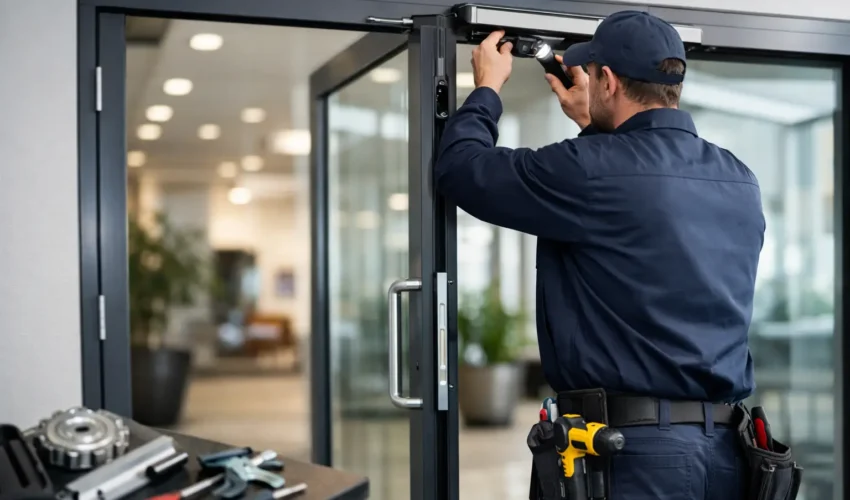
A door that sticks for ten seconds at a busy loading bay can throw off an entire shift. A shutter that refuses to close at the end of the day creates a security problem straight away. That is why commercial door service intervals matter – not as a paperwork exercise, but as a practical way to keep access, safety and trading moving.
For most commercial and industrial sites, there is no single interval that suits every door. Usage, environment, door type and risk level all affect how often a system should be inspected and serviced. A lightly used personnel entrance in a small office does not need the same attention as a high-speed door in a warehouse or an automatic entrance at a medical centre with constant footfall.
What commercial door service intervals actually mean
When people ask about commercial door service intervals, they are usually asking two things at once. First, how often should the door be serviced? Second, how often should it be checked for signs of wear, damage or unsafe operation?
A proper service interval is the planned gap between maintenance visits carried out by qualified engineers. During those visits, the door is inspected, adjusted, tested and, where needed, fitted with replacement parts before a minor issue turns into a breakdown. That is different from reactive repair work, where someone only attends once the door has already failed.
The benefit of planned intervals is straightforward. They reduce unplanned downtime, help keep users safe and usually lower the long-term cost of ownership. Emergency callouts still have their place, but no site wants to rely on them as the main maintenance strategy.
Why there is no one-size-fits-all schedule
The right schedule depends on how hard the door works and what happens if it fails. A roller shutter at a trade counter may cycle up and down all day. An automatic sliding entrance at a retail unit may face steady public use, wind exposure and accidental knocks from trolleys. A fire exit door may not move often, but if it is not operating correctly when needed, the consequences are serious.
Environment plays a part as well. Dust, moisture, temperature changes and coastal air can all speed up wear on tracks, seals, motors, controls and safety devices. In industrial settings, doors are often exposed to forklifts, pallet traffic and demanding opening cycles. In public-facing premises, sensors and safety features need consistent checking because the users change constantly.
That is why a sensible maintenance plan starts with the site itself, not with a generic figure copied from elsewhere.
Typical commercial door service intervals by door type
As a working guide, many commercial doors benefit from servicing at least once or twice a year. Higher-use or safety-critical systems may need more frequent attention.
Roller shutter and industrial doors
Industrial roller shutters, sectional doors and security shutters often suit a six-monthly service interval on busy sites. On lower-use premises, annual servicing may be enough, provided the door is in good condition and not part of a high-risk operation. If the door is used multiple times each day, serves a loading area or protects valuable stock, six-monthly is usually the safer and more economical option.
Automatic sliding and swing doors
Automatic doors generally need closer attention because they combine moving parts, controls and user safety systems. In many settings, six-monthly servicing is a sensible baseline. In healthcare, retail or public buildings with high footfall, more frequent inspections may be appropriate depending on usage and manufacturer guidance.
High-speed doors
High-speed doors work hard by design. On warehouses, food production areas and logistics sites, they can cycle repeatedly throughout the day. Quarterly or six-monthly servicing is often more realistic than annual visits for these systems, especially where downtime affects workflow, temperature control or hygiene routines.
Loading bay and docking equipment
Dock levellers, shelters and related access equipment should be treated as operationally critical. If a loading bay system fails, goods movement stops. Because these systems also involve safety risks for staff and vehicles, intervals should be based on intensity of use and the operating environment, with many sites benefiting from at least six-monthly planned maintenance.
Signs your current interval is too long
A door does not have to fail completely before it tells you the servicing gap is too wide. Slower opening speeds, unusual noises, jerky movement, misalignment, damaged seals and intermittent sensor faults are all early warnings. So are doors that need regular resets, repeated small adjustments or more callouts between planned visits.
If the same entrance keeps causing disruption, the answer is not always a bigger repair. Sometimes the schedule itself is the problem. A site using a door far more heavily than it did two years ago may simply need a shorter interval.
This is common in growing businesses. A unit that once opened a few times a day can become a busy dispatch point after an operational change. The maintenance plan needs to move with that reality.
Compliance, safety and duty of care
Service intervals are not only about convenience. They also support compliance and duty of care. Employers, property managers and facilities teams are responsible for keeping equipment safe for staff, visitors and contractors. If a powered or automatic door is poorly maintained and causes injury, the consequences go beyond repair cost.
The exact inspection regime may depend on the door type, its location and any manufacturer recommendations, but the principle is simple. If people rely on that door for access, security or safe movement, there should be a clear maintenance record and a defensible servicing schedule behind it.
That is especially relevant for automatic entrances, communal access points and industrial doors used around vehicles or handling equipment. A planned approach gives you documented checks, engineer observations and a chance to deal with wear before it becomes a safety issue.
Planned maintenance versus reactive repairs
Some businesses try to save money by postponing servicing and dealing with faults only when they appear. On paper, that can seem efficient. In practice, it often costs more.
Reactive repairs usually happen at the worst moment – when the building is opening, when deliveries are due or when the premises need securing. There is also the wider cost of delay: lost trading time, staff standing idle, security exposure, or visitors unable to enter safely.
Planned maintenance spreads cost more predictably and tends to reduce major failures. It also gives engineers the chance to spot worn components, adjust settings and recommend replacements during a controlled visit rather than an urgent callout. For most busy premises, that is the more sensible operational choice.
How to set the right service interval for your site
The best starting point is a survey by an engineer who understands commercial and industrial door systems, not just one product line. They can look at usage levels, door age, operating environment, previous faults and the consequence of failure.
A practical maintenance plan should answer a few basic questions. How many cycles does the door complete in a day or week? Is it exposed to harsh conditions? Is it public-facing? Would failure stop trade, deliveries or secure closing? Is the system already showing recurring faults?
Once those points are clear, an interval can be set that matches the real demand on the door. For one site, annual servicing may be reasonable. For another, six-monthly or quarterly visits may be the only sensible option. It depends on risk, usage and the cost of downtime.
For businesses across Lanarkshire and Glasgow, that local engineer input matters. Fast attendance is useful, but so is having someone who can assess the door properly, recommend a realistic schedule and support it with repairs when needed. That is where an engineer-led service approach from a specialist such as Door Systems Scotland tends to make the difference.
Commercial door service intervals should change over time
A maintenance plan should not be fixed forever. Doors age, workloads change and parts wear differently depending on use. A service interval that was right when the system was installed may no longer be right three years later.
Reviewing the pattern of faults is often the clearest guide. If a door has gone two years with no issues and relatively low usage, the interval may be adequate. If breakdowns are creeping in between visits, or if usage has increased sharply, the schedule should be tightened before reliability drops further.
Good maintenance is not about over-servicing equipment. It is about servicing it often enough to keep the site safe, secure and operational without paying for unnecessary visits.
The sensible question is not, how rarely can this door be serviced? It is, what interval gives this entrance the best chance of staying dependable when the building needs it most?