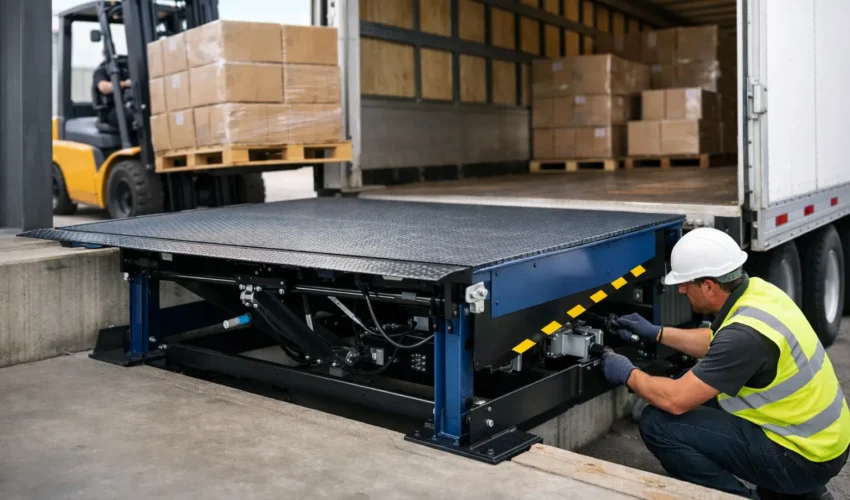
A loading bay usually only gets attention when something slows the yard down. A trailer sits too high, a forklift operator has to work around a poor bridge angle, or water starts getting into the pit and creating a maintenance issue. That is where proper dock leveller installation matters. Done well, it supports safer loading, smoother vehicle turnaround and fewer avoidable problems for warehouse and industrial sites.
For facilities managers and site operators, the leveller is not just another piece of equipment. It is part of the working connection between your building and the vehicles using it every day. If that connection is wrong, the effects show up quickly in productivity, safety and repair costs.
Why dock leveller installation needs proper planning
A dock leveller has to do more than fill a gap. It needs to suit the vehicle types visiting the site, the traffic levels on the bay, the load weights being handled and the surrounding dock arrangement. A unit that works well for a low-frequency loading point may not be suitable for a busy distribution operation with constant forklift movements.
This is why installation starts with the opening, the approach and the building itself rather than just the product catalogue. Pit dimensions, finished floor levels, bumper positions, vehicle restraint requirements and drainage all affect the final specification. On older sites in particular, there can be discrepancies between drawings and the actual structure on site. If these are not identified early, they can cause delays during fitting or lead to compromises that should have been avoided.
A good survey also looks at how the bay is used in real terms. Some premises mainly receive rigid vehicles. Others deal with mixed fleets, including double-deck trailers or varied bed heights. The right answer depends on those day-to-day realities, not just on what appears to be a standard opening.
Choosing the right type of dock leveller
The most common options are swing lip and telescopic lip levellers, typically operated hydraulically. Both can perform well when they are matched to the application.
A swing lip leveller is often a practical choice where vehicle positioning is predictable and loading patterns are relatively straightforward. It can offer reliable performance and good value. A telescopic lip leveller gives more reach and more precise contact with the trailer bed, which can be useful where vehicle variation is greater or where operational control is more demanding.
There is also the question of capacity. It is not simply about the weight of goods being moved, but the combined effect of the load, the handling equipment and the frequency of use. A bay handling pallet trucks now may need to accommodate forklifts later. Specifying too tightly can save money upfront but create limitations or wear issues later on.
For some sites, the leveller should be considered alongside the wider docking system, including dock shelters, dock seals, traffic lights and vehicle restraints. Looking at these elements together usually leads to a safer and more efficient result than treating each item as a separate job.
What happens during dock leveller installation
The exact sequence depends on whether the bay is part of a new build, a refurbishment or a like-for-like replacement. In a new build, the leveller can be coordinated with the builder and steelwork package from the start. That usually gives the cleanest result because the pit, frame and surrounding structure are prepared correctly before the unit arrives.
On an existing site, the job can be more involved. The old leveller may need to be removed, the pit repaired or adjusted, and the bay checked for signs of corrosion, cracked concrete or poor water management. If the surrounding structure has deteriorated, fitting a new leveller without addressing that issue simply stores up future trouble.
Once the opening is confirmed and the correct equipment is on site, the leveller is positioned, fixed and connected. Hydraulic and electrical components are installed where required, then the unit is tested through its full operating range. That includes checking lip projection, platform travel, resting position and safe operation under working conditions.
Commissioning is a key part of the process. Operators need to know how to use the leveller properly, what daily checks to carry out and what signs suggest the unit should be inspected. Even a well-installed system can be damaged by misuse, especially on busy sites where staff changes are frequent.
Common issues that affect installation
The most straightforward dock leveller installation can still be delayed if basic site conditions are not right. Uneven pit construction, inaccurate dimensions, restricted access for lifting equipment and unplanned electrical work are all common examples.
Drainage is another one that gets missed. If water is allowed to collect in the pit, corrosion and reliability issues usually follow. That may not be visible on day one, but it becomes expensive over time. The same applies to poor bay alignment. If vehicles are consistently docking off-centre or striking the bumpers badly, the leveller and surrounding equipment will take unnecessary punishment.
There is also the matter of downtime. Some businesses can take a bay out of use for a planned installation without much disruption. Others operate on tight schedules and need works phased carefully to keep goods moving. In those cases, planning is not just about engineering. It is about keeping the operation running while the work is carried out safely.
Safety, compliance and long-term reliability
A dock leveller sits in a high-risk area where moving vehicles, forklifts and pedestrian activity can overlap. Installation therefore needs to be approached as a safety-critical task, not just a fit-out exercise.
The leveller has to be installed in line with the manufacturer’s guidance and current standards, with the surrounding bay arranged to support safe use. That includes suitable edge protection where needed, correct signage, proper controls and clear understanding of safe operating procedures.
Maintenance should be considered from the beginning. Access to service points, the condition of hydraulic lines, the quality of welds and fixings, and the way the unit sits within the pit all affect long-term reliability. A cheaper installation that cuts corners on setup or finishing can become the more expensive option once breakdowns and call-outs start to build up.
For busy sites, planned maintenance makes a real difference. Regular servicing helps identify wear before it turns into operational downtime. It also supports compliance and gives site managers a clearer picture of asset condition across the loading bay.
How to judge value, not just cost
Cost always matters, but the lowest quote is not always the best decision. Dock leveller installation should be judged on suitability, workmanship and aftercare as much as on headline price.
A properly specified leveller that is installed by experienced engineers should deliver consistent operation for years, provided it is maintained correctly. A poor fit, wrong capacity or rushed installation can lead to repeated defects, safety concerns and avoidable interruptions to loading.
It also helps to ask what is included. Is the quote based on a full survey? Does it allow for remedial work if the pit or bay structure is not in good condition? Will operators receive a handover? Is there servicing and repair support available afterwards? These are practical questions, especially for sites where every hour of downtime affects deliveries, dispatches or customer access.
For businesses across Lanarkshire and Glasgow, local engineering support can be a genuine advantage. If a bay fault develops after installation, fast response matters. Door Systems Scotland works with commercial and industrial customers who need that mix of sound specification, dependable fitting and ongoing support when equipment is under pressure.
When replacement makes more sense than repair
Not every ageing leveller needs replaced immediately, but there is a point where repeated repairs stop being good value. Structural cracking, ongoing hydraulic faults, obsolete parts or a unit that no longer suits current vehicle profiles can all make replacement the better option.
This is especially true when the loading bay has changed over time. A site that once handled occasional deliveries may now be operating as a busier distribution point. If the leveller was never designed for that level of use, repairs may only be dealing with the symptoms.
A survey can usually confirm whether refurbishment is realistic or whether a fresh installation would give better performance and lower risk. That decision should be based on condition, usage and future plans, not just on the age of the equipment.
The right dock leveller installation should leave you with a bay that works properly under real operating conditions, not just one that looks new on handover day. When the survey is thorough, the specification is right and the fitting is carried out properly, loading becomes safer, faster and far less likely to cause unwanted disruption.