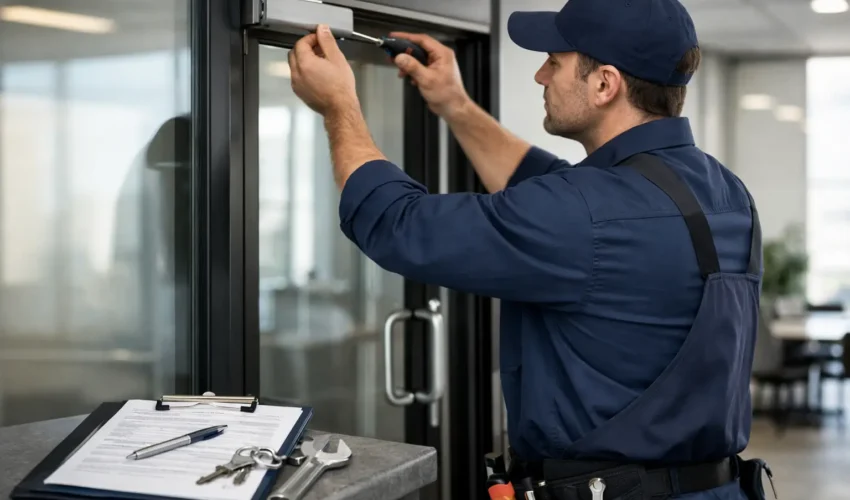
A shutter that sticks at 7am, an automatic entrance that stops mid-cycle, or a loading bay door that will not close properly can disrupt trading before the day has properly started. That is why commercial door maintenance contracts matter for busy premises. They give businesses a planned way to keep critical access points safe, compliant and working when they are needed most.
For many sites, doors are easy to overlook until something fails. In practice, they are part of day-to-day operations. A warehouse depends on roller shutters and dock doors to keep goods moving. A retail unit needs secure shutters and reliable customer access. A medical centre cannot afford an automatic entrance that becomes unsafe or unreliable. When a door system is doing its job, nobody thinks about it. When it is not, the problem becomes urgent very quickly.
Why commercial door maintenance contracts make sense
A maintenance contract is not simply a promise to attend when something goes wrong. The real value is in planned servicing. Regular inspections help identify wear in motors, springs, control panels, safety edges, tracks, sensors and locks before faults become breakdowns. That helps reduce emergency callouts, but it also helps prevent those smaller issues that quietly slow a site down.
There is also a cost argument. Reactive repairs alone often look cheaper on paper until failures start happening at inconvenient times. An out-of-hours attendance, temporary security measures, lost trade or delayed dispatches can quickly outweigh the cost of routine servicing. Planned maintenance gives a business a clearer picture of expected upkeep and can extend the working life of the door itself.
For sites with several door types, contracts are even more useful. A single premises may have automatic pedestrian doors at the entrance, a roller shutter at the rear, fire exit hardware, and a high-speed door in a production area. Each has different moving parts, different risks and different servicing needs. Managing that properly is easier when there is a structured plan rather than a series of separate fixes.
What a good commercial door maintenance contract should include
Not every contract offers the same level of support, so it is worth looking beyond the headline price. A worthwhile agreement should set out what is being maintained, how often engineers will attend, and what checks are included during each visit. If those points are vague, the contract may not deliver much value.
For most commercial and industrial sites, scheduled servicing should include inspection, adjustment, lubrication where required, testing of safety devices, and identification of worn or damaged parts. Doors that rely on photocells, pressure sensors, induction loops or emergency stop systems should be tested properly rather than given a quick visual check. The same applies to shutters and loading systems where safe operation matters just as much as security.
Response arrangements are also important. Planned maintenance reduces failures, but it does not eliminate them. If a door is struck by a vehicle, damaged during heavy use, or affected by an electrical fault, response time matters. A contract should make clear whether emergency callout support is included, prioritised or billed separately. For many businesses, especially those operating early starts, late finishes or shift patterns, this point matters as much as the servicing itself.
A strong provider will also keep service records and flag recommendations clearly. That helps facilities managers and property teams plan ahead instead of being hit with unexpected major repairs.
Which businesses benefit most
Almost any premises with powered or high-use doors can benefit from a maintenance contract, but the priority tends to be highest where downtime has direct operational consequences. Warehouses, distribution sites and manufacturing units are obvious examples because door failures can hold up vehicles, stock movement and staffing. Retail premises and shopfronts also benefit because a faulty shutter or entrance door can affect both security and customer access.
Medical centres, care settings and public-facing buildings often have another concern – safety and accessibility. Automatic swing and sliding doors need to open reliably and operate within safe tolerances. In those environments, maintenance is not just about convenience. It supports a building that people can use confidently.
Multi-site property managers can also gain a lot from a planned arrangement. Instead of waiting for occupiers to report faults after the fact, they can manage asset condition more consistently across a portfolio.
The trade-off between basic and comprehensive cover
This is where it depends on the site. Some businesses only need a straightforward planned servicing schedule with repairs quoted separately as needed. That can work well for lower-use doors or sites with a tight maintenance budget. The benefit is lower fixed cost, but the trade-off is less certainty when a fault appears.
A more comprehensive contract may include priority response, reduced callout charges or agreed labour terms. That usually suits higher-risk operations where the cost of a failed door is far greater than the extra contract spend. If one non-operational shutter stops a dispatch bay, or an entrance failure affects customer flow, quicker support has a clear value.
The right level of cover depends on door type, traffic levels, security requirements and hours of operation. A busy industrial unit in Lanarkshire will not assess risk in the same way as a small office with one automatic entrance. The best approach is a site-led one, based on how the doors are actually used rather than a generic package.
Choosing the right contractor for commercial door maintenance contracts
Technical capability matters, but so does practical service. A contractor should understand the specific door systems on site and be able to inspect, service and repair them properly. That is especially important when premises have a mix of manufacturers, controls and safety features.
Local response is another factor that is often underestimated. When a business needs help quickly, it helps to work with a company that knows the area, can attend promptly and is used to supporting commercial sites across the region. Engineer-led surveys are useful here because they produce recommendations grounded in real site conditions rather than assumptions from a desk.
It is also worth looking at how the contractor communicates. Clear reports, realistic advice and straightforward quotations save time. If every minor issue is presented as an urgent replacement, trust starts to disappear. Good maintenance support should be honest about what needs immediate action, what can be monitored, and when replacement becomes the sensible option.
For businesses across Glasgow, Lanarkshire and surrounding areas, that balance of responsiveness and sound engineering is often what separates a useful maintenance partner from a name on a callout list.
Common problems a contract can help prevent
Most breakdowns do not arrive without warning. A roller shutter may start making more noise than usual. An automatic door may hesitate before opening. A high-speed door may track unevenly or suffer repeated sensor faults. These signs are easy to ignore when the door still functions, but they often point to components drifting out of adjustment or nearing failure.
Routine servicing helps catch those changes early. It can also reduce the wear that comes from poor alignment, damaged tracks, loose fixings or neglected moving parts. Not every issue is preventable, particularly where impact damage is involved, but many expensive failures start as manageable faults.
There is also the question of security. A door that does not close fully, lock correctly or respond properly to controls can leave a site vulnerable. In many premises, access control and physical security are closely tied to the condition of the door system itself.
When to review your current arrangement
If your site only calls for help after a failure, that is usually the first sign your maintenance approach is too reactive. The same applies if the same door needs repeated repairs, if engineers arrive without clear records of previous work, or if servicing visits feel more like a box-ticking exercise than a proper inspection.
A review is also sensible after changes in building use. If traffic has increased, operating hours have extended, or a premises has added new door systems, the original service level may no longer fit. What worked for a light-use unit may be inadequate for a busier operation.
A good contractor should be willing to assess the site, explain the risks plainly and recommend a level of cover that matches the building rather than overselling a package.
Planned maintenance will not stop every fault, and no contract removes the need for repairs altogether. What it does do is give you more control over safety, compliance, cost and disruption. When your doors are part of how your business trades, secures stock or keeps people moving, that control is worth having. If your current setup only gets attention when something jams, sticks or fails, it may be time to put a proper plan in place before the next breakdown chooses the timing for you.