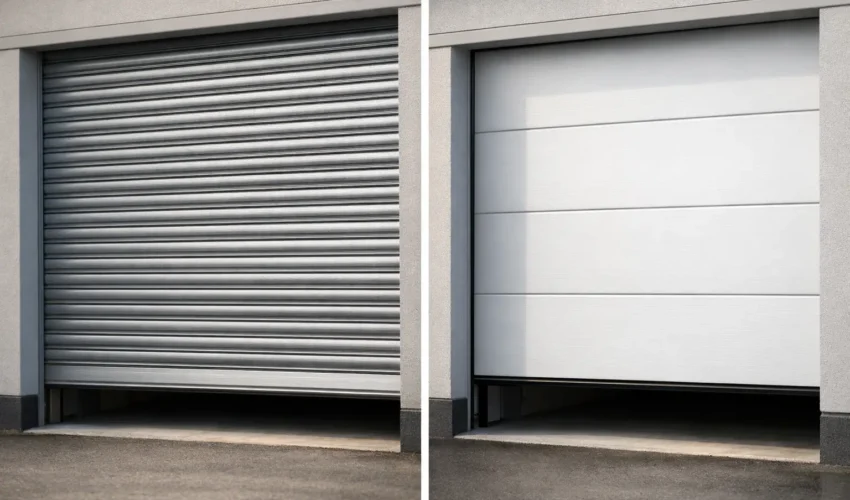
A loading-bay door that jams at 7am, leaks heat through winter or leaves stock exposed overnight is not a minor building issue. It can stop deliveries, delay staff and create a security risk straight away. When weighing up roller shutters vs sectional doors, the right choice comes down to how your premises operate, not simply which door has the lower initial price.
Both systems are proven options for commercial and industrial properties. Both can be automated, specified for frequent use and maintained to provide dependable service. Their design, however, affects security, insulation, available headroom, maintenance needs and the way vehicles and people move through the building.
Roller shutters vs sectional doors: the key difference
A roller shutter is made from interlocking steel or aluminium laths that travel vertically and coil around a barrel above the opening. This makes it a compact, familiar choice for shopfronts, service yards, warehouses and industrial units where the door needs to close securely outside or within an opening.
A sectional door is formed from horizontal insulated panels. The panels travel up on tracks, usually following the underside of the roof once the door is open. Rather than rolling into a coil, the door is stored beneath the ceiling or arranged on a high-lift track configuration.
That difference changes the practical conversation. Roller shutters generally suit applications that prioritise a strong physical barrier and limited internal space. Sectional doors are often preferred where thermal performance, weather sealing and a more controlled loading environment matter most.
When roller shutters are the better fit
Roller shutters remain a sensible choice for many Scottish commercial premises because they are straightforward, space-efficient and well suited to demanding security applications. A steel roller shutter can provide a substantial deterrent at warehouse entrances, workshops, storage compounds and trade counters, particularly when specified with suitable guides, locking and controls.
Their compact curtain is valuable where there is little room inside the building. A shutter can be positioned behind the opening, on the face of the building or in some cases externally, depending on the structure and required finish. This flexibility helps on older industrial units and retail premises where ceiling layout, services or racking make overhead tracks impractical.
For a shopfront or counter, the shutter may be the natural answer. Perforated or punched laths can retain visibility and ventilation where needed, while solid laths provide greater privacy after closing. Security-rated options are available where insurers or risk assessments call for a higher level of protection.
The trade-off is insulation. Standard roller shutter curtains have more gaps and less insulated material than a purpose-designed sectional door. They can be improved with insulated laths, brush seals and correctly fitted guides, but they will not normally match the thermal performance of a well-specified insulated sectional door. If staff work close to the entrance, or if the premises are heated throughout the day, that difference can affect comfort and energy costs.
Roller shutters also need appropriate headroom for the barrel and curtain coil. Although they do not use ceiling tracks in the same way as sectional doors, the space above the opening must be measured properly. A site survey is essential, especially where lintels, steelwork, lighting or fire services are nearby.
When sectional doors make more sense
Sectional doors are particularly effective at loading bays, distribution centres, vehicle workshops and production areas where keeping out wind, rain and cold air is a priority. Their insulated panels and perimeter seals create a much tighter closure than a conventional single-skin shutter.
That is useful in Scotland, where exposed sites can face persistent rain and strong winds. A better-sealed loading entrance helps protect stored goods, improve conditions for staff and reduce the temperature drop experienced every time the door is closed. For temperature-controlled or quality-sensitive operations, it can be a significant operational benefit rather than a cosmetic upgrade.
Sectional doors are also a good option where a large clear opening is required. With the right track arrangement, the door can lift high enough to keep clear of lorry movements and maximise usable opening height. Windows, pedestrian wicket doors and finishes that match the building can be incorporated where they support day-to-day use.
Their main consideration is internal space. The door panels and tracks need clear room above and behind the opening. Roof trusses, ducting, sprinklers, lighting, cranes and stored stock all need to be reviewed before a door is specified. In a busy warehouse, the tracks must also be protected from impact and kept clear as the door moves.
Initial installation costs may be higher than for a basic roller shutter, particularly where high-lift tracks, dock equipment, glazing or specialised controls are involved. However, for premises with high heating costs or a constant flow of loading activity, the improved insulation and seal can justify the investment over time.
Security, weather protection and daily operation
It is easy to assume a roller shutter is always more secure because it looks heavier. In reality, security depends on the full specification: curtain or panel construction, guides, locking, control access, installation quality and how the opening is protected around the frame.
A properly specified roller shutter is an excellent choice for protecting an external opening outside trading hours. Sectional doors can also provide strong security, particularly insulated steel models, but are usually chosen first for their operational and environmental advantages. If the opening is in a high-risk location, discuss the required security level, access controls and any insurer conditions before ordering either system.
For weather resistance and heat retention, sectional doors usually have the advantage. They close with panel joints and perimeter seals designed to limit draughts and water ingress. Roller shutters can perform well when maintained and correctly installed, but worn bottom seals, damaged guides or misaligned curtains quickly reduce their effectiveness.
Opening speed matters too. A standard powered roller shutter or sectional door may be adequate for occasional deliveries. If a doorway is opened repeatedly during a shift, consider whether a high-speed door, or a secondary internal door, would reduce heat loss and waiting time. The best solution may be a combination of systems rather than one door expected to do every job.
Maintenance and repair considerations
Every powered industrial door should be inspected and serviced at intervals that reflect its usage, environment and risk. A door at a lightly used storage unit has different demands from a loading-bay door completing dozens of cycles each day.
Roller shutters need attention to the curtain, guides, barrel, motor, safety brake and bottom rail. Damage from a forklift, forced operation after a fault, or debris in the guides can lead to a curtain that runs unevenly or will not close securely. Small issues are best addressed early, before they become an emergency call-out or leave the site unsecured.
Sectional doors require checks to panels, hinges, rollers, cables, springs, tracks, motor and safety devices. Springs and cables operate under tension, so repairs should be carried out by competent engineers. A dented panel may appear minor, but it can affect alignment and place extra strain on the operator if it is ignored.
For both door types, controls and safety systems deserve equal attention. Photocells, safety edges, emergency release mechanisms and access controls must work correctly. Planned maintenance creates a record of condition and helps identify parts nearing the end of their service life, allowing repairs to be scheduled around operations rather than during an unexpected closure.
Questions to ask before choosing a door
Start with the opening itself. Measure the width and height, but also look above, behind and to the sides. Note roof obstructions, drainage, wind exposure, vehicle routes, pedestrian traffic and whether the doorway opens directly into a heated workspace.
Then consider what happens at the door over a normal week. Is it mainly a security barrier that opens once in the morning and closes at night? Is it a loading bay used by articulated lorries throughout the day? Does it need glazed panels for visibility, a wicket door for staff access, or integration with access control and fire procedures?
Budget should include more than supply and installation. Consider energy use, likely repairs, servicing, interruption to operations and the availability of local emergency support. The cheapest specification can become expensive if it is poorly suited to the working environment.
Get the specification right at survey stage
A professional survey should lead to a clear recommendation, not a standard door selected from a price list. The engineer should assess the structure, usage pattern, safety requirements and practical constraints before confirming whether a roller shutter or sectional door is the better long-term option.
For businesses across Glasgow, Lanarkshire and the surrounding areas, Door Systems Scotland can survey the opening, explain the available options and provide ongoing repairs and planned maintenance once the door is in service. Choosing the right system is easier when the people specifying it also understand what keeps it operating reliably after installation.
If your current door is unreliable, do not wait for a failed opening to make the decision for you. Arrange a survey while there is time to choose a door that protects the premises, supports the working day and can be maintained without unnecessary disruption.