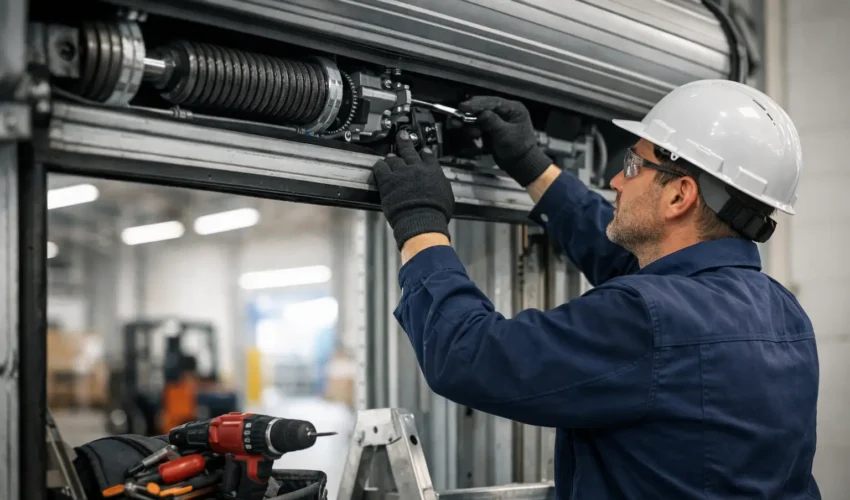
A roller shutter that stops halfway open at 6am can hold up deliveries, leave stock exposed and prevent staff from starting work. A faulty automatic entrance can turn customers away, while a damaged loading-bay door can quickly become a security and safety issue. Industrial door repairs are not simply a maintenance task – they are often the fastest route to getting a site back to normal.
For facilities managers, warehouse operators and business owners, the priority is rarely just getting a door to move again. The repair needs to be safe, reliable and suited to the demands placed on that door every day. That means identifying the actual cause of failure rather than applying a temporary fix that creates another callout a week later.
Industrial Door Repairs: What a Proper Visit Should Cover
An industrial door is a working piece of equipment, often operating many times a day in conditions that are hard on moving parts. Forklift traffic, vibration, poor alignment, weather exposure and accidental impact all take their toll. A competent repair starts with an on-site assessment of the door, its controls and the surrounding structure.
For a roller shutter, an engineer may check the curtain, guides, barrel, springs, motor, safety brake and limit settings. With automatic sliding or swing doors, attention turns to sensors, tracks, belts, operators, activation devices and safety functions. High-speed doors need careful examination of the curtain, wind bars, drive system and control panel, as a small alignment issue can stop rapid cycles altogether.
The best solution depends on the fault and the role of the entrance. A warehouse shutter that cannot close may need an emergency attendance to secure the building first, followed by a fuller repair when parts are available. A door that is still operating but making unusual noise allows more time for diagnosis, although delaying action can turn a replaceable component into a larger mechanical failure.
A thorough visit should leave you clear on three points: what has failed, what is needed to restore safe operation and whether any further work is advisable. This helps premises managers make a practical decision based on risk, cost and operational disruption.
Signs a Door Needs Attention Before It Fails
Doors rarely fail without warning. The difficulty is that early signs are easy to dismiss when the site is busy and the door is still opening and closing. Acting at that stage is usually less disruptive than arranging emergency repairs after a complete breakdown.
Look out for slower movement, jerking during travel, scraping noises, a shutter curtain sitting unevenly in the guides or a door that no longer closes tightly. On powered systems, intermittent controls, unusual motor noise, inconsistent sensor operation and repeated resetting are all reasons to arrange an inspection.
Physical damage should also be taken seriously. A lorry or forklift strike can bend guides, knock a door out of alignment or compromise safety equipment even when the door appears to work. Continuing to operate damaged equipment can put people at risk and may increase the cost of the eventual repair.
For security shutters and external industrial doors, gaps, damaged locks, weakened bottom rails and doors that do not fully close demand prompt attention. A door that leaves a commercial premises vulnerable overnight is not a fault to monitor until the next planned visit.
The First Response When a Door Breaks Down
The correct response depends on whether the issue affects security, safe access or operations. If the door is stuck open, damaged following impact, or unable to secure the premises, stop using it where safe to do so and keep people clear of the opening. Avoid forcing the curtain, panels or operator by hand unless you have been trained in the door’s emergency release procedure.
It is helpful to give the repair engineer a clear description before they arrive. Note the door type, what it was doing when it failed, whether there has been an impact, any error message on the control panel and whether the door is open, closed or partially open. If possible, take photographs of visible damage from a safe distance. This information can help the engineer prepare for the likely fault and identify whether urgent securing work is needed.
Do not allow staff to repeatedly press controls in the hope that the door will reset itself. Repeated operation can worsen a motor, gearbox or control fault. Equally, do not bypass photocells, safety edges or other protective devices simply to keep traffic moving. A short-term workaround is not worthwhile if it creates a serious accident risk.
Why Parts, Diagnosis and Door Type Matter
There is no single repair approach for every industrial entrance. A manually operated shutter and a high-cycle automatic door may show similar symptoms but have very different causes. Age also matters. Older doors can often be repaired successfully, but sourcing obsolete components or correcting multiple worn parts may make replacement the better long-term choice.
For example, a single damaged slat in a shutter curtain may be a straightforward repair. If the curtain is badly distorted, the guides are bent and the motor has been strained, replacing only one part may not restore dependable operation. Similarly, a failed sensor on an automatic door can be a simple component replacement, but recurring sensor faults might point to damaged cabling, poor positioning or a control issue.
Recognised manufacturers and correctly matched components matter because doors are engineered as systems. The wrong spring tension, an unsuitable motor or poorly configured safety device can lead to unreliable movement and unnecessary wear. This is particularly relevant for high-speed doors, docking systems and busy loading areas, where performance and safety are closely linked.
A good engineer will explain the options without pushing replacement where a repair is sensible. At the same time, they should be direct where repeated reactive work is no longer cost-effective. The right decision is the one that protects your operation over the coming months, not merely the next shift.
Planned Maintenance Reduces Emergency Callouts
Industrial door repairs are sometimes unavoidable. Accidental damage, component failure and severe weather can happen without warning. However, planned maintenance significantly reduces failures caused by gradual wear, poor adjustment and neglected safety components.
A servicing programme can be tailored to the door type, usage level and environment. A shutter at a small commercial unit may need a different schedule from a distribution-centre door operating throughout the day. Doors exposed to coastal weather, dust, cold storage conditions or frequent vehicle movements may also need closer attention.
During a planned service, engineers can inspect mechanical wear, test safety systems, check controls and alignment, lubricate appropriate parts, and identify components nearing the end of their service life. The value is not just in keeping a record of work completed. It is in having time to plan repairs around deliveries, trading hours or site shutdowns rather than reacting when access is lost.
Maintenance also gives site teams a useful point of contact. Engineers who understand the doors on your premises can assess a breakdown more quickly and provide informed advice on repair, upgrade or replacement.
Choosing a Repair Partner for Your Site
Speed matters when a door failure affects access or security, but a rapid response should still include proper engineering judgement. Look for a contractor that works with the type of door you have, can support urgent callouts and is willing to inspect the full system rather than treating every fault as a standard part swap.
Local coverage is valuable when timing is critical. For businesses across Glasgow, Lanarkshire and surrounding areas, an engineer who can attend promptly can make the difference between a contained disruption and a full day of lost activity. It is also worth asking about planned servicing after the repair, especially where the same door has failed more than once.
Door Systems Scotland supports commercial and industrial sites with repairs, maintenance and emergency response for shutters, automatic doors, high-speed doors and loading-bay equipment. A site survey and clear quotation allow the work to be matched to the door, the building and the way your team uses it.
A faulty door is easier to manage when the issue is addressed early and by people who understand the equipment. If a door is slowing down, making noise or no longer securing properly, arranging an inspection now can protect the next delivery, the next trading day and the safety of everyone using the entrance.