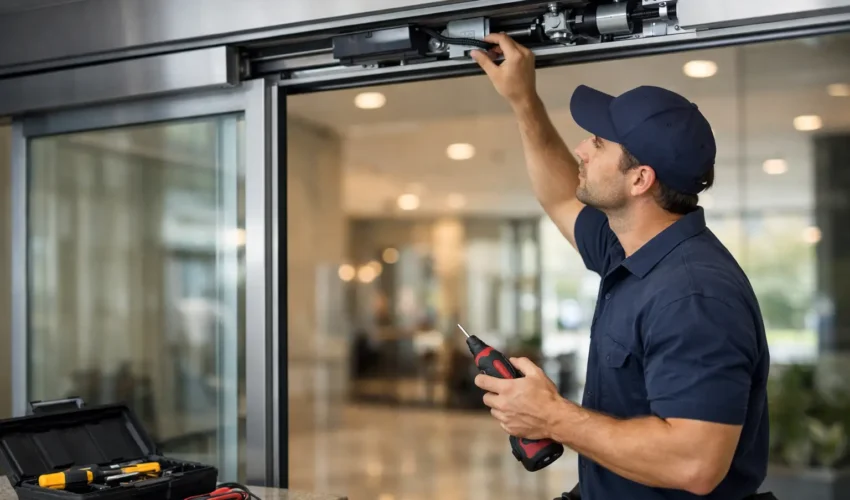
A sliding entrance door that hesitates at opening time, or a swing door that closes too sharply, is more than an inconvenience. It can disrupt customer access, create a safety concern and leave staff trying to manage a busy entrance manually. Knowing how to maintain automatic doors helps commercial and industrial premises prevent these issues before they become an urgent repair callout.
Automatic doors work hard. In retail units, medical centres, offices, warehouses and public buildings, they may operate hundreds or thousands of times each day. Dirt, weather, foot traffic, trolley impacts and general wear all affect their performance. A sensible maintenance routine combines simple site checks with planned professional servicing.
How to maintain automatic doors between services
Daily or weekly checks do not replace an engineer inspection, but they give facilities teams an early warning when something has changed. The key is to observe the door operating normally rather than attempting to adjust its settings.
Start by keeping the doorway, threshold and guide areas clean. Leaves, grit, packaging, stones and pooled water can interfere with sliding tracks, floor guides and drainage points. At entrances exposed to Scottish weather, this is particularly relevant after heavy rain, frost or high winds. Clean surrounding glass and frames with suitable products, but avoid spraying liquid directly into sensors, operators or electrical components.
Watch a complete opening and closing cycle from a safe distance. The door should move at a consistent speed, open fully, close smoothly and come to rest without scraping, banging or shuddering. Listen for new noises such as grinding, squealing, clicking or repeated motor activity. These can point to worn rollers, loose fixings, a misaligned leaf or a developing operator fault.
Check that activation devices respond as intended. Depending on the installation, this may include motion sensors, push pads, access control, key switches or safety beams. A sensor that reacts too late, opens when nobody is present or fails to detect someone in the doorway needs attention. Do not cover, reposition or alter the sensitivity of safety sensors unless this has been assessed by a competent engineer.
It is also worth checking the door’s signage and visibility markings. Safety decals, manifestation markings and emergency instructions should be clean, legible and present. This is especially important where glazed doors sit within a busy public entrance.
Keep safety systems clear and testable
Automatic doors are designed to reduce the risk of contact, trapping and collision, but those protections depend on the equipment being in good condition. Safety sensors, presence detectors, finger guards, emergency break-out functions and controlled closing settings all need to operate correctly.
Staff should know what normal operation looks like and what to report. A door should be taken out of automatic use if it is striking people, failing to stop or reverse when it should, leaving an unsafe gap, or showing visible damage to glass, frames, arms or mechanisms. Where possible, isolate the door safely and arrange a professional assessment rather than allowing people to work around a known fault.
Never wedge an automatic door open, force it shut or disable safety devices to keep traffic moving. That can turn a relatively straightforward fault into damaged hardware, an injury risk or a more expensive repair. If access is essential, a temporary managed solution may be safer while an engineer attends.
For powered pedestrian doors, servicing should take account of the applicable safety requirements, the door type, its use and the manufacturer’s instructions. A busy healthcare entrance has different risks from a low-traffic staff entrance, while a door exposed to loading activity may need more frequent checks than one inside a sheltered office reception.
Clean the right parts without creating faults
Regular cleaning is useful, but automatic doors are not a general maintenance task for untrained staff. Most cleaning should focus on the surfaces around the operating system: glazing, handles, frames, thresholds and the clear opening.
Use a soft cloth and appropriate non-abrasive cleaner for glass and powder-coated or aluminium finishes. Remove debris from floor channels and ensure mats do not creep into the door’s path. Entrance mats should sit flat and be replaced if curled edges create a trip hazard or obstruct the leaf.
Avoid pressure washing near automatic operators, using harsh solvents on seals or finishes, and applying unapproved lubricant to tracks, rollers or drive components. The wrong lubricant can attract grit and make movement worse. It can also conceal a fault that an engineer needs to identify. Where lubrication is required, it should be carried out to the manufacturer’s specification during a service visit.
Record faults before they become downtime
A brief door log is one of the most useful tools a site can maintain. It does not need to be complicated. Record the date, door location, what happened, the weather conditions if relevant, any display code and whether the fault was intermittent or constant.
For example, note whether the door only sticks first thing in the morning, fails during heavy rain, makes noise on closing or behaves differently when the building is busy. This information helps an engineer diagnose the problem faster and can reduce the time spent investigating an intermittent issue.
Repeated minor faults deserve attention. If staff regularly reset a door, manually assist it open or ignore a warning light because it eventually starts working again, the system is not operating reliably. Small problems often progress into failed motors, damaged belts, worn rollers or a complete loss of access at the worst possible time.
Arrange planned servicing at the right interval
Professional planned maintenance is where the deeper mechanical, electrical and safety checks take place. An engineer can inspect the operator, drive belt or gearbox, fixings, rollers, guide systems, locks, seals, electrical connections and control settings. They can also test safety devices under operating conditions and identify components approaching the end of their useful life.
There is no single servicing interval that suits every automatic door. Frequency depends on usage, door type, environment, age and the consequences of failure. A public-facing entrance or a door operating continuously across long trading hours may require more frequent planned maintenance than a lightly used internal access door.
A maintenance agreement can make budgeting and compliance easier because visits are scheduled rather than triggered only after a breakdown. It also gives a clearer service history for property managers responsible for multiple sites. The objective is not to replace parts unnecessarily. It is to spot wear at a stage where repairs can be planned around trading, deliveries or staff access.
For businesses across Glasgow, Lanarkshire and the surrounding areas, Door Systems Scotland can assess the condition and duty level of an automatic door system and recommend a practical maintenance schedule based on how the entrance is actually used.
Know when to call for an urgent repair
Some faults should not wait for the next planned service. Arrange prompt assistance if the door will not open or close, has become noisy or unstable, moves erratically, repeatedly reverses, shows damaged glazing or hardware, or no longer responds consistently to its activation device.
Urgency also depends on the role of the door. A failed main entrance can stop customers entering a shop or patients reaching a clinic. A door that cannot secure properly may leave a premises exposed outside trading hours. At a warehouse or industrial site, an unreliable access point can delay staff, visitors and deliveries.
When reporting the fault, provide the door type, location, make if known, the symptoms, any fault code and whether the doorway can be secured. Clear information helps the responding engineer arrive prepared and keeps disruption to a minimum.
Give staff clear responsibilities
The best maintenance plan is undermined if nobody knows who is responsible for reporting problems. Give nominated staff a simple process: keep the entrance clear, carry out visual checks, record unusual operation and report faults without attempting repairs.
Facilities managers should also ensure that cleaners, security staff and contractors understand that sensors, tracks and operators are not to be obstructed or altered. This is particularly useful in shared buildings where several teams use the same entrance.
A well-maintained automatic door should fade into the background because it opens safely, closes securely and keeps people moving. Treat the first unusual sound, delay or sensor issue as useful information, and arrange expert attention before it becomes the reason your entrance stops working.