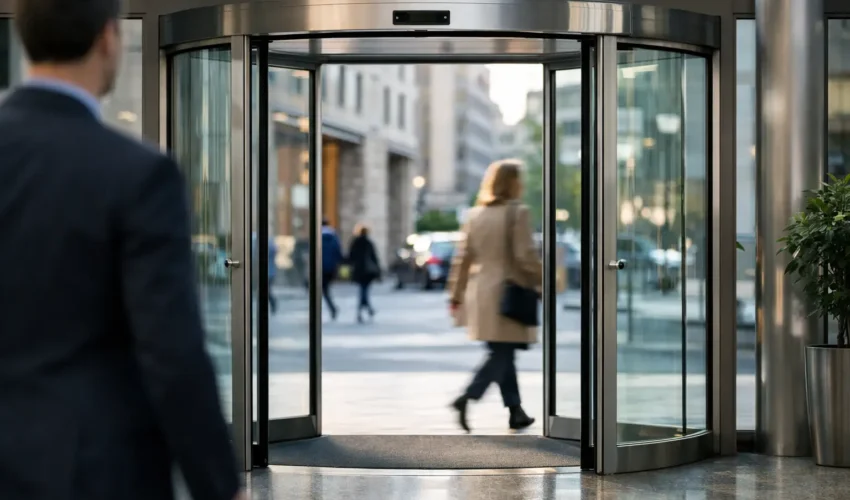
A door that hesitates, closes too quickly or will not open at all can stop customers at the threshold. For public-facing premises, automatic doors Glasgow businesses depend on are not simply a convenience: they manage access, support accessibility, protect internal temperatures and keep footfall moving when the building is busy.
The right system should suit how people use the entrance, not just the width of the opening. A medical centre has very different needs from a retail unit, office reception, warehouse pedestrian entrance or mixed-use commercial building. Getting the specification right at the survey stage prevents avoidable disruption, repeat repairs and an entrance that quickly becomes a frustration for staff and visitors.
Choosing automatic doors in Glasgow
Automatic sliding doors are often the first choice for high-traffic entrances. They provide a clear opening, allow people with prams, wheelchairs, trolleys or bags to pass easily, and work well where there is limited space for a door leaf to swing. They are common in shops, healthcare settings, offices and larger communal entrances.
Automatic swing doors can be the better fit where the entrance is narrower, footfall is lower or an existing hinged-door arrangement needs to be retained. They can be installed as a single or pair of doors and are particularly useful for side entrances, accessible entrances and internal routes. Their suitability depends on the available clearance around the opening, the weight of the door and whether pedestrian traffic approaches from both directions.
The best option is rarely decided from photographs alone. An engineer should assess the opening, structural condition, glazed areas, prevailing footfall, escape routes and power supply. They should also ask how the building operates at peak times. A busy Glasgow city-centre shop may need fast, reliable opening cycles and effective draught control, while a small clinic may place greater emphasis on quiet operation, controlled access and ease of use for visitors with reduced mobility.
Consider the entrance as a working system
The operator is only one part of an automatic door installation. The door leaves, glazing, framing, sensors, safety devices, locking, access controls and controls all need to work together. If one component is poorly matched, the whole entrance can become unreliable.
For example, fitting an operator to worn or poorly aligned door leaves may lead to repeated faults. Equally, selecting a system with a slow opening speed for a high-footfall entrance can create queues and encourage people to force their way through. A site survey gives the installer the chance to identify these issues before installation begins.
Safety and accessibility are part of the specification
Automatic doors must be set up to detect people approaching and passing through the opening. Presence sensors, safety sensors and correctly adjusted opening and closing forces are essential. The aim is straightforward: pedestrians should be able to use the entrance confidently without being struck by a moving door or finding it closes before they have cleared the opening.
This matters particularly where children, older visitors, wheelchair users, delivery staff and people carrying goods use the same entrance. Sensor positioning cannot be treated as a one-size-fits-all detail. Reflections from glass, layout changes near the doorway, floor finishes and nearby displays can affect performance, so testing on site is essential.
Accessibility should also be considered beyond the automated opening itself. A suitable clear passage width, level threshold, visible manifestation on glazing and well-positioned activation controls all contribute to a more usable entrance. Where access control is required, it must not make independent entry unnecessarily difficult for authorised visitors.
Fire strategy is another consideration. Some sites require doors that interface with the building’s fire alarm arrangement, release locks in an emergency or operate in a defined fail-safe position. This should be agreed during design rather than added as an afterthought. The right approach depends on the building layout, escape plan and the advice supporting the wider fire-safety arrangement.
Security without creating a barrier to trade
An automatic entrance can improve security, but it needs to be specified realistically. Standard sliding or swing doors are designed primarily for pedestrian access, not as a substitute for a security shutter or dedicated access-control system where a higher level of protection is needed.
For retail premises, a common arrangement is an automatic entrance for trading hours combined with security shutters or other physical protection when closed. Offices and healthcare settings may benefit from timed locking, keypad entry, fob access or monitored release. The correct solution depends on who needs access, when they need it and how the premises are used outside normal hours.
There is a trade-off to manage. Very restrictive access settings can make an entrance feel unwelcoming and create delays for legitimate visitors. Leaving a system permanently open, on the other hand, can affect security and increase heating costs. A properly commissioned system allows the business to choose operating modes that suit the time of day, staffing levels and building use.
Installation planning that limits disruption
Replacing or installing an automatic door can affect a busy entrance, so planning matters. Before work starts, the installer should agree how pedestrians will be diverted, whether temporary access is needed and when noisy or intrusive work can take place. For a shop, reception or medical setting, this can be as important as the equipment itself.
Electrical provision should be checked early. Operators require a suitable, safe supply, and any associated controls, locking or alarm interfaces must be coordinated. If new glazing, framing or structural alterations are required, these should form part of a joined-up plan rather than being left for separate contractors to resolve later.
Once fitted, the door needs commissioning and handover. This includes checking sensor coverage, door movement, safety functions, locking, manual release arrangements and any access-control settings. Staff should know what normal operation looks like, how to select available modes and what to do if the entrance develops a fault.
Why planned maintenance protects day-to-day operations
Automatic doors operate repeatedly throughout the day. Dust in tracks, worn rollers, loose fixings, damaged brushes, misaligned leaves and sensor issues can all develop gradually. A door may still appear to function, but operate noisily, drag, fail to close consistently or become less safe for users.
Planned maintenance identifies wear before it becomes an urgent failure. A competent service visit should include a practical inspection of mechanical components, safety sensors, operator settings, guide tracks, glazing condition, locking and control functions. The precise checks will vary by system, but the purpose is the same: keep the entrance safe, dependable and ready for daily use.
Maintenance is especially valuable in sites exposed to heavy footfall, wind-driven rain, grit or frequent delivery movements. In these conditions, a low-cost reactive approach can prove expensive. A failure at opening time may mean lost trade, frustrated visitors, additional security risks and pressure on staff to manage the entrance manually.
Door Systems Scotland provides installation, repairs and planned maintenance for commercial door systems, with engineer-led surveys to establish what the site genuinely needs. For businesses where a failed entrance affects trading or safe access, the availability of a rapid emergency repair response is a practical safeguard rather than an optional extra.
Signs that a repair should not wait
A door that will not close and lock properly needs prompt attention, particularly outside trading hours. The same applies when the door moves unpredictably, makes unusual grinding noises, repeatedly reverses without an obvious obstruction or has damaged glass, frames or sensors.
Do not ask staff to force, prop or repeatedly reset a faulty automatic door. That can increase damage and may create a safety issue. If safe operation cannot be confirmed, restrict use of the entrance, provide an alternative route where possible and arrange an inspection by a qualified door engineer.
Getting a useful quote for an automatic door
A meaningful quote should be based on the actual opening and operating requirement, not a generic price for an operator. Be ready to discuss the approximate door size, current arrangement, expected number of users, accessibility requirements, security concerns, opening hours and whether the entrance must remain available during works.
It is also worth asking what is included after installation. Clarify commissioning, user handover, warranty arrangements, servicing requirements and emergency support. The cheapest initial proposal is not always the most cost-effective if it leaves out essential safety devices, suitable locking or the maintenance needed to keep the system working properly.
A dependable automatic entrance should disappear into the working day: visitors arrive, staff move freely and the building remains secure when it needs to be. The most useful next step is a site survey that turns those practical requirements into a door system built for the way your premises actually operate.