When an automatic door starts hesitating, misreading foot traffic or failing to close properly, the problem rarely stays small for long. A busy entrance can turn into a bottleneck within hours, and in some settings it becomes a security, safety or accessibility issue just as quickly. That is why commercial automatic door servicing matters – not as a box-ticking exercise, but as a practical way to keep premises operating properly.
For retail units, healthcare settings, offices, schools and industrial sites with pedestrian access points, automatic doors do a simple job under constant pressure. They open thousands of times, deal with weather, dust and impact, and are expected to perform without fuss. Most people only notice them when they stop working. By that stage, you may already be dealing with delayed access, frustrated visitors, staff complaints or an urgent repair callout.
What commercial automatic door servicing actually covers
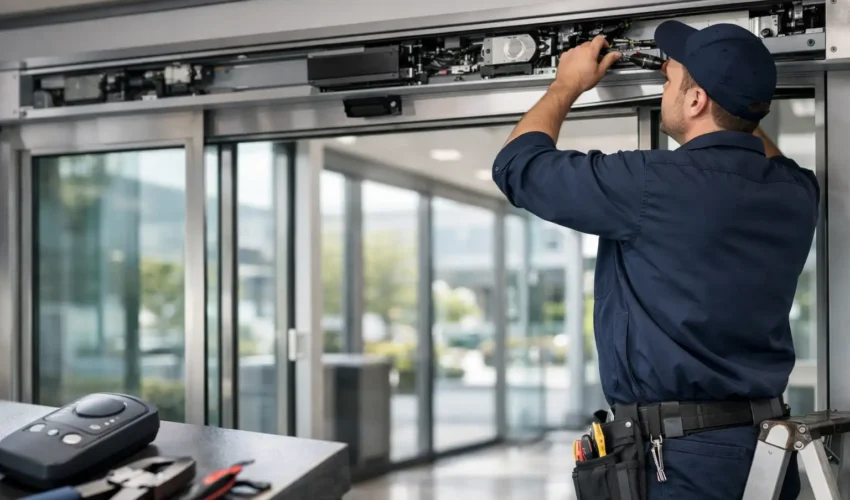
Commercial automatic door servicing is not just a quick visual inspection. A proper service looks at how the full system is performing, including operators, sensors, safety devices, door leaves, tracks, guides, control units and activation points. The aim is to catch wear, misalignment and developing faults before they cause a shutdown.
In practical terms, that means checking opening and closing speeds, testing sensor response, inspecting moving parts, tightening fixings, adjusting settings where needed and identifying components that are starting to fail. Engineers should also check whether the door is operating safely for the people using it, particularly where vulnerable users, members of the public or high footfall are involved.
The exact scope depends on the door type and the environment. A sliding entrance door at a town centre retail unit faces different demands from a swing door at a medical centre or a staff access door at a warehouse. The servicing schedule should reflect that reality rather than applying the same approach to every building.
Why planned servicing usually costs less than reactive repairs
The biggest cost of a door failure is often not the repair itself. It is the disruption around it. If customers cannot enter easily, deliveries are delayed, staff have to manage access manually or a site is left insecure, the knock-on effect can outweigh the engineer visit very quickly.
Planned servicing reduces the chance of unexpected downtime because faults are picked up earlier. A worn roller, loose belt, contaminated sensor or tired motor assembly can often be dealt with before it turns into a full failure. That gives businesses more control over cost, timing and disruption.
There is also the question of component life. Automatic doors are mechanical and electrical systems, so they respond well to regular adjustment and inspection. Leaving them untouched until something breaks tends to shorten the life of parts and increase the likelihood of repeat callouts. For premises managers trying to control maintenance budgets across multiple assets, that reactive cycle becomes expensive.
Safety, compliance and public access
Automatic doors sit at the intersection of convenience and safety. They need to provide reliable access while protecting users from entrapment, impact and faulty operation. That is one reason servicing should never be treated as optional, especially in buildings open to the public.
A door that opens late, closes too quickly or fails to detect someone properly is not just inconvenient. It can create a real risk. In healthcare premises, care environments, schools and busy commercial entrances, that risk is even more significant because users may include children, elderly visitors or people with limited mobility.
Regular servicing helps demonstrate that the equipment is being maintained responsibly. It also gives duty holders a clearer record of condition, repair history and recommended action. If an issue is identified, it can be prioritised properly instead of being left until there is an incident or a complete breakdown.
Signs your automatic doors need attention sooner
Not every problem waits for the next planned visit. Some warning signs mean a door should be inspected sooner rather than later. Slower operation is one of the most common. So are unusual noises, inconsistent opening cycles, intermittent sensor response and doors stopping short of fully opening or closing.
You may also notice doors drifting out of alignment, scraping, bouncing on close or resetting repeatedly. In some cases the issue is obvious, such as accidental impact or a damaged safety sensor. In others, the fault appears minor but points to a control or operator problem that can worsen quickly.
If staff are having to intervene, prop doors open, power cycle the system or explain access problems to visitors, it is already affecting operations. That is the point to arrange inspection rather than waiting for a complete failure.
How service frequency depends on use
There is no single servicing interval that suits every site. The right frequency depends on traffic levels, the type of door, the age of the system and the conditions it operates in. A lightly used office entrance may need a different plan from a supermarket entrance or a clinical setting with near constant use.
Environment matters as well. Doors exposed to wind, rain, grit or fluctuating temperatures can experience more wear. The same applies where trolleys, cages or deliveries regularly pass through. A site with long operating hours will usually need closer attention than one with limited daily use.
This is where engineer-led assessment makes a difference. A service plan should be based on what the door is actually doing day to day, not just what looks acceptable on paper. For many commercial premises, a tailored planned maintenance arrangement gives better value than waiting for faults and arranging emergency attendance each time.
Commercial automatic door servicing and emergency response
Even with good maintenance, unexpected faults can still happen. Components fail, doors get damaged and electrical issues occur without warning. The difference is that a well-serviced system is generally less likely to fail suddenly and easier to diagnose when it does.
That matters when access is business-critical. If an entrance door at a medical facility stops working, or a retail frontage cannot secure properly at the end of the day, response time becomes vital. Fast repair support is part of the wider value of commercial automatic door servicing because it sits alongside planned maintenance rather than replacing it.
For businesses across Lanarkshire and Glasgow, working with a local specialist can make this far more straightforward. It means the engineer attending understands common site demands in the area, can assess whether repair or replacement is the sensible option, and can act quickly when downtime is costing money.
Choosing a service provider
Not all servicing is equal. What matters is practical engineering competence, clear reporting and a willingness to deal with the actual condition of the door rather than carrying out a rushed visit and leaving issues unresolved.
A good provider will assess the system properly, explain faults in plain terms and recommend action based on safety, reliability and cost. Sometimes that means a straightforward adjustment. Sometimes it means replacing worn components. Occasionally, particularly with older or poorly supported systems, it means advising that replacement will be more economical than repeated repair. The right answer depends on the condition of the door, parts availability and how critical the entrance is to the building.
It also helps to work with a company that can support the full life of the asset – from survey and installation through to servicing, repairs and emergency attendance. That continuity tends to produce better long-term decisions because the engineer is looking at the whole system, not just the immediate fault.
When repair is enough and when replacement makes more sense
This is where experience matters. Many automatic door issues are repairable, and there is no value in pushing for replacement when a well-executed repair and maintenance plan will restore reliable service. On the other hand, repeatedly spending money on an ageing system with recurring faults is rarely a good use of budget.
A realistic assessment should consider the age of the operator, the frequency of faults, the condition of safety components and whether replacement parts are still readily available. It should also consider the building itself. If traffic patterns have changed, accessibility requirements have increased or the current setup is no longer fit for use, replacement may solve more than one problem at once.
That said, businesses do not always need to make a full upgrade immediately. In some cases, a targeted repair combined with closer servicing can bridge the gap and buy time for planned capital spend.
For most commercial premises, the sensible approach is straightforward. Keep automatic doors on a proper servicing schedule, deal with early faults before they escalate, and use a contractor who understands both urgency and long-term reliability. Door Systems Scotland supports businesses with exactly that sort of practical, responsive engineering approach.
If your entrance doors are critical to trading, access or day-to-day site safety, servicing is not just maintenance – it is part of keeping the whole building working as it should.