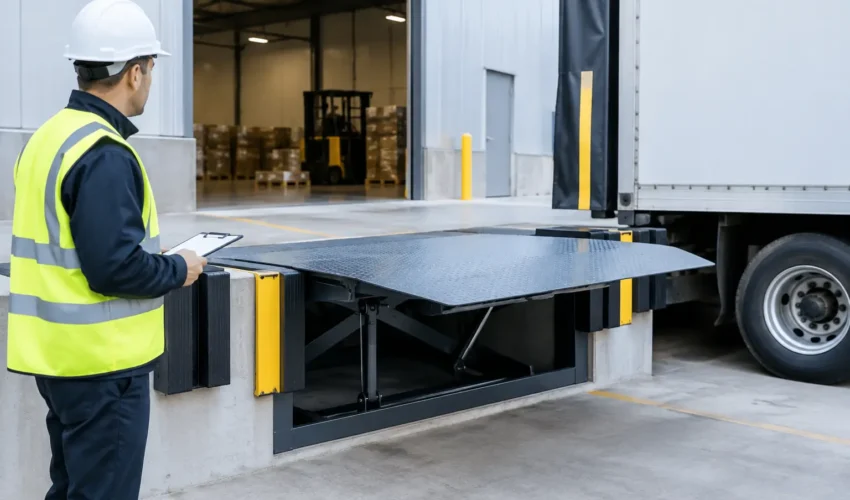
A loading bay can lose hours of productive time because of one poorly matched dock leveller. If operators are relying on loose boards, struggling to bridge a height gap, or waiting for a specific vehicle to arrive, the equipment is not doing its job. Knowing how to choose dock levellers means looking beyond the purchase price and specifying a system that suits your vehicles, loads, building and daily operating conditions.
For warehouses, distribution centres, manufacturers and trade counters, the right leveller makes loading safer and quicker. The wrong one can create avoidable risks, damage pallets and forklift trucks, and lead to repeated repair call-outs. A proper site survey is the starting point for a reliable installation.
Start with the vehicles using the bay
The most useful question is not simply, “What size dock leveller do we need?” It is, “What vehicles will use this bay most often?” Record the bed heights, widths and types of vehicle expected, including rigid lorries, articulated trailers, vans and curtain-siders.
A dock leveller must bridge the difference between the loading bay floor and the vehicle bed safely. Vehicle bed heights vary significantly, particularly where a site receives mixed fleets or third-party deliveries. If the range is too wide for a standard leveller, the platform may operate at an excessive incline or decline. That affects forklift stability, increases wear and makes loading more difficult for staff.
Consider vehicle movement as well. Some operations load vehicles that remain still at the bay, while others deal with air-suspension trailers that rise and fall as loads are removed. A suitable leveller needs enough operating range to accommodate these changes without forcing operators into unsafe workarounds.
Measure more than the dock opening
The width and depth of the existing pit or proposed opening matter, but they are only part of the specification. A survey should also assess the approach area, internal floor level, external yard gradient, drainage and the condition of the concrete surround.
A loading bay with limited external space may need a different arrangement from one with a large, level marshalling yard. Equally, a bay that regularly receives short vehicles may need careful consideration of bumpers, wheel guides and the position at which the vehicle stops. These details determine whether the leveller lip reaches and rests correctly on the vehicle bed.
Choose a dock leveller type for the work you do
There is no single best dock leveller for every site. The right choice depends on traffic volume, load types, vehicle variation and the level of control your operation requires.
A swing-lip dock leveller is a common choice for general loading bays. As the platform raises, a hinged lip swings out to bridge onto the vehicle bed. It can provide an efficient, practical solution where trailers reverse consistently into position and there is a suitable working range.
Telescopic-lip dock levellers use a lip that extends horizontally. This gives the operator greater control over where the lip lands on the vehicle floor, which is useful where vehicles vary in length or where loading needs to take place closer to the rear of the trailer. They are often a strong option for busy sites handling different types of vehicle throughout the day.
Hydraulic dock levellers are generally suited to frequent use because operation is controlled, consistent and less physically demanding for staff. Mechanical models can have a role in lower-traffic applications, but they should be assessed honestly against expected use. Choosing a lower-cost mechanism for an intensive loading operation can lead to more downtime and higher maintenance costs over time.
Vertical-storing dock levellers are worth considering where temperature control, hygiene or security is a priority. By storing upright, they can allow an insulated sectional door to close fully to the floor, rather than sitting behind a parked horizontal platform. This may benefit chilled stores, food facilities and buildings where reducing air leakage matters.
Specify the right load capacity, not just the heaviest pallet
The stated capacity of a dock leveller must cover the combined working load. That includes the weight of the forklift truck or pallet truck, the load being carried and the effect of repeated movement across the platform. A 2,000 kg pallet does not mean a 2,000 kg leveller is adequate once the handling equipment is included.
Your engineer should also consider dynamic loading. A forklift crossing a leveller creates forces that differ from a stationary load, particularly when traffic is fast, frequent or poorly controlled. Heavy-duty operations may need a higher capacity platform, stronger deck construction and a specification designed for intensive cycles.
It can be tempting to select the highest capacity available as a precaution. However, overspecifying without considering the actual site and operating needs can add unnecessary cost. The sensible approach is to allow a safe margin based on real loading patterns, anticipated growth and the equipment used on site.
Put safety features at the centre of the decision
Dock levellers sit at the meeting point of people, forklifts and moving vehicles. That makes safety systems essential rather than optional extras. The equipment should form part of a broader loading bay safety plan that includes staff training, traffic management and regular inspection.
Look for reliable safety supports for maintenance, clear controls, anti-slip deck surfaces and effective toe guards where appropriate. Emergency stop controls and controlled lowering functions are also important. The exact features depend on the equipment type, but staff should be able to operate the leveller without uncertainty or excessive manual effort.
Vehicle restraint is another consideration. If a trailer pulls away while a forklift is entering or leaving, the consequences can be serious. Depending on the bay layout and vehicle fleet, wheel chocks, traffic lights, wheel guides or a dedicated vehicle restraint system may be appropriate. Dock shelters and seals can also improve weather protection while reducing the risk of misaligned vehicles damaging the bay.
Safe use does not stop at installation. Operators need clear procedures for checking that the vehicle is secure, the lip is correctly supported and the loading area is clear before work begins. Regular planned maintenance helps ensure safety devices continue to operate as intended.
Account for Scottish weather and building condition
Rain, frost, wind and standing water all affect a loading bay. External components need to withstand the local environment, while drainage must prevent water collecting around the pit, platform or door threshold. Water ingress can contribute to corrosion, slippery surfaces and avoidable electrical faults.
For sites across Glasgow, Lanarkshire and elsewhere in Scotland, it is also worth considering how the dock equipment works alongside the industrial door. A high-speed door, sectional door, dock shelter and leveller should operate as one practical system. An efficient leveller is of limited value if the door opening is too narrow, a damaged seal lets weather into the building, or the controls create delays for operators.
Older premises can present additional challenges. Uneven concrete, damaged pit edges and outdated electrical supplies may need remedial work before a new leveller is installed. Identifying this during the survey prevents surprises once installation is under way.
Plan for servicing, repairs and downtime
A dock leveller is hard-working equipment. Hinges, cylinders, lip mechanisms, hydraulic lines, controls and platform structure all need regular attention. Servicing should be part of the purchase decision, not an afterthought once something fails.
Ask how routine inspections will be carried out, what common wear parts are held, and who will respond if the leveller fails during a busy delivery period. For a site that cannot pause despatch or goods-in operations, local engineering support and emergency response may be as valuable as the initial specification.
Keep a record of defects, repairs and inspections. Small issues such as unusual noises, slow movement, damaged lips or oil leaks should be reported early. Continued use of damaged dock equipment can turn a straightforward repair into a longer shutdown and may put employees at risk.
How to choose dock levellers with a proper survey
The most dependable way to choose dock levellers is to arrange a site survey before committing to a model. An experienced engineer can measure vehicle and bay dimensions, review traffic flow, inspect the existing structure and discuss how staff actually use the area. This produces a specification based on operational reality rather than an assumption from a catalogue.
Door Systems Scotland can assess dock leveller requirements alongside associated doors, shelters, seals and safety equipment, then provide installation and ongoing maintenance support. The goal is not simply to fill a dock opening. It is to give your team a loading bay that remains safe, efficient and dependable through daily use.
Before approving the work, involve the people who run the bay. Their experience of awkward deliveries, vehicle types and recurring faults often reveals the detail that turns a standard installation into a system that works properly for years.