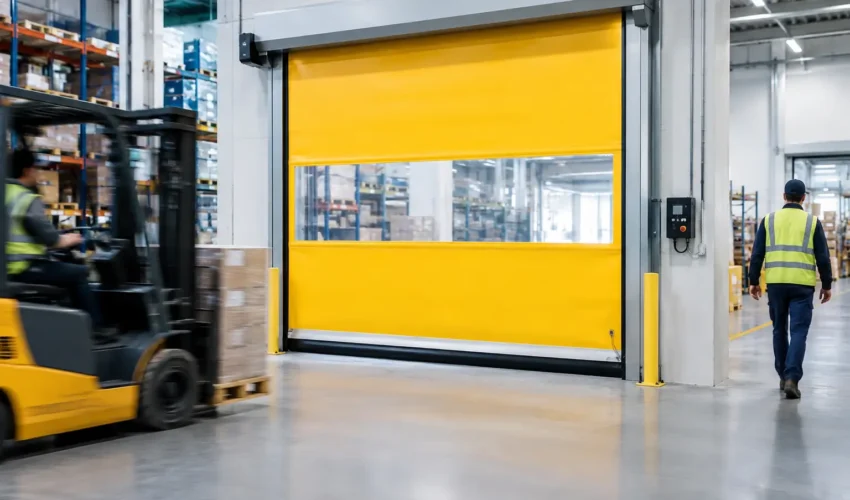
A high speed door can open and close in a matter of seconds, often where forklifts, pallet lorries, pedestrians and deliveries are all moving at once. That naturally raises the question: are high speed doors safe? When correctly specified, professionally installed and routinely maintained, they can be an extremely safe choice for busy commercial and industrial premises. But speed alone does not make a door safe. The right safety equipment, controls, site layout and ongoing servicing all matter.
For warehouse, manufacturing, retail and temperature-controlled environments, the benefit is clear: a door that closes promptly helps control access, reduce draughts and keep operations moving. The safety case has to be just as clear, particularly where people and vehicles share an opening.
Are high speed doors safe in daily use?
Yes, provided the door is designed for its environment and its protective systems are working as intended. Modern high speed doors are not simply faster roller shutters. They are usually built around controls and safety devices that monitor the opening, respond to obstruction and manage how the curtain moves.
A properly selected door should prevent normal closing movement when a person, forklift or object is detected in its path. If contact does occur, the system should react appropriately rather than continue applying force. Many high speed fabric doors also use a flexible bottom edge or a soft curtain design, reducing the injury and damage risk associated with a rigid moving panel.
That said, no powered door is risk-free. A door installed at a busy loading bay has different demands from one separating two clean internal areas. A rapid door at a pedestrian entrance needs different activation and protection from a door used solely by authorised forklift traffic. Safety depends on the application, not just the product label.
The features that make a high speed door safer
Safety starts with choosing an appropriate operating system. On a well-planned installation, the engineer will consider who uses the opening, what passes through it, how quickly traffic approaches and whether people can enter the area unexpectedly.
Presence detection and light protection
Photocells, light curtains and other presence-detection devices create a protected zone around the doorway. If a person or vehicle breaks that zone while the door is closing, the control system can stop or reverse the door. Light curtains are particularly useful where pedestrians and forklift lorries approach from different directions, because they can protect a wider section of the opening than a single beam.
These devices need to be positioned correctly and kept clean. A photocell knocked out of alignment, obscured by dust or damaged by a pallet can leave a door operating differently from how staff expect. This is one reason safety checks should form part of planned maintenance rather than being left until a fault causes disruption.
A responsive bottom edge and curtain
Many high speed doors use a flexible curtain and a soft or monitored bottom edge. If the lower edge meets an obstruction, it sends a signal to stop or reverse the door. This is useful in facilities where minor contact is possible, such as a fast-moving warehouse operation.
The exact arrangement varies by manufacturer and model. Some doors are intended to avoid contact through non-contact safety devices; others include an additional contact-sensitive safety edge. The important point is that the system matches the risks at the site and is tested after installation, repair and adjustment.
Controlled activation
A door should not open simply because somebody walks nearby. Activation methods can include push buttons, pull cords, radar sensors, induction loops, remote controls, access control readers and vehicle detection. Each has a place, but the wrong method can create unnecessary movement or encourage unsafe shortcuts.
For example, a radar sensor may improve traffic flow at an internal forklift route, while access control could be more suitable for a secure stock room. Separating vehicle and pedestrian routes, then using activation devices suited to each route, is often safer than relying on staff to judge a gap in traffic.
Emergency controls and clear manual release
Staff need to know how to stop the door in an emergency and what to do if there is a power failure or a fault. Clearly marked emergency stop controls, suitable isolation procedures and an accessible manual release arrangement are practical essentials.
Training does not need to be complicated, but it must be site-specific. New staff, agency workers and regular contractors should understand that a high speed door is powered equipment, not something to duck under or force open.
Installation quality matters as much as the door itself
A high quality door can still become unsafe if it is poorly fitted, incorrectly programmed or installed without considering site conditions. The opening must be measured accurately, structural fixings need to be suitable and the guide rails, curtain, motor and safety devices must be aligned and commissioned as a complete system.
The surrounding area also needs attention. Poor lighting, blind corners, uneven floors and unmarked pedestrian routes all increase the chance of an incident. In a loading area, a high speed door may work best alongside barriers, floor markings, warning signage and traffic controls. These measures are not extras where people and vehicles mix. They are part of creating a safe operating environment.
An engineer-led site survey is valuable because it identifies those practical issues before the equipment is ordered. It can also prevent a common mistake: choosing the fastest available door when a slightly slower model with more suitable controls would be the safer and more reliable option.
Why maintenance is a safety requirement, not an optional cost
High speed doors can complete many cycles each day. That continual use places wear on curtains, guides, drive components, safety edges, sensors and control equipment. Even a small fault can affect safe operation, particularly if employees have become used to a door opening or closing in a particular way.
Planned maintenance identifies worn or damaged components before they become a failure. A competent service visit should include checking the door’s travel, fixings, curtain condition, balance where relevant, safety sensors, emergency stop function and activation devices. Any fault should be recorded and addressed promptly.
There is a commercial benefit as well. A door that fails open can leave a building exposed to weather, heat loss and unauthorised access. A door that fails shut may stop goods moving, delay a delivery or prevent a team from using part of the premises. Regular servicing supports safety while reducing the risk of costly unplanned downtime.
Door Systems Scotland regularly sees avoidable faults caused by impact damage, contaminated sensors and components that have been allowed to wear beyond their service life. Calling for a repair as soon as a door behaves unusually is safer and usually less disruptive than waiting for a complete breakdown.
The risks to manage around high speed doors
The most common safety problems are rarely caused by the door travelling quickly on its own. They tend to arise from poor use, inadequate separation of people and vehicles, damaged safety equipment or a door being used after it has been struck.
Forklift impact is a particular concern. A fabric curtain may recover from a minor collision, and some systems are designed to self-reinsert after an impact. That does not mean the incident should be ignored. Guide rails, sensors, structural fixings and the drive system may still need inspection before the door returns to normal use.
It is also unwise to disable sensors because they cause nuisance stoppages. Repeated interruptions are a sign that the sensor position, activation settings, traffic route or staff procedure needs review. Bypassing a safety device transfers the problem to the people working nearby.
Choosing the right door for the opening
When assessing a high speed door, consider the size of the opening, expected number of cycles, wind exposure, hygiene or temperature requirements, security needs, vehicle types and pedestrian movement. A door in a food production area may prioritise cleanability and environmental separation. A distribution warehouse may need rapid cycles, clear vision panels and strong impact recovery. An external opening may require a different specification from an internal partition.
There are trade-offs. A very fast door can improve efficiency and reduce heat loss, but it needs controls that suit the approach speed of vehicles and people. A more complex safety arrangement may cost more initially, yet it may be the sensible choice where the consequences of an incident or stoppage are high.
For busy Scottish workplaces, a proper survey and a clear maintenance plan are the practical starting points. If staff are hesitating around a doorway, forklifts are regularly clipping the curtain, or a door is behaving unpredictably, arrange an inspection before a minor issue becomes a safety incident or an operational stoppage.