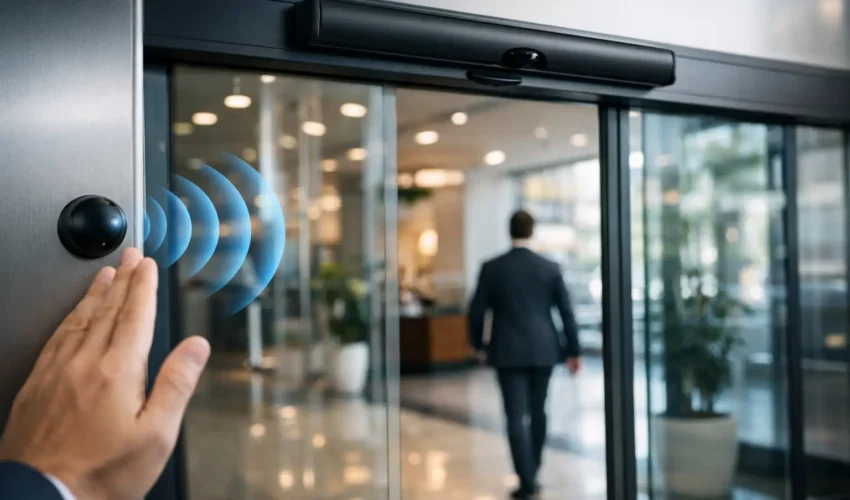
A door that opens late, closes on a trolley or keeps cycling for no obvious reason is more than an irritation. It can disrupt deliveries, create an access issue for visitors and leave staff questioning whether an entrance is safe to use. This automatic door sensor review looks at the sensor types that matter in commercial settings, how they perform in real conditions and what should be checked before replacing a part or specifying a new door.
For premises with regular pedestrian traffic, the right sensor arrangement is part of the door system, not an optional add-on. A good installation considers the door type, approach routes, traffic volume, weather exposure, users and the consequences of a failure. That is especially relevant for busy healthcare sites, retail entrances, offices, warehouses and mixed-use commercial buildings.
Automatic door sensor review: what is being assessed?
The word “sensor” is often used to describe several different devices. They do different jobs, and problems arise when activation and safety functions are treated as though they are interchangeable.
An activation sensor tells the operator that someone, or something, wants the door to open. A safety sensor detects a person or obstruction in the door’s path and prevents movement that could cause an impact or trapping risk. Some units combine functions, but they still need correct positioning, programming and testing.
A useful review should therefore look beyond whether the door opens when somebody walks towards it. It should assess detection reliability, the width and depth of the detection zone, reaction to side traffic, compatibility with the operator, resistance to environmental interference and the condition of cabling and fixings. It should also consider whether the system remains appropriate after a change in how the building is used.
For example, a sensor that works well at a quiet office entrance may be unsuitable at a supermarket doorway where customers pass close by, trolleys approach at different angles and a draughty entrance creates changing conditions. Likewise, a warehouse pedestrian door beside forklift activity requires a different detection strategy from a reception door used by visitors and wheelchair users.
The main sensor types and where they fit
Microwave and radar activation sensors
Microwave or radar sensors detect movement approaching the door. They are commonly used above automatic sliding doors because they provide hands-free activation and can be adjusted to cover a chosen approach area.
Their main advantage is convenience. When correctly set, they open the door before a pedestrian reaches it, helping to maintain steady traffic flow. They can also be effective where users carry parcels, push prams or use mobility equipment.
The trade-off is that radar sees movement, not intent. If its field is too wide, it may pick up passing footfall, vehicles or movement on an adjacent pavement. The result is unnecessary door cycling, heat loss and faster wear on the operator. If it is set too narrowly, users may stop or hesitate at the entrance before the door responds. Careful aiming and sensitivity adjustment are as important as the sensor itself.
Active infrared presence sensors
Active infrared sensors project a series of invisible beams or a monitored field near the threshold and door travel area. Their role is generally safety rather than activation. They help ensure the door does not close while a person, wheelchair, trolley or other obstruction remains in the protected zone.
These sensors are particularly valuable on sliding doors, where pedestrians can pause in the opening, and on swing doors, where the arc of the leaf creates a movement zone that must be properly protected. A correctly configured sensor should detect a person who is stationary, not only someone in motion.
Performance can be affected by dirty lenses, direct sunlight, reflective flooring, snow, rain or changed surroundings. A newly installed display stand, planter or promotional board can alter the detection field. Routine cleaning and testing are simple but essential parts of maintenance.
Safety light curtains
A light curtain uses multiple beams to protect a larger vertical area around the opening. It is often a strong option where a standard threshold sensor leaves gaps in protection or where varied users pass through the door.
Light curtains can be well suited to high-use public entrances, care settings and locations where children, small pets or low-level obstructions could be present. Their broader coverage comes with a need for precise installation and alignment. Damage, contamination or an incorrectly mounted curtain can produce intermittent faults that are difficult for untrained staff to diagnose.
Push pads, access control and touchless switches
Not every automatic door needs a motion sensor. Push pads, coded controls, card readers and touchless switches give the site more control over who activates the door and when. They are often used for staff-only areas, accessible entrances, secure corridors and controlled access points.
A push pad can reduce unwanted opening cycles, but it relies on the user understanding where it is and being able to reach it. For public access, its position, visibility and mounting height matter. Touchless switches offer a useful alternative where hygiene or hands-free use is a priority, though their activation range still needs to be set to avoid accidental operation.
Why false openings and missed detection need different fixes
A door opening repeatedly when nobody is entering is usually an activation issue. The cause might be an over-sensitive radar field, movement from nearby traffic, a loose sensor cover, electrical interference or a change in the area around the entrance. Reducing sensitivity may help, but it is not always the correct answer. If the sensor is aimed poorly, a lower setting could create missed activations for genuine users.
A door failing to remain open when someone is in the threshold is more serious. This may indicate a safety sensor fault, obstructed lens, damaged cable, incorrect configuration or a wider problem with the operator’s monitored safety circuit. Staff should not attempt to bypass or disconnect a safety device to keep the entrance running. The door should be taken out of service or operated in a safe manual mode until a competent engineer has inspected it.
There is also a third category: doors that hesitate, reverse unexpectedly or stop mid-cycle. These symptoms can involve sensors, but they can also be caused by worn rollers, track contamination, belt or drive issues, poor alignment or power supply faults. Replacing a sensor without checking the complete system can turn a straightforward repair into repeated call-outs.
What a proper site survey should cover
The most dependable sensor specification starts at the entrance, not in a catalogue. An engineer should observe how people actually approach and use the door. Peak periods matter, as do delivery times, nearby vehicle movements, the width of the entrance and whether the door is exposed to wind-driven rain or low winter sunlight.
The survey should identify the door operator and existing control equipment, then confirm what safety devices are fitted and whether they are compatible with the proposed components. It should also check sightlines. A reception desk, queue barrier or display placed close to the opening can alter pedestrian behaviour and create a risk that was not present when the door was installed.
For powered pedestrian doors, the installation and ongoing maintenance should be considered against the applicable safety requirements, including BS EN 16005 where relevant. Compliance is not achieved by fitting a sensor in isolation. It depends on the complete door, its safety devices, force settings, signage, controls, inspection arrangements and documented testing.
Maintenance is where sensor reliability is won or lost
Sensors operate in demanding environments. At commercial entrances they are exposed to dust, fingerprints, condensation, salt, vibration and regular knocks from deliveries or cleaning equipment. A device may appear intact while its lens is partially obscured or its bracket has shifted by a few millimetres.
Planned maintenance should include functional tests of each activation and safety zone, cleaning of optical surfaces, inspection of cables and connectors, confirmation of mounting angles and a check that the door reacts correctly to an obstruction. Engineers should also review the door’s closing speed, hold-open time and any fault history. Those settings affect both user experience and wear on the system.
For site teams, a brief visual check is worthwhile. Look for damaged covers, loose fittings, unusual flashing indicators, inconsistent opening behaviour and obstacles placed near the doorway. Record the issue and arrange a repair rather than repeatedly resetting the operator. Recurrent faults are evidence that something needs investigated.
Choosing the right answer for your premises
There is no single best automatic door sensor. A busy Glasgow retail entrance may need finely tuned radar activation with full threshold presence protection. A medical centre may place greater value on reliable detection of slow-moving users and mobility aids. A warehouse office entrance may benefit from controlled activation that avoids opening for passing plant or lorry movements.
The right choice balances accessibility, safety, security, energy use and traffic flow. It also needs to be serviceable locally, with settings that can be checked and adjusted as the premises change. Door Systems Scotland can survey automatic sliding and swing door systems, identify the cause of unreliable operation and recommend repairs, replacement sensors or a more suitable safety arrangement.
If your entrance is false-triggering, failing to detect users or showing signs of unreliable operation, arrange an inspection before a minor sensor fault becomes a closure, a security concern or an avoidable disruption to your day.