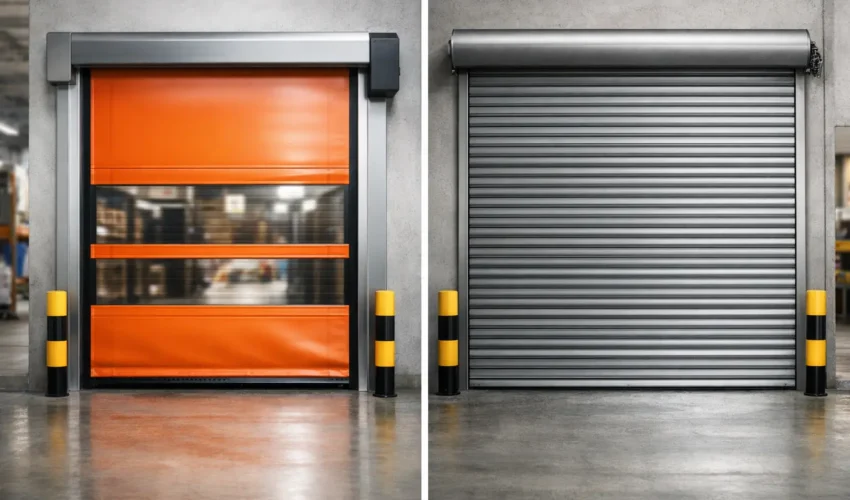
A busy loading bay loses more than a few seconds every time its door opens. Heat escapes, wind and rain enter, vehicle movements slow down and a damaged curtain can stop despatch altogether. That is why the choice between high speed doors vs shutters should start with how your premises operates, rather than simply which option has the lower purchase price.
For many commercial and industrial sites, roller shutters remain the sensible answer. They are tough, secure and well suited to external openings that are not constantly in use. High-speed doors serve a different purpose: they are designed for frequent, rapid cycles where traffic flow, temperature control and safety matter more than maximum physical security alone.
High speed doors vs shutters: the key difference
The main distinction is in the job each system is built to do. A roller shutter is primarily a security door. Its interlocking steel or aluminium laths form a strong barrier when closed, making it a dependable choice for shopfronts, warehouses, compounds and industrial units.
A high-speed door is primarily an operational door. It uses a flexible curtain, rapid-drive system and safety controls to open and close quickly, often in high-traffic internal areas or at controlled external entrances. Depending on the model and specification, it can be suited to food production, logistics, manufacturing, cold storage and clean environments.
Neither is automatically better. A warehouse with a lorry entrance used a handful of times each day may benefit most from a well-specified insulated roller shutter. A distribution area with pallet lorries passing through every few minutes may save significant time and energy with a high-speed door.
When a roller shutter is the practical choice
Roller shutters are familiar for good reason. They offer a strong physical deterrent, can cover wide openings and are available in a range of finishes, lath profiles and insulation levels. For an external opening that must be secure overnight, a shutter is often the first system to consider.
They work particularly well where opening cycles are relatively limited. A commercial unit, service yard, storage building or retail stock entrance may only need the door opened for deliveries, collections and staff access. In these circumstances, the additional cost of a rapid door may not deliver a worthwhile return.
Security and durability
A properly specified shutter gives a business owner confidence that the premises are protected when unoccupied. Steel laths, guides, bottom rails and locking arrangements create a far more substantial barrier than a standard flexible high-speed curtain.
This matters for sites storing tools, stock, machinery or vehicles. It also matters where insurance requirements call for a higher level of physical protection. Security shutters can be tailored to the risk level of the property, while fire-rated shutters may be needed where compartmentation is part of the building’s fire strategy.
Lower upfront cost for lower-use openings
For many straightforward industrial applications, a roller shutter has a lower initial cost than a high-speed door. The mechanism is less specialised, and the door is suited to the demands of occasional rather than continuous movement.
That does not mean shutters are maintenance-free. Springs, motors, safety brakes, guides and laths all require inspection and servicing. A shutter that becomes stiff, noisy or slow should be checked before a minor issue becomes a failed opening on a working day.
Where high-speed doors earn their place
High-speed doors are designed to keep work moving. Their faster opening and closing cycle reduces the time an opening is exposed to weather, dust, pests and unauthorised access. On a busy site, that difference is felt every day.
A standard shutter can take long enough to open that staff may leave it raised between movements. That is understandable when people are under pressure, but it compromises security and allows conditioned air to escape. A rapid door can close automatically after each authorised passage, creating a more controlled environment without slowing the operation down.
Better for traffic flow and energy control
In warehouses, production areas and distribution facilities, fast movement through doorways has a direct effect on productivity. Forklift operators and pedestrian teams do not need to wait for a slow curtain to travel its full height. Sensors, remote controls, pull switches and access controls can be specified to suit the flow of people and vehicles.
High-speed doors can also support lower heating or cooling losses. This is particularly relevant in Scotland, where cold air and driving rain can quickly affect comfort and energy use at a frequently opened entrance. The real benefit depends on the opening size, daily cycle count and the temperature difference between spaces, but a rapid closing door often makes a clear operational difference.
For chilled areas, food handling or clean processes, the right high-speed model can help separate zones and reduce contamination risk. The door must still be selected carefully for the environment. A standard rapid door is not automatically suitable for washdown conditions, low temperatures or hygienic applications.
Designed for frequent use
High-speed systems are engineered for repeated daily cycles, making them a strong option where a conventional shutter would be constantly travelling up and down. Their safety features are also important. Light curtains, photocells and a flexible breakaway curtain can reduce the impact of minor collisions and help the door recover more quickly.
However, flexible does not mean indestructible. Forklift contact, damaged sensors, misaligned guides and worn drive components can all cause downtime. Rapid doors should be included in a planned maintenance programme, especially where a single opening is critical to production or logistics.
Security, insulation and safety: compare the real requirements
The right choice often comes down to three questions: how frequently is the opening used, what must the door protect, and what happens if it fails?
If security is the main concern, a roller shutter normally has the advantage. It provides the stronger physical barrier and is better suited to protecting an external building opening after hours. Some sites use a high-speed door internally and a roller shutter externally, giving staff fast access during the day and stronger security at night.
If insulation is the priority, do not assume that either door will solve the issue on its own. Insulated roller shutters can reduce heat loss when closed, while high-speed doors limit the length of time an opening remains exposed. At a busy opening, fast closing may be more valuable than the thermal rating of a door that is left open for extended periods.
Safety must be considered as part of the whole installation. Door type, traffic routes, visibility, controls, vehicle speed and pedestrian segregation all affect risk. A site survey should identify pinch points, blind approaches and the correct safety devices for the opening. The cheapest specification can become expensive if it creates repeated operational problems or requires frequent callouts.
Installation considerations that affect cost
The quoted door price is only one part of the decision. Headroom, side room, structural condition, electrical supply, wind exposure and the need for access controls can all affect the final installation scope.
A roller shutter may require suitable fixing points, clear guide positions and enough headroom for the curtain and barrel assembly. A high-speed door requires accurate measurement, appropriate control placement and safety equipment matched to its operating speed. For external rapid doors, wind resistance and weather sealing need particular attention.
It is also worth considering what happens during a fault. A manual override, safe access to components and availability of replacement parts can make a real difference when a door is stuck open or closed. For facilities managers, repair response and ongoing engineering support should carry proper weight alongside the initial capital cost.
A sensible way to choose the right door
Start by recording how the opening is actually used over a normal week. Note the number of cycles, the type of traffic, whether the door is internal or external, and whether heating, hygiene or security is the main pressure. This usually makes the decision clearer than comparing specifications in isolation.
Choose a roller shutter where security, durability and occasional access are the priority. Choose a high-speed door where frequent movement, environmental separation and reduced waiting time will improve the operation. Where an opening has competing demands, a combined arrangement may be the most effective solution.
For premises across Glasgow, Lanarkshire and the surrounding area, Door Systems Scotland can assess the opening on site and advise on a door system that suits the building, traffic and budget. A practical survey before ordering helps avoid a door that looks suitable on paper but creates avoidable delays once the site is operating.