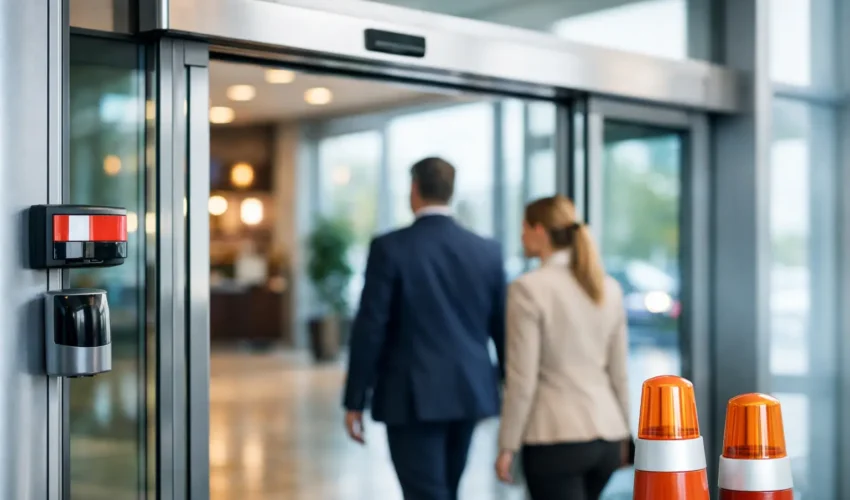
An automatic door that opens at the right time is easy to overlook. One that closes unexpectedly, hesitates in a busy entrance or fails during a delivery can quickly create a safety issue, access problem and interruption to trade. This automatic door safety guide is for the people responsible for commercial premises, from retail units and medical centres to warehouses, offices and managed properties.
Automatic sliding and swing doors are designed to make access safer and easier, but only when the system is correctly specified, installed, monitored and maintained. Safety is not simply a matter of keeping the door moving. It means ensuring pedestrians can approach, pass through and leave the doorway without being struck, trapped or exposed to a faulty installation.
Why automatic door safety needs active management
A powered door has moving leaves, sensors, control equipment and safety devices working together. A fault in any one part can change how the door responds to a person, wheelchair, trolley or delivery load. Damage may be obvious, such as a bent door leaf or cracked glass, but many problems begin less visibly: a sensor that no longer detects an approach, a loose floor guide, reduced closing force or a poorly aligned safety beam.
For duty holders, the consequences go beyond inconvenience. A door that does not perform as intended can lead to injury, restricted emergency access, complaints from customers and avoidable disruption for staff. It can also leave a building less secure if the door cannot lock or close correctly out of hours.
The right approach depends on the setting. A low-traffic office entrance has different risks from a supermarket doorway used continuously throughout the day. A medical centre must consider patients with limited mobility, while a warehouse entrance may need clear separation between pedestrian routes and vehicle movements. The equipment and inspection regime should reflect the real use of the site, not a generic checklist.
Automatic door safety guide: what a safe system includes
A safe automatic door installation starts with suitable equipment. The operator, door leaves, glazing, activation devices and safety sensors must be compatible and installed for the opening, pedestrian traffic and environment. Retrofitting an operator to an unsuitable door can create problems with stability, closing forces and safety protection.
Detection and presence sensors
Activation sensors tell the door to open when a person approaches. Presence sensors protect the threshold and closing path, helping to prevent the door from moving into someone who remains in the opening. Depending on the door type and location, these may be infrared sensors, monitored safety sensors, light curtains or other protective devices.
Sensors need to be positioned and adjusted for the actual approach routes. A sensor that works in an empty entrance may not perform properly once promotional displays, queue barriers, seasonal stock or furniture have been placed nearby. Reflections from glass, strong sunlight, rain and dirt can also affect some detection systems.
Safe movement and controlled force
The door should open and close smoothly at an appropriate speed, without jolting, dragging or excessive force. A swing door needs particular care because its moving arc can strike someone approaching from the side or standing behind it. Sliding doors require a clear, protected threshold and correctly functioning closing-edge safety.
Safety settings are not something to alter casually to make a door feel faster or shut more firmly. A door that appears sluggish may have a developing mechanical or electrical fault. An engineer should identify the cause rather than compensate by increasing force or reducing sensor coverage.
Clear markings and unobstructed routes
Glass door leaves and fixed side panels should be easy to see, particularly where the entrance has high levels of daylight or visual clutter behind it. Appropriate manifestation and signage reduce the chance of pedestrians walking into glazing.
Keep the doorway clear. Do not store parcels, bins, display stands or cleaning equipment within the opening zone or beside safety sensors. These items can cause false activation, obstruct a person’s path or mask a fault until the door is under pressure during a busy period.
Emergency arrangements and manual operation
Staff should know what to do if an automatic door stops working. This includes understanding whether the door can be safely placed into a manual mode, how to secure the entrance and when to prevent public access altogether. The emergency release, break-out function or battery backup arrangement will vary by system, so site-specific instruction matters.
Do not assume that a door can simply be forced open in an emergency. Forcing a powered door may cause further damage and leave the opening unsafe. Where escape routes are involved, the door configuration and emergency operation must be suitable for the building’s fire and evacuation arrangements.
Daily checks that catch problems early
A quick visual and functional check before opening can prevent a minor issue becoming an incident during trading hours. It should be completed by a trained, nominated member of staff, particularly at entrances with regular public use. The aim is not to repair the door, but to identify changes and take it out of service where necessary.
Check that the approach area and threshold are clean and free from obstructions. Observe the door through several opening and closing cycles from both directions. It should activate consistently, move without unusual noise and stop or reverse correctly when the safety area is occupied. Look for loose covers, damaged seals, broken glass, rubbing door leaves and water ingress around the operator or threshold.
Pay attention to changes reported by users. A customer saying the door closed too soon, or a member of staff noticing that it occasionally fails to open, is useful evidence. Intermittent faults rarely improve on their own. Record the issue, restrict use if there is any doubt about safety and arrange an inspection.
When to remove an automatic door from service
Some faults need immediate action rather than observation. Isolate the door from normal automatic use and seek professional support if it closes onto people, fails to detect someone in the opening, moves unpredictably, has damaged glazing or exposed components, or makes grinding and repeated impact noises.
The same applies if the door will not secure, cannot be used safely as an escape route or has been struck by a trolley, vehicle or delivery load. A door may still appear to operate after an impact, but alignment, floor guides, sensors and fixings can all be affected.
If you need to maintain access while a fault is being addressed, use a safe alternative route where possible. Clearly communicate the change to staff and visitors, especially where accessibility may be affected. Leaving a questionable door operating because the premises are busy is a poor trade-off.
Planned servicing is part of compliance, not an optional extra
Routine servicing gives an engineer the opportunity to inspect the parts users cannot reasonably assess: drive belts, rollers, bearings, fixings, wiring, control boards, safety circuits, sensor performance and door alignment. It also creates a clear maintenance record, which is valuable for managing risk across a commercial property portfolio.
Service frequency should be based on door type, traffic levels, environment and the manufacturer’s recommendations. A heavily used entrance in a retail, healthcare or transport setting will normally require more attention than a lightly used staff entrance. Dusty industrial environments, exposed coastal locations and sites with frequent delivery activity can also increase wear.
For workplace equipment, employers and responsible persons should ensure powered doors are maintained in a safe condition. A documented risk assessment, appropriate inspections and planned maintenance support that duty. Relevant British and European standards for pedestrian automatic doors, including BS EN 16005, provide a useful technical framework, but compliance is not achieved by paperwork alone. The installation must work safely in the conditions on site.
Common issues that should not be ignored
Automatic door faults often start with small operational changes. A door that pauses before closing may have a sensor issue or obstruction. A sliding leaf that scrapes along its track may have worn rollers or a damaged guide. A swing door that drifts, slams or fails to return smoothly may need adjustment or mechanical repair.
Weather can expose weaknesses too. Water entering a threshold, wind pressure affecting door movement or condensation around electrical components can all contribute to unreliable performance. In Scotland, exposed entrances can experience rapid changes in weather, so inspection of seals, drainage and external sensor positioning is worthwhile.
Repeated call-outs for the same fault are a sign to look beyond a temporary repair. The underlying cause may be incorrect specification, poor door alignment, worn components or a sensor arrangement that does not suit the way the premises are used. A proper site survey can prevent ongoing disruption and unnecessary repair spend.
Give staff clear instructions
The people using the building every day are often the first to spot a problem. They should know not to interfere with sensors, force door leaves, prop an automatic door open or alter control settings without authorisation. They should also know who to report faults to and what action to take if the entrance becomes unsafe.
A short written procedure is usually enough. It should cover daily observations, fault reporting, temporary access arrangements and the circumstances in which the door must be switched off or isolated. Facilities teams managing several locations benefit from using the same reporting process across each site, while allowing for the different systems installed.
Door Systems Scotland supports businesses with automatic door installation, repairs and planned maintenance, including urgent faults that put safe access or security at risk. An engineer-led inspection can establish whether a door needs adjustment, replacement parts, a more suitable safety arrangement or a longer-term maintenance plan.
A reliable automatic door should never require staff or visitors to work around its faults. Treat the first sign of inconsistent movement as a reason to check the system, and you are far more likely to protect people, maintain access and avoid a disruptive failure at the worst possible time.