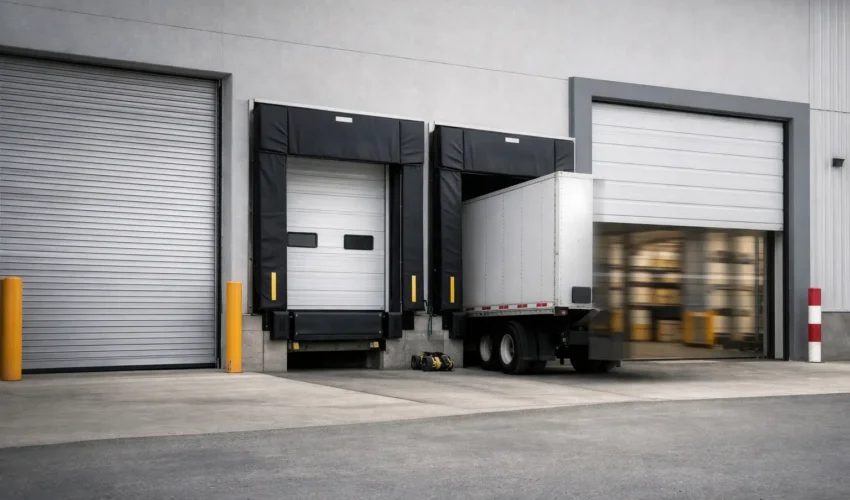
A warehouse door that sticks halfway through a delivery, leaves a loading bay exposed overnight or takes too long to open can quickly hold up a whole shift. The best warehouse door types are not simply the strongest or fastest available. They are the types that suit your traffic, opening size, security requirements, building layout and the conditions your team works in every day.
For warehouse operators and facilities managers, the right choice reduces lost time at the loading bay, protects stock and vehicles, and helps maintain a safer working environment. The wrong choice can create repeated repair costs, draughts, bottlenecks and unnecessary risk. Here is a practical way to assess the main options before specifying a new installation or replacing an ageing door.
What makes a warehouse door right for the job?
Start with how the opening is used rather than the door itself. A door serving occasional pallet deliveries has very different demands from one opening hundreds of times a day for forklift traffic. A secure external entrance also needs a different solution from an internal door separating chilled storage from a picking area.
Consider the frequency of operation, the speed required, whether people and vehicles use the same route, and the amount of headroom and side room available. Exposure matters too. A door facing prevailing weather in Scotland may need better wind resistance, insulation and sealing than a sheltered internal opening.
Security, fire compartmentation and emergency access should be agreed at the design stage. It is usually more cost-effective to specify the correct controls, safety equipment and door construction from the outset than to modify a poorly matched system later.
Best warehouse door types for common operations
Industrial roller shutter doors
Industrial roller shutters are a familiar choice for warehouses, trade counters and service yards because they are durable, secure and efficient with space. The curtain rolls up above the opening, so there is no need for a door leaf to swing into a loading area or yard. They work particularly well for wide external entrances, storage compounds and premises where security is a priority.
Steel roller shutters are available in a range of duty ratings and can be manually operated for smaller openings or electrically powered for frequent use. For busy sites, powered operation with suitable safety devices is normally the practical option. Remote controls, key switches, push buttons and access control can all be specified around the way the site operates.
The trade-off is that a standard roller shutter may not be the quickest option for constant traffic, and it can offer less thermal performance than an insulated sectional door. A heavily used shutter also needs planned servicing. Springs, guides, motors and safety systems should be inspected before wear develops into a breakdown.
Insulated sectional overhead doors
Sectional overhead doors are made from insulated panels that rise vertically and track beneath the roof. They are often one of the best choices for warehouses that need to control heat loss while retaining a substantial, secure external door.
Their insulated construction can help maintain more stable internal temperatures, which is useful for temperature-sensitive stock, staff comfort and energy-conscious buildings. Good perimeter seals also reduce draughts, dust and rain ingress around the opening. Windows can be included where daylight or visibility is useful, while pedestrian wicket doors may suit locations where staff need access without raising the full door.
Sectional doors need sufficient headroom and clear space around the opening for tracks and panels. They may therefore be less suitable for buildings with restricted roof space, overhead services or unusual structural features. A site survey is the best way to establish whether standard lift, high lift or another track arrangement is appropriate.
High-speed doors
High-speed doors are designed for openings that see continual movement. They open and close much faster than conventional shutters, helping to keep forklift routes flowing and limiting the time an opening is exposed to cold air, wind, dust or contaminants.
They are particularly effective between warehouse zones, in distribution centres, food handling areas, manufacturing facilities and temperature-controlled spaces. Rapid operation can also improve safety when combined with visibility panels, sensors and clearly managed vehicle routes.
Not every warehouse needs one. If a door only opens a few times per day, the added investment may not be justified. High-speed doors are also precision systems, so regular maintenance is essential to preserve their speed, alignment and safety performance. For high-traffic routes, however, reduced waiting time and improved environmental control can make a significant operational difference.
Sliding and swing doors
Sliding and swing doors are often used for internal warehouse separation, staff entrances, production areas and controlled access points. They can be manual or automatic, with automatic sliding doors offering hands-free access where staff, trolleys or frequent pedestrian traffic pass through.
A sliding door is useful where there is clear wall space beside the opening but limited overhead space. A swing door can be a straightforward, economical solution for lower-traffic internal routes, provided the swing area is kept clear. Both can be specified with vision panels, impact protection and access control where needed.
These are generally not a replacement for a high-security external loading door. Their value lies in controlling movement within the building and creating clear separation between operational areas.
Dock doors and loading bay systems
The door at a loading bay should be considered alongside the dock leveller, dock shelter, vehicle restraint and traffic process. A strong door alone will not solve delays caused by an awkward docking arrangement or poor weather sealing around a parked lorry.
Sectional doors and roller shutters are both commonly used at loading bays. Sectional doors can provide improved insulation and sealing, while roller shutters may suit sites where compact overhead storage and security are the main concerns. The right option depends on the dock layout, vehicle types, loading frequency and the condition of the existing opening.
Where loading bays handle frequent deliveries, dependable controls and quick repair support matter as much as the original installation. A bay that cannot be secured or safely used can stop goods moving in or out of the building.
Fire-rated and security-rated doors
Some warehouse openings need to do more than provide access. Fire-rated doors help maintain compartmentation by slowing the spread of fire and smoke for a specified period. They must be correctly specified, installed and maintained, particularly where linked to alarm systems or automatic closing mechanisms.
Security-rated shutters and doors are suited to vulnerable entrances, high-value stock areas and premises exposed when unoccupied. The required level of protection depends on the risk assessment, location and insurance expectations. A heavier-duty product is not automatically the best answer if it compromises daily access or is unsuitable for the opening structure.
Match the door to traffic and environment
A useful rule is to separate security needs from speed needs. A warehouse entrance that opens for deliveries twice daily may benefit from a secure industrial roller shutter. A route used by forklifts every few minutes may be better served by a high-speed door. A loading bay with heat loss concerns may justify insulated sectional doors and improved dock sealing.
Think about people as well as equipment. Pedestrian access should not rely on staff walking beneath a moving shutter or through active forklift lanes. Separate personnel doors, visibility panels, warning lights and appropriate sensors can make routines safer and easier to manage.
It is also worth considering what happens during a power failure or equipment fault. Emergency release arrangements, manual override, secure closing and access for repair engineers should be part of the discussion. A warehouse door is a working piece of equipment, not a fit-and-forget building feature.
Installation and maintenance affect long-term value
Even a well-specified door will underperform if it is poorly installed or left without servicing. Correct measurement, structural checks, safe electrical work and commissioning all affect reliability from day one. The same applies to the controls and safety devices around the door.
Planned maintenance helps identify worn cables, damaged guides, faulty safety edges, misaligned tracks and motor issues before they cause an operational stoppage. For busy warehouses, arranging servicing around quieter periods is often far less disruptive than waiting for an emergency callout.
Door Systems Scotland provides engineer-led surveys, installation, repairs and planned maintenance for industrial and commercial door systems. For sites across Glasgow, Lanarkshire and further afield, a survey can clarify which door type fits the opening, the working environment and the level of support required after installation.
The best decision is usually the one that keeps your site moving on an ordinary wet Tuesday as reliably as it does during a major delivery. Assess the opening, watch the traffic flow and choose a door system that your team can operate safely, securely and without delay.