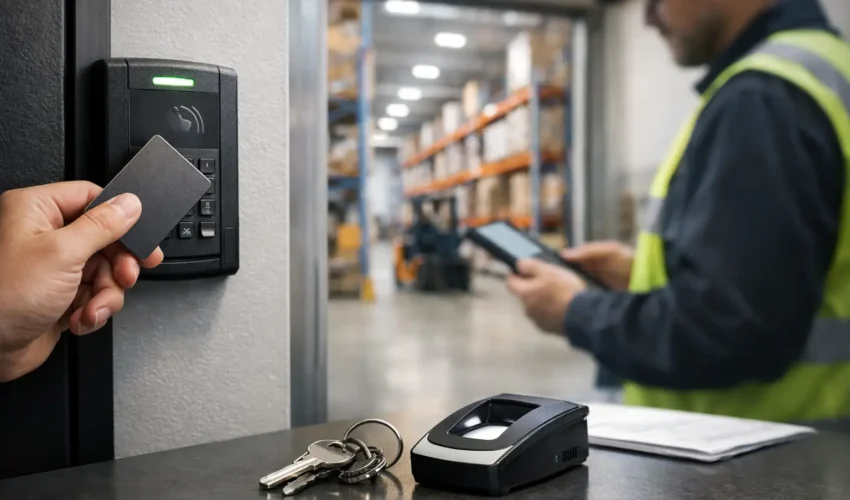
A warehouse door left unsecured for half an hour can create more than a security problem. It can delay vehicle movements, expose stock, interfere with shift changeovers and leave site managers answering awkward questions after the fact. That is why warehouse access control systems matter. In a busy industrial setting, they are not just about who gets in and out. They shape how safely, efficiently and reliably the whole site operates.
For most warehouse operators, the challenge is not deciding whether access control is needed. It is deciding what level of control is right for the building, the traffic pattern and the risk profile. A small trade counter with limited staff movement needs something very different from a distribution site handling multiple drivers, contractors and out-of-hours deliveries.
What warehouse access control systems actually do
At a practical level, warehouse access control systems manage entry to and around your premises. That can include pedestrian doors, staff entrances, vehicle gates, roller shutter access points, internal restricted areas and loading bays. The system decides who can enter, where they can go and when they can do it.
That sounds straightforward, but the real value comes from the detail. A decent setup helps separate staff from visitors, keeps sensitive stock or plant rooms restricted, records movement on site and reduces the chance of doors being left open or used improperly. In warehouses where timing, stock integrity and health and safety all matter, those details are not minor.
Some sites need a simple keypad or fob-based arrangement on selected doors. Others need integrated control tied to automatic doors, shutters, gates, intercoms and CCTV. The right answer depends on how the site works day to day, not on choosing the most feature-heavy package available.
Security is only part of the picture
It is easy to think of access control purely as a theft prevention measure. That is certainly part of it, especially where high-value goods, tools, pharmaceuticals or confidential materials are stored. But warehouse environments also have clear operational and safety pressures.
If unauthorised people can wander into loading areas, forklift routes or service corridors, the risk is immediate. If delivery drivers enter through the wrong point, they can disrupt traffic flow. If staff rely on shared codes that are rarely changed, accountability quickly disappears. A warehouse usually has multiple moving parts at once, so poor access arrangements tend to create knock-on problems rather than isolated ones.
This is where a properly specified system earns its place. It can help control movement without slowing the business down. That balance matters. Too little control creates risk. Too much friction frustrates staff and can lead to workarounds, which usually defeats the point.
The main types of warehouse access control systems
Most warehouse access control systems fall into a few broad categories, although many sites use a combination rather than one single method.
Keypad entry is common where basic control is enough and user numbers are relatively small. It is affordable and simple to use, but shared codes can become a weakness if they are not managed properly. Once too many people know the same code, the audit trail becomes less useful.
Proximity fobs and access cards offer better individual control. They allow permissions to be issued and removed without changing the whole system, which is useful for staff turnover, temporary access or contractor visits. For many commercial premises, this is a practical middle ground between cost and control.
Biometric access, such as fingerprint or facial recognition, gives a higher level of certainty about who is entering. It suits some secure environments, but it is not right for every warehouse. Cost, staff acceptance, data handling and site conditions all need thought. In dusty, fast-moving industrial settings, simpler methods can sometimes be more dependable.
Intercom and remote-release systems are useful where visitors, drivers or couriers need controlled entry without a staffed reception. They can work well at external gates or delivery entrances, particularly when tied into cameras.
Integrated systems bring these elements together with electric locking, automatic doors, shutters or gates. This is where access control becomes part of the wider building operation rather than a standalone device on the wall.
Where access control often works best in a warehouse
Not every door needs the same level of control. In fact, treating every opening the same is often a poor use of budget. The smarter approach is to identify the points that genuinely affect security, safety and continuity.
Staff entrances are an obvious starting point, especially on sites with shift work. Controlled access removes the need for doors to be propped open and creates a record of entry. Goods-in and dispatch areas are also high priority, particularly where external doors connect directly to valuable stock.
Plant rooms, server rooms, hazardous storage and management offices are common internal areas that benefit from restricted access. If your warehouse includes trade counter space, customer-facing areas should also be separated clearly from operational zones. That protects both visitors and staff.
For some operators, the real issue is the perimeter. Vehicle barriers, sliding gates and gate automation can be just as important as door hardware inside the building. There is little value in tightening up internal access if the outer boundary remains poorly controlled.
Choosing a system that fits the site
The best specification usually starts with questions, not products. How many people need access? Are there different user groups? Are some areas time-restricted? What happens during deliveries, emergency callouts or weekend working? Do doors need to integrate with shutters, automatic entrances or fire safety systems?
These questions matter because warehouse access control systems should reflect actual site use. A facility with high staff turnover may benefit from access credentials that are quick to issue and cancel. A multi-tenant building may need clear separation between units. A 24-hour operation may need dependable remote management and rapid fault response if an entry point fails.
Durability matters as well. Warehouse environments can be hard on equipment. Dust, moisture, impact risk, temperature swings and heavy traffic all affect performance. Hardware suited to a tidy office block may not last in a loading bay or external gate position.
This is also where engineer-led site surveys make a difference. On paper, a system might look suitable. On site, cable routes, power availability, door condition, user behaviour and traffic flow often tell a different story.
Integration with doors, shutters and gates
Access control rarely works in isolation on a warehouse site. It is usually tied to the physical access equipment already in place, whether that is a steel personnel door, an automatic sliding door, a high-speed door, a roller shutter or a perimeter gate.
That integration needs to be thought through properly. For example, fitting electronic control to an ageing shutter that already suffers intermittent faults can create frustration rather than improvement. Likewise, adding a card reader to an external entrance without checking door closers, locking hardware and safety devices may leave weak points in daily use.
When the physical door and the control system are specified together, the result is far more reliable. Opening speed, locking method, traffic volume and emergency egress all need to work as one. Businesses that depend on uninterrupted access tend to benefit from dealing with contractors who understand both sides of that equation – the control technology and the door engineering behind it.
Maintenance and emergency response matter more than many buyers expect
A well-designed system can still become a liability if it is not maintained. Readers, locks, control panels and door interfaces all need periodic inspection, testing and adjustment. Warehouses are not forgiving environments, and faults tend to show up at the worst possible time – during a delivery peak, after hours or when a secure area must be accessed quickly.
That is why ongoing support should be part of the buying decision. Planned maintenance helps prevent avoidable breakdowns, while emergency repair cover limits downtime if something fails unexpectedly. For warehouse operators, the cost of a non-functioning access point is not just the repair bill. It can mean delayed goods, staff standing idle, security exposure or temporary workarounds that are less safe.
For businesses across Lanarkshire and Glasgow, working with a local specialist such as Door Systems Scotland can make that support more practical. Fast response is not a marketing extra in this setting. It is part of keeping the site running.
A sensible investment, if it is specified properly
There is no single best option for every warehouse. Some sites need straightforward staff entry control on a handful of doors. Others need a more integrated setup covering gates, shutters, restricted areas and timed permissions. The difference comes down to risk, traffic and how much disruption a failure would cause.
The strongest results usually come from a measured approach. Start with the points that matter most, make sure the door hardware itself is fit for purpose, and choose a system that your team will actually use correctly. Good access control should make the site easier to manage, not harder.
If your warehouse has grown over time, changed use, or relies on older doors and locks that no longer match current demands, it is worth having the setup reviewed. A practical survey often highlights simple improvements that tighten security, support compliance and reduce avoidable delays before they turn into bigger problems.