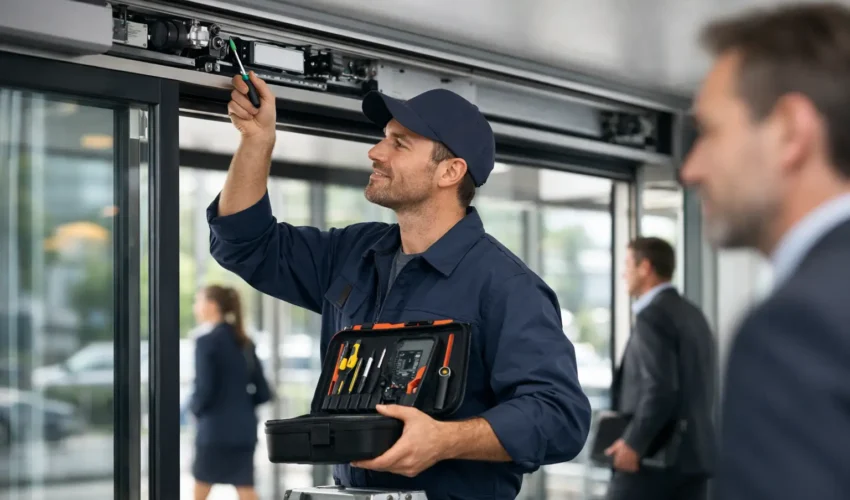
A failed entrance door at 8.30 on a busy Monday does more than cause inconvenience. It can leave a shop exposed, stop customers getting in, delay deliveries, create accessibility issues and put staff in the position of managing a problem they cannot fix themselves. That is why automatic door servicing matters. For commercial premises, it is not just a maintenance task in the diary. It is part of keeping the building safe, open and operational.
Automatic doors work hard in places where traffic is constant. Retail units, medical centres, offices, warehouses and public-facing buildings all rely on them to open reliably, close securely and respond properly to sensors and controls. When they are left too long without attention, small issues tend to become expensive ones.
Why automatic door servicing matters
Most automatic door faults do not appear out of nowhere. They build over time through wear on moving parts, sensor misalignment, contaminated tracks, loose fixings, damaged safety devices or general strain from frequent use. A door might still open, but more slowly than it should. It might hesitate before closing, make unusual noise, or stop short and need to be reset. Those early signs are exactly what routine servicing is meant to catch.
For building operators, the value is practical. Planned servicing helps reduce unplanned shutdowns, lowers the risk of a door becoming unsafe, and gives you a clearer picture of the overall condition of the system. It also helps avoid the disruption of an emergency callout when the entrance is already out of action.
There is a cost angle as well. Leaving a minor issue unresolved often means more parts are affected. A worn roller or belt that could have been adjusted or replaced early may end up putting strain on the operator, the track or the motor. In most cases, regular servicing is more cost-effective than repeated reactive repairs.
What automatic door servicing usually includes
A proper service should be more than a quick visual check. The engineer needs to assess how the whole system is performing, not just whether the leaves move from open to closed.
That normally starts with the mechanical side. Tracks, rollers, guides, hinges, operators and drive components are inspected for wear, damage and alignment issues. Fixings are checked, moving parts are adjusted where needed, and components are cleaned so dirt and debris are not interfering with operation.
The electrical and control side is just as important. Sensors, activation devices, control panels, safety features and stop functions need to be tested to confirm the door responds correctly. Opening and closing speeds may also be checked and adjusted where appropriate. If the system includes access control or integration with fire alarms, those interfaces should be reviewed as part of the visit.
A good service also includes reporting. If a component is close to failure, or if the door is operating but not to the standard it should, that should be clearly explained. Facilities teams and business owners need straightforward advice on what needs immediate attention, what can be planned, and what is simply worth monitoring.
Different sites need different servicing schedules
There is no single servicing interval that suits every automatic door. It depends on traffic levels, environment, door type and how critical that entrance is to daily operations.
A busy retail entrance or healthcare setting may put far more cycles on a door than a small office reception. A warehouse door exposed to dust, temperature changes or vehicle traffic may need closer attention than an internal pedestrian entrance in a cleaner environment. If the door is the main public access point, the impact of failure is also much greater.
That is why servicing needs to be based on use, not guesswork. Some sites benefit from more frequent planned visits because the cost of downtime is high. Others may need a lighter schedule, provided the system is in good condition and usage is modest. The right approach is usually identified during a site survey or after reviewing the door’s maintenance history.
Signs your doors need attention before the next service
Even with a planned maintenance schedule in place, site teams should not ignore changes in how an automatic door behaves. Doors nearly always give warning signs before they stop altogether.
If the door is opening unevenly, slowing down, reversing unexpectedly or making scraping, grinding or knocking sounds, it is worth arranging inspection sooner rather than later. The same applies if sensors seem inconsistent, the door is sticking in the open position, or staff are repeatedly resetting the system to get it moving again.
Another common issue is damage from impact. Trolleys, cages, pallet movement and pedestrian traffic can all affect alignment, safety sensors or door leaves. The door may still function after a knock, but that does not mean it is working as intended. A quick inspection can often prevent a larger repair later.
Compliance, safety and public access
For most commercial premises, automatic doors are not just a convenience feature. They play a role in safe access and, in many buildings, accessible entry. If an entrance door is unreliable, the problem is not limited to operations. It can affect customer experience, staff safety and your ability to provide appropriate access to the building.
That is one reason servicing should always be carried out by engineers who understand both the mechanical and safety side of the system. A door that opens and closes is not necessarily a door that is operating safely. Sensors, force settings, safety presence detection and emergency functions all need to be checked properly.
For facilities managers and property managers, that professional record of inspection and maintenance is useful too. It shows the door has not simply been left to fail. In buildings with high footfall or public access, that matters.
Planned servicing versus reactive repair
Some businesses still take a repair-only approach. On paper, it can seem like the cheaper option. In practice, it usually works until the first serious failure happens at the wrong time.
Reactive repair has its place. Components fail unexpectedly, accidents happen, and emergency support is sometimes unavoidable. But relying on callouts alone tends to mean more disruption, more urgent decision-making and less control over cost. You are solving problems after they have already affected the premises.
Planned automatic door servicing is different. It gives you a chance to deal with wear before it becomes failure, schedule work around operations where possible, and keep better control over the condition of critical access points. For sites where trading, logistics or public access depends on the entrance working properly, that shift from reactive to planned support usually pays for itself.
Choosing the right automatic door servicing provider
Not every contractor approaches servicing in the same way. For a business that depends on reliable access, the key question is not just who can attend, but who can assess the door properly and support it over the long term.
Experience with commercial and industrial door systems matters. So does the ability to identify faults accurately, source the right parts and give practical advice rather than vague recommendations. A provider with engineer-led surveys and a strong repair background will often spot risk earlier because they know how these systems fail in real working environments.
Response times matter too. If your entrance fails, you need to know there is a route to fast support, especially for sites that cannot afford prolonged closure. That is one reason many businesses across Lanarkshire and Glasgow prefer working with a local specialist rather than a distant national chain. Local accountability tends to mean clearer communication and quicker action when something goes wrong.
It also helps when the provider can support more than one type of door on site. Many commercial properties have a mix of automatic entrances, shutters, sectional doors or loading access equipment. Coordinating servicing through one dependable engineering team can simplify maintenance planning and reduce the hassle of juggling multiple contractors.
When servicing leads to repair or replacement
A service visit does not always end with a clean bill of health. Sometimes the right outcome is a repair, and occasionally the more sensible decision is replacement.
That depends on age, parts availability, repair history and the role the door plays on site. If a system is generally sound and the issue is limited to a worn component, repair is often straightforward. If the operator is obsolete, breakdowns are becoming frequent, or the door is no longer suitable for the traffic it handles, replacement may be the better long-term investment.
The important point is honesty. Businesses need clear advice based on condition and risk, not a push towards the most expensive option. A dependable service partner should explain the trade-off between keeping an older system going and replacing it before it becomes a recurring problem.
Door Systems Scotland works with commercial customers who need that kind of straight answer – whether the job is routine servicing, urgent repair or a wider upgrade plan.
Automatic doors are easy to take for granted when they work as they should. The real test is what happens when they do not. If your entrance is critical to security, accessibility or day-to-day operations, regular servicing is not an extra. It is one of the simplest ways to keep your premises moving without unnecessary disruption.