A damaged shopfront after closing time is more than an inconvenience. It can expose stock, delay opening, unsettle staff and leave a business owner managing an urgent repair when they should be trading. This retail security shutter guide explains what to consider before installing, replacing or maintaining shutters at a retail premises.
The right shutter should make the building harder to attack without making daily opening and closing difficult. For shops across Glasgow, Lanarkshire and the wider area, that means looking beyond price alone. The shutter type, installation quality, controls and ongoing servicing all affect security and reliability.
Start with the risks at your premises
Every retail unit has a different risk profile. A high-street shop with wide glazed frontage has different requirements from a trade counter on an industrial estate, while a pharmacy or jewellery retailer may need a higher level of protection than a small office reception.
Consider what happens outside trading hours, how visible the premises is from the road, whether there have been attempted break-ins nearby, and what stock or equipment is kept behind the frontage. Also think about the practical routine. If staff must open several shutters before customers can enter, slow or unreliable operation soon becomes a daily problem.
A site survey is the best place to start. An experienced engineer can assess the opening, supporting structure, headroom, side room, power supply and the condition of the existing door or shopfront. This avoids specifying a shutter that looks suitable on paper but is awkward to fit or operate in practice.
Types of retail security shutters
Solid roller shutters
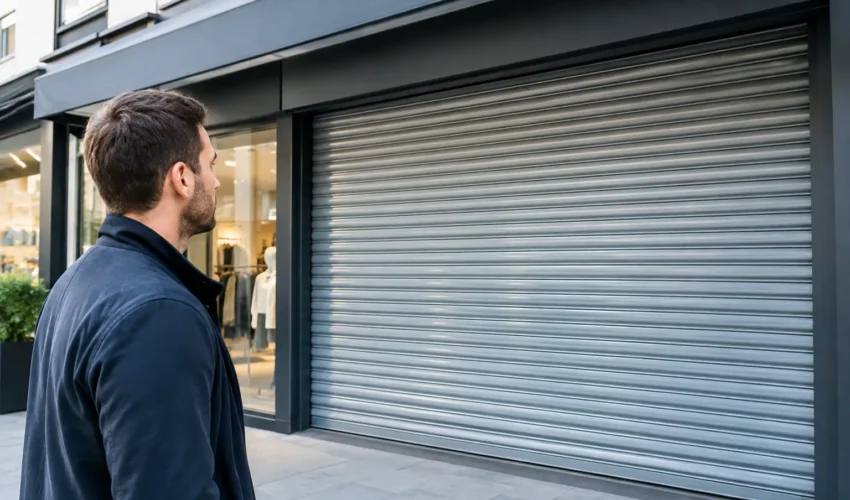
Solid steel or aluminium roller shutters provide privacy as well as physical protection. They are often suited to premises where the owner does not need the window display visible overnight, such as stockrooms, trade counters and units in less exposed locations.
Their main advantage is straightforward security. However, a solid shutter completely hides the display, which may not suit retailers that rely on passing trade or want their branding visible after hours. Some local planning conditions may also influence the appearance of shutters on prominent frontages.
Perforated and punched shutters
Perforated shutters offer a middle ground. Their pattern allows some visibility and airflow while retaining a physical barrier across the opening. They are commonly chosen for shopping centres, retail parks and shops where the window display remains part of the business after closing.
The trade-off is that visibility can also reveal products inside. This can be managed with sensible merchandising, internal lighting and careful positioning of high-value stock, but it should be considered before installation.
Brick-bond and grille shutters
Brick-bond shutters and security grilles give a more open appearance, making them useful where air circulation, visibility or a lighter visual finish matters. They can work well on internal mall entrances, service counters and some shopfronts.
They are not automatically the right answer for every external opening. The required level of resistance, the exposure of the premises and the quality of the guides, locks and fixings should all be assessed as part of the complete system.
Insulated shutters
For retail units with a larger rear entrance, stock area or combined warehouse space, insulated roller shutters may be a better fit. They can improve thermal performance and reduce noise as well as securing the opening. This can be valuable where staff work close to loading areas or where heat loss through a large doorway is a concern.
A retail security shutter guide to specification
The curtain is only one part of a security shutter. A well-specified system includes the shutter curtain, guide rails, bottom rail, barrel, motor, controls, safety devices and locking arrangement. Weakness in any one area can affect the performance of the whole installation.
For a small manually operated shutter, a reliable locking system may be the central consideration. For a larger electrically operated shutter, the motor duty, emergency release and safe control position become just as significant. A busy retailer may open and close a shutter several times a day, so a unit designed only for occasional use can wear prematurely.
Ask the installer to explain why the proposed shutter suits your opening and trading pattern. A clear quote should identify the shutter type, dimensions, finish, operation method and any electrical work required. It should also set out whether removal of the existing shutter, disposal, making good and access equipment are included.
Do not assume the heaviest-looking shutter is always the best option. An unnecessarily heavy curtain may add cost and strain to a small opening, while an underspecified shutter can be vulnerable and unreliable. The correct choice is proportionate to the risk and the way the premises operates.
Manual, electric and remote operation
Manual shutters can be a sensible option for smaller, lighter openings with limited daily use. They avoid the need for a motor and may have lower initial costs. However, manual lifting can be difficult for staff, especially as components age or if the shutter is large.
Electric shutters are generally more practical for wider shopfronts, frequent operation or premises where staff need to open safely and quickly. They can be operated with key switches, push buttons, remote controls or other access arrangements. The controls should be positioned where staff can see the full opening and stop anyone walking beneath the shutter while it moves.
Electric operation also requires planning for a power failure. Depending on the shutter and building use, this may involve an internal manual override, a secure external override or another agreed emergency procedure. There is no single answer for every shop, but staff should know how to use the system before it is needed.
Safety is part of security
A shutter that protects the premises but creates a risk to staff or customers is not a good installation. Powered shutters can cause serious injury if they close onto a person, trolley or display stand. Appropriate safety measures may include a hold-to-run control, safety edge, photocells or other protection suited to the opening and how it is used.
Keep the area beneath the shutter clear. Display boards, bins, deliveries and temporary promotions can all obstruct the opening. If a shutter begins to catch, make unusual noise, stop partway or require repeated attempts to operate, do not force it. Continued use can turn a minor alignment or component issue into a failed motor, damaged curtain or broken spring.
Maintenance prevents the worst timing
Security shutters often fail at the least convenient moment: early morning, after closing, or during a delivery. Planned maintenance reduces that risk by identifying worn parts before they cause a breakdown.
During a service, an engineer can inspect the curtain and guides, check fixings, assess the motor and transmission, test safety devices, examine controls and identify damage or wear. The exact frequency depends on the shutter type, usage and environment. A lightly used internal grille will not have the same needs as an external shutter operated daily in a busy retail setting.
Retailers should also make simple visual checks part of their routine. Look for dents, loose guides, damaged slats, frayed cables, water ingress around controls and changes in movement or sound. Report faults early rather than waiting for the shutter to stop completely.
What to do when a shutter will not open or close
If a shutter is stuck, first secure the area and avoid repeated operation. Do not attempt to cut cables, remove covers or force the curtain back into the guides. These systems can store significant tension, and untrained intervention can cause injury or further damage.
If the premises cannot open for trade, cannot be secured overnight, or has suffered attempted forced entry, contact a specialist repair company promptly. A rapid response matters because every hour of downtime can affect sales, staff access and customer confidence. Where possible, a competent engineer should assess the cause, make the opening safe and advise whether a repair can be completed immediately or if temporary security is required.
Door Systems Scotland provides installation, repairs and planned maintenance for commercial security shutters, including emergency support when a failed shutter puts trading or site security at risk.
Make the shutter part of the wider security plan
A shutter is most effective when it works alongside sensible shop security. Good exterior lighting, clear sightlines, an alarm, CCTV, protected internal stock areas and a reliable locking routine all reduce risk. Staff should know who holds keys or remotes, how to report faults and what to do if the shutter cannot be secured.
Before committing to a new installation, arrange a survey and ask practical questions about daily use, emergency release, servicing and likely repair support. The best retail security shutter is the one that protects the premises every night and still opens without fuss when it is time to trade.